An enterprise SMS project needs a defined delivered workload, not a large “SMS per minute” number copied from another model. Choosing a 32-port GSM gateway means specifying active radio channels, message segmentation, carrier permission, application behaviour and recovery. Stored SIM capacity and headline throughput cannot replace those requirements.
Updated
Telarvo Store sells SMS hardware and is the supplier behind this guide. The comparison below is a specification-led selection framework, not an independent top-ten ranking. It covers documented Telarvo 32-port configurations and shows how to compare any quotation using the same technical and commercial evidence.
Which 32-port GSM gateway fits an enterprise SMS workload?
Choose a configuration that passes your workload test.
Confirm active channels, carrier compatibility, message encoding, application interfaces and recovery. More stored SIMs do not independently establish higher delivered throughput or permission to send business messaging.
Define the workload by destination, message type, peak submission pattern and acceptable delivery delay. An OTP stream needs different scheduling and expiry behaviour from a scheduled notification batch. A gateway that accepts a large queue can still deliver too late for the intended business event.
List the carrier arrangements and permitted messaging use before evaluating hardware. A local SIM price is not evidence that the plan supports automated enterprise traffic. Subscription restrictions and sender requirements remain part of the deployment regardless of channel count or allocation features.
The Telarvo SMS gateway collection provides the relevant hardware family. Use its model names to request an exact bill of materials, then require performance evidence for that configuration. Do not assign the company’s flagship or sitewide peak claim to a 32-port unit without a matching model-specific test and measurement definition.
Compare documented 32-port configurations without inventing a ranking
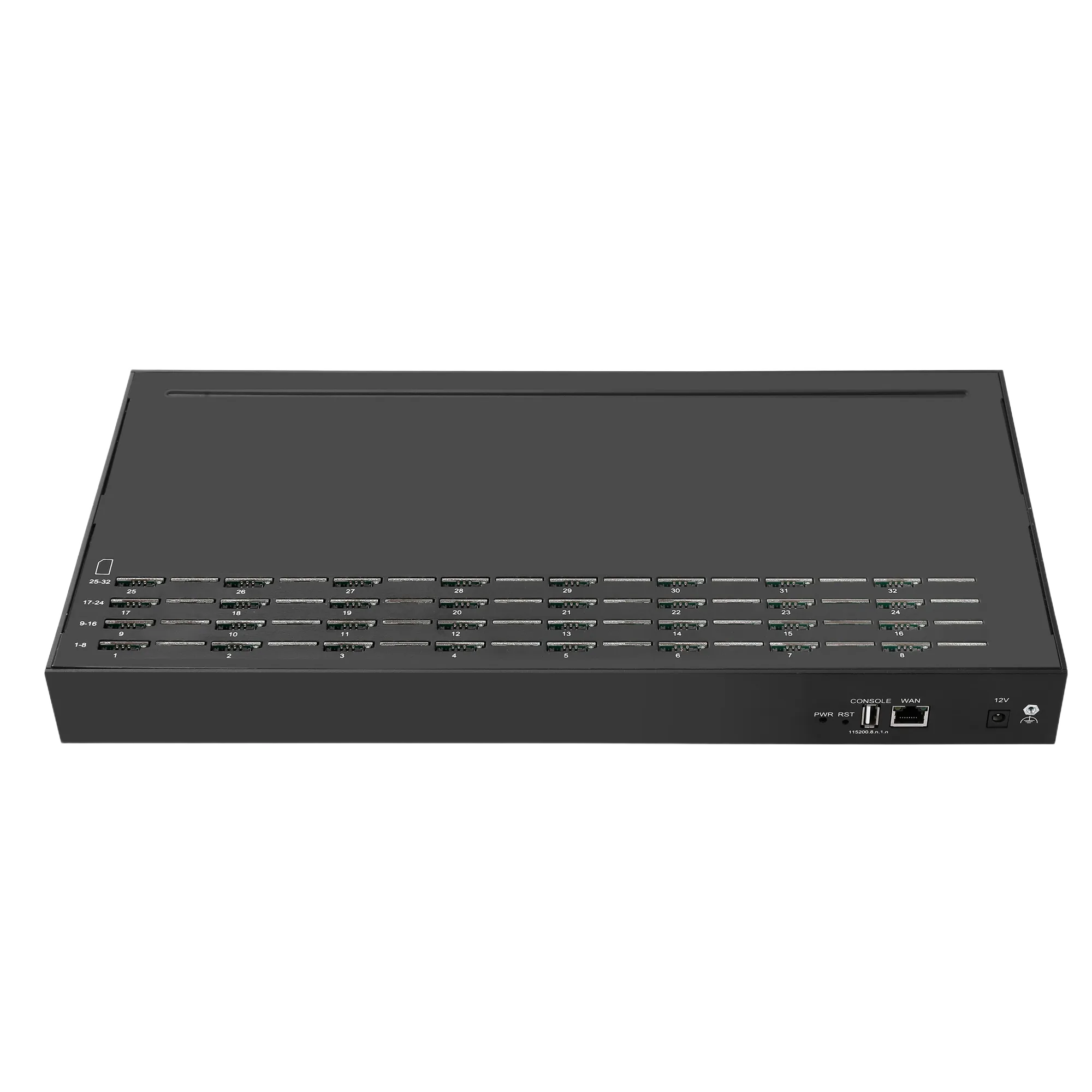
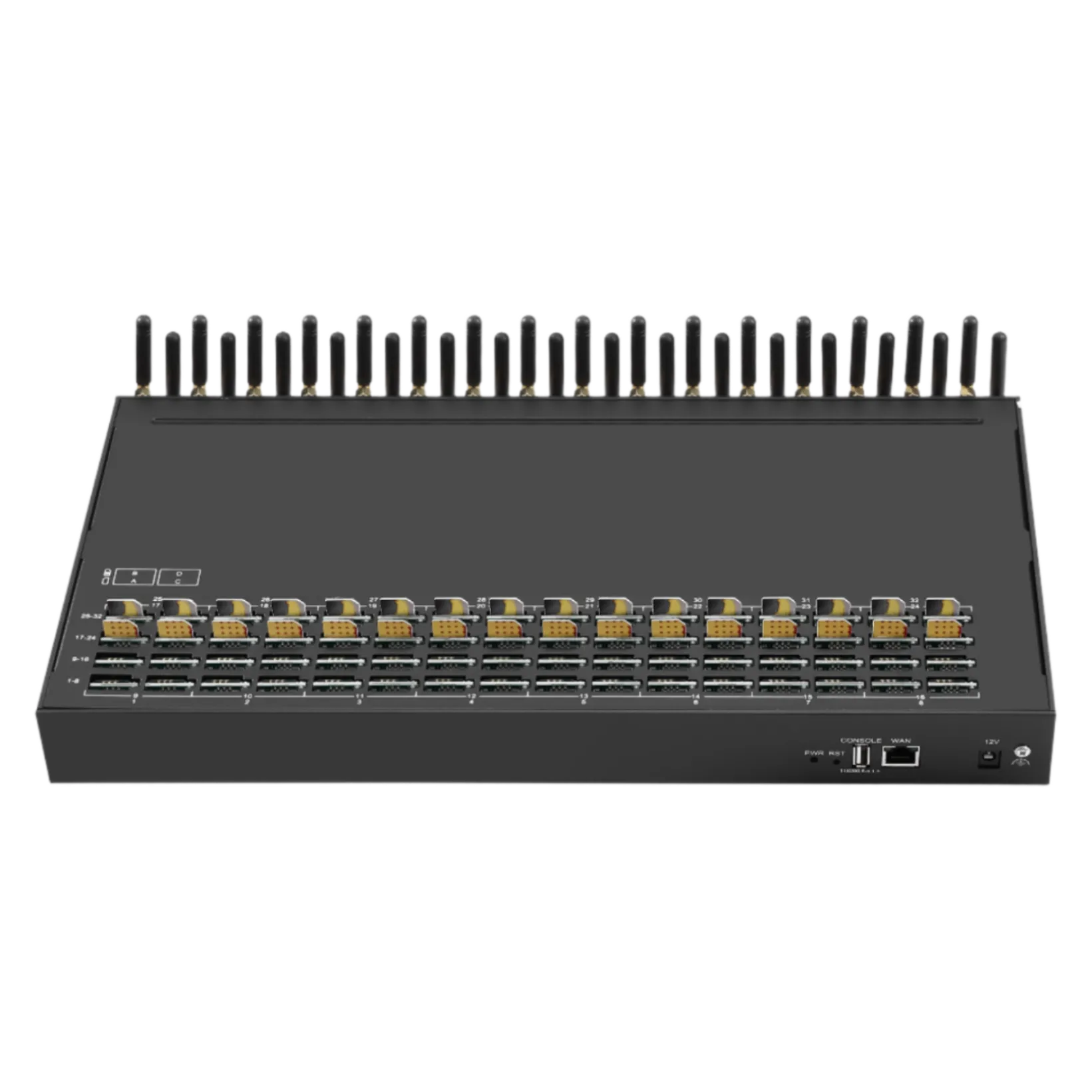
Telarvo offers several SK 32-port SMS configurations with different SIM capacities and an eSIM option. They are useful candidates for different inventory requirements, not automatically different speed tiers. Compare the supported active allocation, interfaces and cellular revision behind each quotation.
| Listed configuration | Nominal ports / SIM provision | Primary procurement question |
|---|---|---|
| SK-SMS Gateway 32-32 | 32 / 32 | Does one stored SIM per port meet the workflow? |
| SK-SMS Gateway 32-128 | 32 / 128 | How are stored cards assigned to active radios? |
| SK-SMS Gateway 32-256 | 32 / 256 | What inventory-management and recovery controls apply? |
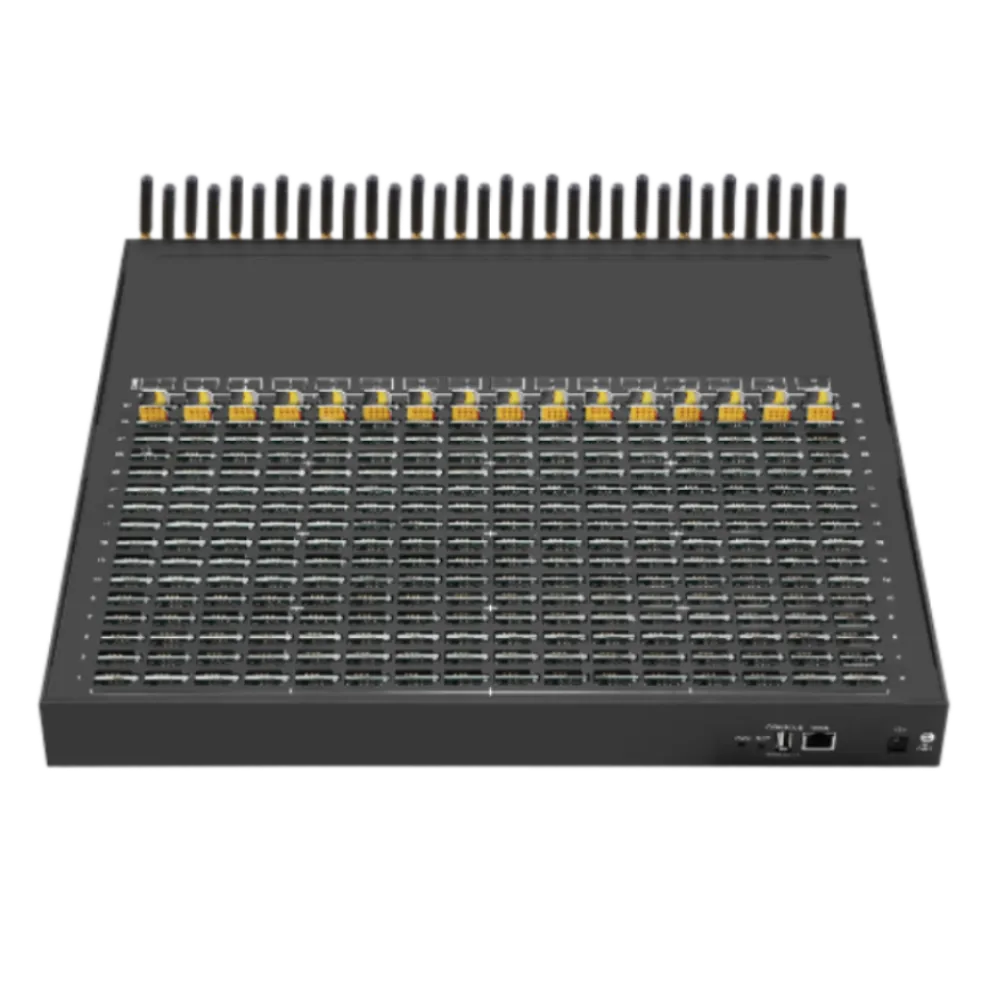
| SK-SMS Gateway 32-512 | 32 / 512 | Which numbers remain continuously attached and reachable? |
| SK-SMS Gateway-32E-SIM | 32, eSIM | Which provisioning and active-profile arrangement is supported? |
This is a list of identifiable configurations, not a claim that ten verified competitors have been tested. Prices should come from a current quotation rather than an old catalogue snapshot. Ask every supplier for the same carrier/module/firmware matrix and workload test if cross-vendor comparison is required.
A portfolio can also contain 64-port products; that does not make them 32-port candidates. Keep the selected model class consistent when comparing capacity and cost, and identify any proposed alternative explicitly rather than silently substituting a different channel count.
What do ports, slots and completed messages actually measure?
Ports describe radios; stored slots describe inventory.
Successful application messages depend on encoding, segmentation, scheduling and carrier delivery. A 32-channel chassis with more stored cards still needs a supported active assignment and messaging path.
Require three separate counts in the supplier’s report: installed subscriber inventory, simultaneously usable radio channels and successful delivered transactions. A statement such as “512 SIM capacity” answers the first question only. It does not establish that 512 numbers are concurrently reachable or that all cards increase immediate sending capacity.
For inbound workflows, ask what happens to an unassigned SIM’s messages and how long carrier retention can be relied on. For outbound workflows, ask whether a card change requires registration and how that interval affects the queue. Do not treat every inventory slot as an additional active modem.
Make the unit behind a throughput claim explicit: API requests, SMS segments, submissions accepted by the gateway or messages with a defined delivery result. These measures can differ substantially. The acceptance metric should describe the business transaction and deadline, while the technical report preserves the segment and network events needed to explain failures.
Account for message encoding before estimating capacity
An application message can consume more than one SMS segment. The encoded text and concatenation rules determine the number of network units required, so a rate measured using short plain text cannot simply be applied to a longer multilingual template.
Twilio’s SMS character-limit documentation describes the common GSM-7 single-segment limit of 160 characters and UCS-2 limit of 70, with typical multipart payloads of 153 and 67 respectively. Extended characters and implementation differences can affect the actual count; use the encoded template rather than a visual character count alone.
For a clearly labelled planning example, 1,000 application messages consuming two SMS segments each require 2,000 segment submissions before retries. That is arithmetic about a hypothetical workload, not a Telarvo performance result. The effective service time and delivery result still need measurement on the approved carrier arrangement.
Test production-like templates, including language variants, punctuation, URLs and variable fields. A template that fits one segment during development can cross a boundary when personalised values become longer. Preserve both the application-message count and segment count in benchmark reports so procurement can compare the same workload across systems.
Select HTTP or SMPP using the application’s actual requirements
The best interface is the one the application can operate reliably, observe and recover. The SK SMS family offers HTTP and SMPP interfaces, but model-specific endpoint behaviour, security and delivery-status mapping require an interface specification for the supplied firmware.
The SMPP v3.4 specification defines protocol operations and session relationships; it does not specify a particular gateway’s throughput or complete feature support. Ask which bind modes, message identifiers, delivery receipts, encoding fields and error responses are implemented. A label saying SMPP-compatible is not an acceptance report.
For an HTTP interface, request endpoint documentation, authentication, response codes, status retrieval and timeout behaviour. Establish whether a request accepted by the API is merely queued or has reached a later delivery stage. The caller must distinguish those states rather than immediately treating a successful HTTP response as handset delivery.
Choose the interface using the existing software, required volume, session handling and integration ownership. Keep the API credentials and permitted routes separate from general administration. If a third-party application is included in the quote, identify its licences and support scope rather than assuming the hardware eliminates all server or software requirements.
Define delivery status, retries and expiry before connecting the CRM
A reliable business workflow needs a state model, not only a send command. Distinguish accepted, queued, submitted, delivered, failed and unknown states according to the actual interface. Decide which evidence advances the business event and what happens when the expected status never arrives.
Twilio’s outbound-status documentation is a useful example of separating message lifecycle events. Its platform-specific states are not asserted as Telarvo API fields; ask for the gateway’s own mapping and available carrier evidence.
Define retry rules for temporary and permanent failures. An application timeout can occur after a request has already been accepted, so an immediate resend may create a duplicate. Establish correlation identifiers and the supported way to check an uncertain request before submitting it again.
For OTPs, align queue expiry with the account’s verification deadline. For alerts, decide whether a late notification remains useful. Preserve the original event identity across attempts so the system can reconcile results. A gateway queue that eventually drains is not automatically a successful workflow when the message arrives after its business purpose has expired.
Design queueing and routing for the peak workload
Measure the burst pattern the application actually creates. A steady average can hide a short surge of verification requests or an entire notification batch released at one time. Allocate capacity according to service priority and accepted carrier terms rather than distributing every request identically across available SIMs.
Define queue limits, admission behaviour, expiry and overflow. Decide whether urgent messages can bypass or use reserved capacity relative to routine campaigns. If another provider is a fallback, establish which destinations and message types it supports and how duplicate delivery is prevented during an uncertain primary submission.
Twilio’s scaling guidance provides an example of why throughput and queueing must be considered together. Its provider-specific limits are not hardware specifications for Telarvo. The practical application is to request a defined queue and overload test for the proposed gateway system.
Record how SIM reassignment affects active channels and queued traffic. A larger inventory can support administration, but reattachment intervals can also interrupt a channel’s availability. Keep the scheduling policy observable and lawful; pacing or card allocation cannot create permission to exceed the subscription’s permitted business use.
Build the benchmark around the acceptance deadline
Ask the supplier to test the supplied modem revision, firmware, carrier combination and representative message templates. Define the starting state, workload, duration, status evidence and deadline before running the test. A short peak burst is not a substitute for a report showing sustained service and recovery.
Compare at least these observations:
- Application messages and SMS segments submitted.
- Requests accepted, rejected and left in an uncertain state.
- Queue depth and age during the peak.
- Available radio channels and cellular registration changes.
- Successful delivery according to a defined evidence source.
- Failures by cause and retry result.
- Messages expiring before their business deadline.
- Restoration after a controlled restart or link interruption.
Keep average and tail delays distinct, and report the denominator behind any success rate. A result excluding rejected requests can look different from the application’s experienced success rate. Preserve raw timestamps and identifiers sufficient to explain the totals without exposing message content unnecessarily.
The SMS gateway solution page provides deployment context. The purchase acceptance should use measured behaviour for the exact selected system rather than converting a general product-family claim into a guaranteed delivered rate.
Protect message access and use an approved carrier arrangement
On-premise equipment can give the operator control over local application storage and administration, but it does not make SMS end-to-end private. The carrier path and recipient device remain part of delivery. Document where message content, credentials and logs are stored, who may read them and how long they are retained.
Restrict management and API access to authorised systems. Ask which interfaces support protected transport, and check the exact firmware rather than assuming HTTP means HTTPS. RFC 8446 specifies TLS 1.3; citing it does not establish support across the gateway’s entire management and messaging path.
Verify the carrier agreement for the intended application-to-person traffic, consent and sender requirements in the operating markets. Do not present SIM rotation, device-identity changes or human-behaviour imitation as a guarantee against blocking. Those mechanisms do not replace authorised service or the sender’s obligations.
Separate operational limits from permissions. Queue controls can help avoid overload and make service predictable, but approval for marketing, verification and other traffic remains specific to the plan and jurisdiction. Keep that confirmation with the procurement record instead of inferring it from the hardware’s ability to send.
Compare hardware, cloud and hybrid cost on the same basis
Use the same destinations, templates, segment counts, peak pattern and delivery requirement for each architecture. A hardware quote includes equipment but may exclude carrier plans, integration, power, support and replacement. A cloud price can include some services while excluding sender registration or other market-specific costs.
For hardware, include the gateway, approved subscriptions, controller/accessories, application software, installation, security, monitoring and spare capacity. For a hosted service, include transaction and segment pricing, number/sender costs, integration and support. Keep fixed and recurring costs separate so the decision shows both startup expenditure and ongoing responsibility.
A hybrid design can be appropriate when different destinations or service types need different authorised paths. Define route ownership, fallback conditions and reconciliation rather than treating hybrid as an automatic reliability improvement. It can also add complexity when a request’s status is uncertain across providers.
Review SIM pool accessories only where the selected gateway and workflow support them. More inventory has an operating cost and does not independently lower cost per delivered message. Compare the complete system using successful, timely business transactions rather than a favourable per-SIM rate or assumed universal cloud markup.
Send suppliers an RFQ that resolves the important unknowns
Specify the required 32-port class, production countries/carriers, approved subscriptions, message types and representative encoded templates. State the peak submission pattern, maximum acceptable queue delay, required inbound functions and how delivery will be measured. Identify the CRM or application, integration owner and preferred API.
Require an exact response for radio revision, bands, firmware, interface specification, active SIM mapping and software licences. Ask for the proposed benchmark, fault-recovery behaviour, support scope and substitution policy. Compare suppliers against the same requirements rather than rewarding vague claims about unlimited sending, instant receipts or immunity from carrier restrictions.
Make unresolved requirements visible in the purchasing process. If the model’s delivery-status semantics or active profile arrangement is unknown, request the specification before issuing the order. Do not fill a gap by borrowing a feature from another product family.
Telarvo’s broader SMS modem collection represents another equipment approach; it should be compared explicitly if proposed as an alternative, not silently treated as an identical network appliance. Preserve the accepted bill of materials and test report with the quote so installation and future replacements can follow the same configuration.
Choose the gateway by delivered work and operating evidence
After commissioning, retain the approved workload as a repeatable regression sample. Include representative short messages, multipart messages, destination networks and expired jobs. Run a controlled check after a relevant firmware, routing or carrier change, with agreed limits and authorised recipients. Compare delivery outcomes and queue age with the original acceptance record rather than checking only whether the management interface opens.
Assign an owner to investigate changes in delivery status or delays. The application team, gateway supplier and carrier may each see a different stage of the message lifecycle. Shared timestamps and job identifiers make that handoff practical and help distinguish a queueing problem from a network or destination failure.
A 32-port purchase is strongest when the active channels, encoded workload, authorised carriers and application state model are all defined. Stored inventory supports administration; it does not independently determine concurrency or delivered throughput. A model-specific benchmark connects the hardware claim to the business deadline.
Use compatibility and interface support as entry requirements, then compare queueing, recovery, security and complete cost. Reject unsupported claims rather than trying to compensate for missing evidence with an attractive chassis price. Preserve the tested configuration and identify changes that require revalidation.
Request a Telarvo 32-port SMS specification review with your carrier matrix, peak workload, encoded templates and API requirements. Ask for the exact configuration, current quote and acceptance-test scope before approving the project.
FAQ
Can a receipt marked delivered prove that the recipient read the message?
No. The available receipt can represent a network or device-level delivery event rather than human reading. Ask what the selected gateway and carrier actually report, including late or unavailable receipts. Keep message delivery separate from account verification, link clicks or another business response. For an OTP workflow, successful delivery alone does not establish that the user received a valid code in time or completed authentication. The application must record its own completion event separately.
Can USB modem pools and network SMS gateways be compared as identical products?
No. Both can use cellular modules, but the host, drivers, management, API and recovery dependencies can differ. Define the complete architecture and bill of materials for each proposal, including software and support. Compare the same encoded workload and delivery deadline rather than only the number of modems. A lower bare-equipment price can omit an application host or integration work, while a network appliance still needs a business application and a supported carrier arrangement to perform the intended workflow.
What should happen after the application times out during a send request?
Follow the interface’s documented uncertainty and status-reconciliation behaviour. A timeout does not prove that the gateway rejected the request; it may already have accepted or submitted it. Use a supported correlation identifier and status check before resending where possible. Define a policy for cases that cannot be resolved, including expiry and duplicate risk. The application and gateway should be tested together for this scenario so retries do not quietly create multiple notifications or verification messages.
Can a 32-port gateway guarantee that SIMs will never be blocked?
No. Carrier permission, plan restrictions, traffic requirements and enforcement remain outside a universal hardware guarantee. Allocation and queue controls can support an authorised operating policy, but cannot make prohibited traffic permitted. Obtain the appropriate agreement and maintain observable limits for the intended use. If a line is restricted, investigate the carrier’s reason rather than treating identity changes or a larger SIM inventory as the default remedy. Preserve that requirement in procurement and ongoing operations.