A SIM bank is a general-purpose piece of infrastructure, and like any such device its value depends on what it is used for. That makes the compliance question part of the design rather than an afterthought, because the same appliance supports workloads that are routine and workloads that are not.
This guide covers the network appliance specifically: what distinguishes it from a directly connected bank, where it sits in the topology, what operational capabilities matter, how authorised use is documented, and what to monitor so that the estate is accountable rather than merely functional.
What makes a SIM bank a network appliance?
It presents SIMs over the network, not a direct link.
The distinction determines where the bank can sit relative to the radios, and therefore what the deployment can be designed to do.
A directly connected bank sits close to the gateways it serves, with a short physical link between them. A network appliance presents the same SIMs over an IP path, which allows the estate to be placed independently of the radios: the cards where access is controlled, the radios where coverage is adequate. That separation is the reason to choose the network form at all.
The cost is a dependency. A network appliance introduces a link between the SIM layer and the radios, and that link becomes part of the failure domain. Where the link fails, every SIM behind it becomes unavailable at once, which is a systemic failure rather than a gradual degradation. The design consequence is that the link should be short, stable and monitored, and that its failure behaviour should be established at commissioning rather than during an incident.
Where does it sit in the topology?
Between the SIM estate and the radios that use it.
The position determines what the appliance can protect and what it exposes.
Three placements are common. In the same rack as the gateways, which keeps the link short and gives up the main benefit of separation. In a separate controlled space on the same site, which is the usual arrangement where access is the constraint. And across sites, which is possible in principle and requires the link to be treated as a production dependency with its own redundancy.
Two design decisions belong with the placement. Whether the link is on a dedicated segment rather than sharing general traffic, since a link that carries SIM signalling should not compete with office traffic. And what happens to the radios when the link is unavailable, because a gateway that presents stale SIM state is harder to diagnose than one that reports the estate as unavailable.
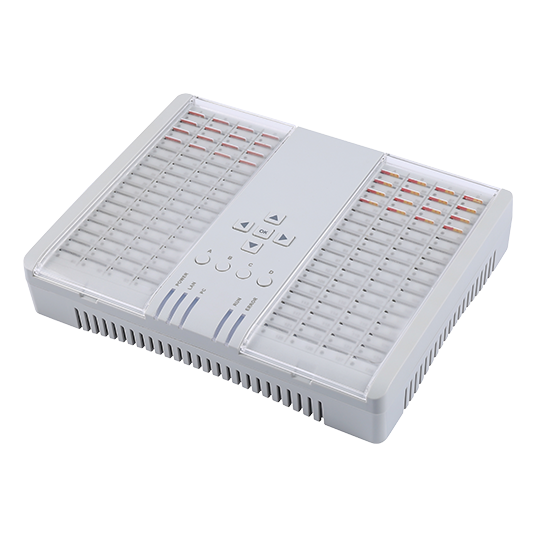
The published SIMBANK128 at $1,600.00 provides 128 slots with hot-swapping, dynamic SIM allocation and failover for GoIP gateways, which are the features that make a separated topology operationally viable rather than merely possible.
What operational capabilities should it provide?
Allocation, hot-swap, failover and reporting.
Each capability answers a question that arises in ordinary operation rather than in an emergency.
Allocation determines which gateway uses which SIM, and whether that assignment is fixed or dynamic. Hot-swap allows a slot to be taken out of service without disturbing the rest of the chassis, which is what makes a card replacement a routine task. Failover determines what happens when a SIM stops responding, and whether the traffic moves or the channel is reported unavailable. Reporting provides per-slot state, which is the capability that makes any of the others diagnosable.
The reporting capability is the one that decides whether the appliance is operable at scale. In a chassis with a hundred or more slots, the difference between per-slot state and per-device state is the difference between a fault that can be located and a fault that can only be observed.
What are the legitimate uses and their limits?
Authorised use with evidence, not unrestricted use.
The appliance is a general-purpose device, and the boundary is defined by what the operator can document rather than by what the hardware can do.
Three uses are straightforwardly legitimate: consolidating a SIM estate that the organisation owns, keeping cards in a controlled location while radios sit where coverage is adequate, and reducing physical handling in a deployment whose cards are replaced regularly. Each of those is an asset-management function, and each leaves a record.
The boundary is crossed where the estate serves traffic the operator cannot account for, or where access to the appliance is not attributable. That is not a property of the hardware but of how it is operated, and the controls that keep a deployment on the right side of the line are ordinary ones: authenticated access, per-SIM or per-group allocation rather than an anonymous pool, and a record that links a SIM to a purpose.
Where the traffic is commercial, the consent and identification expectations described by M3AAWG apply to the message rather than to the device, and they do not become lighter because the SIMs are centralised. The numbering that recipients see is standardised under the ITU Recommendation E.164 numbering plan, while the registration requirements in each market remain a matter for the national framework.
How should authorised use be documented?
One record per SIM that answers who authorised it.
The record is what turns an estate into an accountable one, and it is cheapest to build at the start.
Four fields are sufficient as a minimum: the SIM identifier, the purpose or customer it serves, the person or process that authorised its use, and the date it was commissioned. Where the estate supports several business lines, the purpose field is what allows a report to be produced per line rather than per device, which is usually what an audit or a customer enquiry actually asks for.
Two practices keep it current. The record should be updated as part of the physical or logical change rather than as a follow-up task, so that a swap is not complete until the record reflects it. And it should be reconciled periodically against the appliance’s own reported state, because a register can drift when a card is replaced in an emergency and the paperwork follows later.
Where the deployment carries commercial traffic and the market framework requires an identifiable sender, the record also provides the link between the SIM and the entity responsible for the traffic, which is the question a regulator or a carrier is most likely to ask.
What should be monitored?
Per-slot state rather than device presence.
The metric that matters is whether each slot is usable, not whether the appliance is powered on.
Four figures are worth monitoring. Slots populated, which confirms the estate is intact. Slots reporting a registered state, which is the number that actually predicts whether traffic can flow. Slots unavailable for longer than a defined interval, which surfaces a fault before a campaign finds it. And link state between the appliance and the gateways, because a link failure makes every SIM behind it unavailable at once.
Alerting on the second figure rather than the first is the change that most improves operability. An appliance with every slot populated and a fifth of them unavailable reports as healthy under a presence check and as degraded under a registration check, and only the second predicts the outcome of a batch.
Where the deployment also has to satisfy an equipment or market framework, the ETSI standards catalogue covers the network and equipment side of the same requirement, and the messaging behaviour behind the traffic is specified by 3GPP.
What belongs in the acceptance test?
Slot inventory, pairing accuracy, recovery.
The test should establish that the appliance is operable, not merely that it is present.
- Slot inventory. Confirm the appliance reports every populated slot and that the register matches it.
- Pairing accuracy. Exercise one slot per group and confirm the number presented matches the register rather than the physical order.
- Hot-swap behaviour. Take one slot out of service and confirm the rest of the estate is unaffected.
- Link failure and recovery. Disturb the link and confirm automatic recovery without manual intervention, and record what the gateways report while it is down.
- Attribution. From the appliance record alone, answer which SIM carried a given interaction and who authorised its use.
Item two is the one that catches the most common silent defect at this scale. Item five is the one that converts the estate from functional to accountable, and it is the item most often added later rather than tested at commissioning.
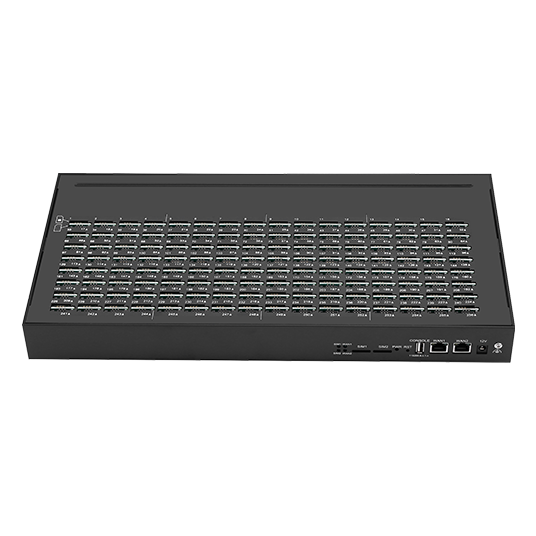
Where the estate needs to grow beyond a single chassis, the capacity steps in the SIMPOOL range follow the same topology and the same monitoring model.
Where the deployment has to reference the numbering or interconnection conventions a carrier expects, the publications of the ITU Telecommunication Standardization Sector provide a neutral reference point for the terminology.
Conclusion
A network SIM bank appliance separates the SIM estate from the radios, which is why it is chosen, and introduces a link that becomes part of the failure domain, which is what it costs. The capabilities that matter operationally are allocation, hot-swap, failover and per-slot reporting, and the last of those is what makes the others diagnosable at scale.
The compliance boundary belongs in the design rather than in a review afterwards. It is drawn by authenticated access, allocation by purpose rather than by availability, and a record that links each SIM to a person or process that authorised it. Monitoring registered slots rather than populated ones, and testing attribution at commissioning, are what keep the deployment accountable as well as functional.
Document authorised use before the estate grows. Send your slot count, topology and access requirements to service@telarvo.com, or review the published configurations on the SIMPOOL pages and the SIMBANK128 page.
FAQ
What is the difference between a network SIM bank and a directly connected one?
A directly connected bank sits close to the gateways with a short physical link; a network appliance presents the same SIMs over an IP path, which allows the estate to sit where access is controlled while the radios sit where coverage is adequate. The cost is that the link becomes part of the failure domain, so it should be short, stable and monitored.
Is a SIM bank legal to operate?
The appliance is general-purpose infrastructure, and the boundary is defined by what the operator can document rather than by the hardware. Authenticated access, allocation by purpose rather than by availability, and a record linking each SIM to the person or process that authorised its use are the ordinary controls that keep a deployment accountable. Consent and identification obligations attach to the traffic rather than to the device.
What should be monitored on a SIM bank appliance?
Registered slots rather than populated slots, because that is the figure that predicts whether traffic can flow. Also slots unavailable for longer than a defined interval, and link state between the appliance and the gateways, since a link failure makes every SIM behind it unavailable at once. An appliance with every slot populated but a fifth unavailable reports as healthy under a presence check and degraded under a registration check.
What happens when the link to the gateways fails?
Every SIM behind that link becomes unavailable at once, so the failure is systemic rather than gradual. Confirm during commissioning that both elements recover automatically when the link is restored, and record what the gateways report while it is down, because a gateway presenting stale SIM state is harder to diagnose than one that reports the estate as unavailable.