A SIM bank is the part of a deployment that is hardest to replace and easiest to misconfigure, and the failure modes that matter appear only under load. This article gives a protocol that can be run in a day, before the deployment carries traffic.
It covers what reliability means for a SIM bank, how to test slot inventory accuracy and hot-swap behaviour, how link failure and recovery behave, what to measure thermally after steady state, and how to record the results as a baseline.
What SIM bank reliability testing actually measures
Four things, none of which is the failure rate of the electronics.
The first is inventory accuracy: whether the device reports the card in each slot correctly, and whether that report remains correct after a restart. The second is pairing accuracy: whether the mapping between a slot and the gateway port that uses it stays stable, because a bank that reassigns a card to a different port produces behaviour that looks like a subscription problem rather than a bank problem. The third is continuity: whether the link between the bank and the gateways survives a disturbance without losing the sessions that depend on it. The fourth is thermal stability, because a bank with a large number of cards in a small space produces continuous heat and its behaviour changes after it has been running for some hours.
None of those is described by a datasheet, and all of them can be measured in a day with the equipment that will be deployed. The card identity used to track which subscription is where is defined in ITU-T E.212, and having the device report that identity consistently is the basis of the inventory check.
| Property | What it affects | How it is tested |
|---|---|---|
| Inventory accuracy | Knowing which card is where | Read all slots, restart, read again |
| Pairing stability | Which port uses which card | Compare mapping before and after a restart |
| Continuity | Sessions surviving a disturbance | Interrupt the link under load and observe recovery |
| Thermal stability | Behaviour after hours of operation | Measure after steady state rather than at startup |
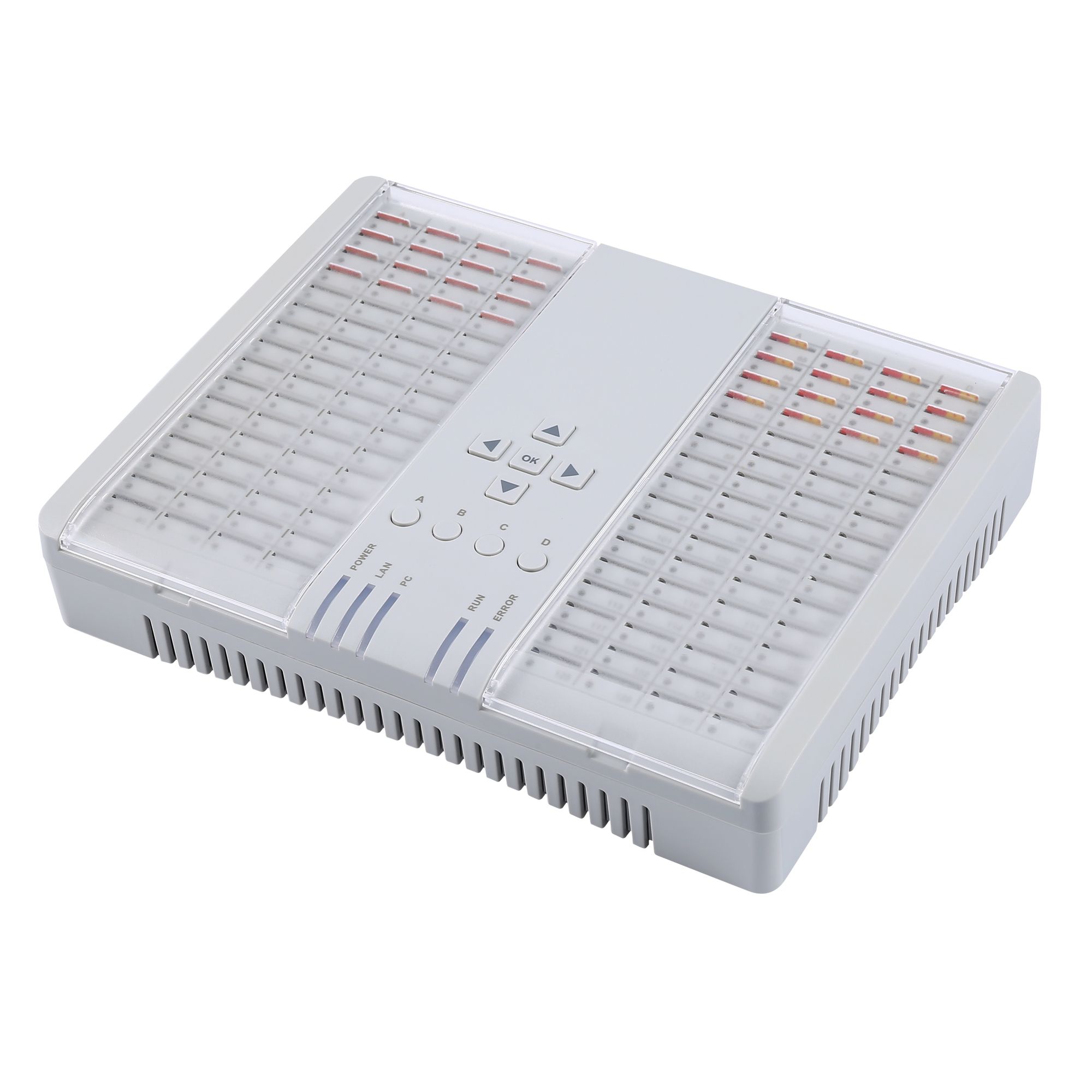
Slot inventory and pairing accuracy
Test it by reading the bank twice with a disturbance in between.
The inventory check begins with a full read of every slot, recorded as a list of slot number against card identity. The bank is then restarted, or the management session is re-established, and the read is repeated. The two lists are compared, and any difference is a finding. A card that appears in a different slot, a slot that reads empty when it is not, or an identity that changes between reads are all conditions that will produce a support call in production, where the cause will be attributed to the wrong component.
Pairing accuracy is tested the same way but with the gateways attached. The mapping from each bank slot to the gateway port that uses it is recorded, the bank is restarted, and the mapping is read again. Where the device reassigns slots, the mapping changes and the traffic from one subscription begins to appear under another. That failure is particularly confusing because the symptoms are delivery problems on specific numbers, which is exactly how a subscription issue presents.
Two smaller checks belong to the same test. Whether the bank reports a slot as empty when a card is removed, so that the state is accurate rather than cached. And whether a card inserted while the device is running is detected within a predictable interval, because an unpredictable detection delay makes the inventory unreliable even when it is eventually correct.
Hot-swap behaviour under load
Removing a card while traffic is flowing shows what the rest of the deployment does.
The hot-swap test has two parts, and the second is the one that matters. The first is whether the bank detects the removal and updates its state, which is a property of the device. The second is what happens to the traffic that was using that card: whether the gateway raises an alarm, whether the work in flight is retried elsewhere, whether the queue stalls, and whether sessions on other slots are affected. A bank that handles the removal gracefully still produces an outage if the surrounding system has no way to notice.
Inserting a card is the mirror test and is often more revealing. The question is whether the bank and the gateway bring the new card into service cleanly and predictably: how long until it appears in the inventory, how long until the module attaches to it, and whether the pool returns to its previous state without intervention. Where the process requires a manual step that is not documented, that step will be rediscovered during an incident rather than during a planned change.
The surrounding traffic behaviour is worth recording as a number rather than an impression. How many messages were in flight when the card was removed, how many were retried successfully, and how many required manual reconciliation are the three figures that tell you whether hot-swapping is a routine operation in this deployment or an event with consequences.
Link failure and recovery
The link between a bank and its gateways is a single point of failure by design.
Three behaviours are worth measuring. Whether the gateways detect the loss of the link and raise an alarm rather than continuing to attempt sends against a card they can no longer reach. Whether the sessions recover automatically when the link returns, and how long that takes. And whether the bank maintains its state across the interruption, so that the mapping between slots and ports is unchanged afterwards.
The test is straightforward: with traffic running, break the link for a defined period, then restore it and observe. The period should be long enough to be realistic, which in most deployments means minutes rather than seconds, because a brief interruption is absorbed by retries and tells you nothing about the behaviour that matters. The three figures to record are the time to detection, the time to recovery, and the number of messages that required manual reconciliation.
Where the topology allows the link to be made redundant, the same test should be repeated with the redundancy in place, and the result compared. A redundant link that takes the same time to recover as a single one has not provided redundancy in any operational sense, and that finding is worth having before the deployment rather than after.
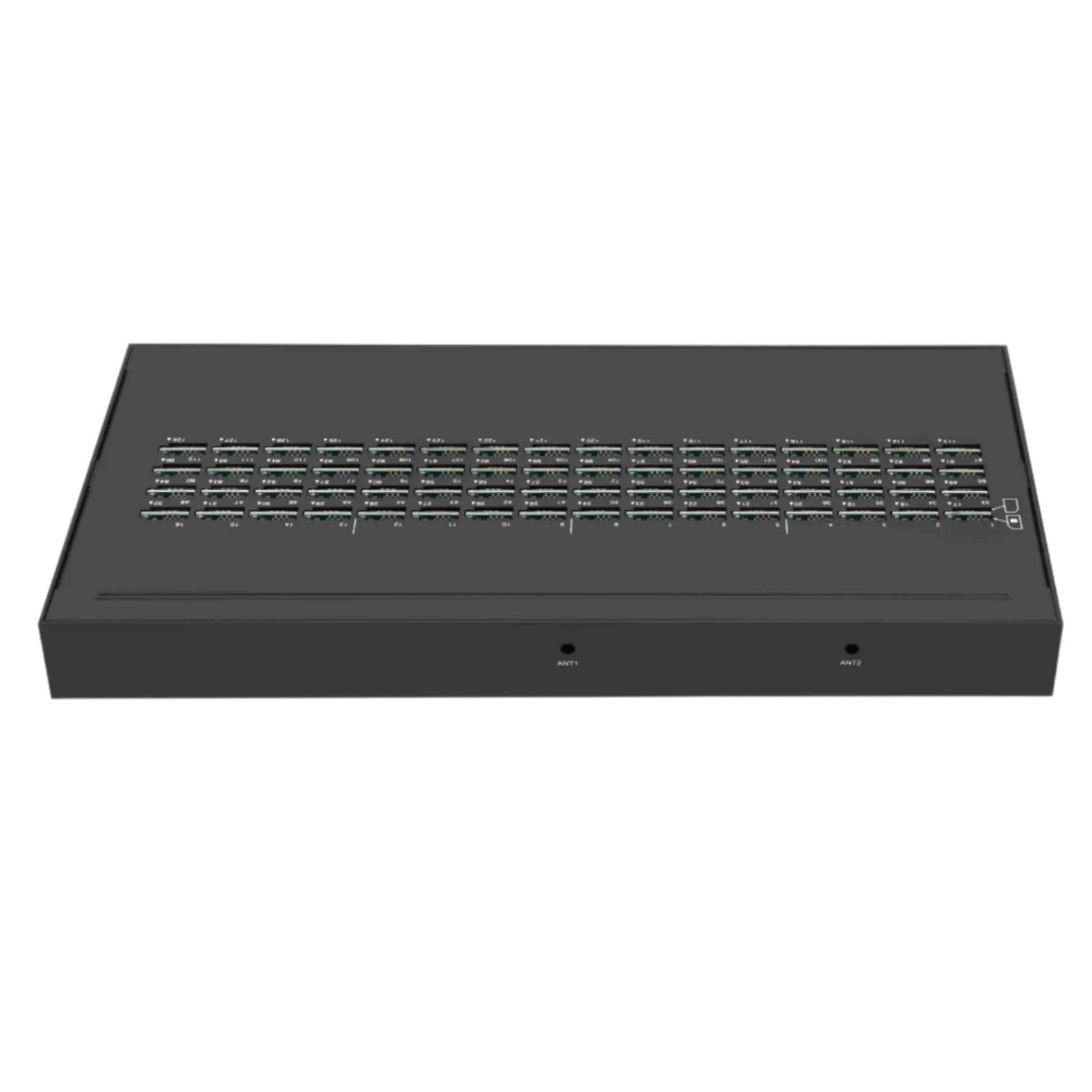
Thermal behaviour after steady state
The measurement that matters is taken hours after the bank has been running.
A SIM bank with a large number of cards produces heat continuously, and its temperature rises over the first hours of operation before reaching a steady state. Measurements taken at startup describe a cooler device than the one that will be in service, which is why the protocol requires the thermal reading to be taken after several hours of load rather than at commissioning. The environmental class the equipment is declared against, defined for fixed installations in ETSI EN 300 019-1-3, one of the ETSI standards, gives the reference against which the room should be compared.
Two readings make the measurement useful: the temperature inside the bank and the temperature of the air entering it. The difference describes how effectively the enclosure moves heat away from the cards, and a large difference indicates that the airflow path is the constraint. Where the bank is mounted in a rack with other equipment, the intake temperature is the relevant figure rather than the room temperature, because the air reaching the bank has already passed whatever is mounted below it.
The behavioural observation belongs alongside the temperatures. Whether the bank and the gateways continue to operate normally at steady state, whether any error rate changes as the device warms, and whether the recovery time from a link interruption is different when the device is warm are all worth noting, because a device that behaves differently at steady state is one whose commissioning results do not describe its production behaviour.
Recording results as a baseline
The protocol produces a document, and the document is the output.
Six items make a baseline that can be compared later: the full slot inventory with card identities, the mapping from slots to gateway ports, the detection and recovery times for a link interruption, the number of messages requiring reconciliation in each test, the steady state temperatures with the intake temperature, and the firmware versions of the bank and the gateways. Recorded together, they allow a later problem to be diagnosed by comparison rather than by hypothesis.
The value of the baseline appears months later, when a behaviour changes and the question is whether it has changed. Without a recorded starting point, the answer is a matter of memory, and the resulting discussion consumes more time than the original test would have. The operational practice of keeping system records that can be relied on is described in NIST SP 800-123, and the command interface used to read the state of the bank and its cards is standardised, with the field definitions in 3GPP TS 27.005 and its ETSI TS 127 005 equivalent.
The management functions that a mature operation defines around configuration and fault data are catalogued in ITU-T M.3400, and the vocabulary is useful if the baseline has to be presented to somebody outside the engineering team. The contents matter more than the format, provided the format is one that survives being read a year later by somebody who was not present.
A test protocol
The protocol tests the properties of a SIM bank that a specification does not describe, in an order that moves from inventory to behaviour under load. It produces a baseline that later faults are compared against, and it is short enough to complete before the deployment carries traffic.
- Read the full slot inventory and record slot number against card identity.
- Restart the bank and read the inventory again; compare the two lists.
- Record the mapping from slots to gateway ports, restart, and compare.
- Remove a card under load and record detection, retry and reconciliation counts.
- Insert a card under load and record how long it takes to enter service.
- Break the bank-to-gateway link for a realistic period and record detection and recovery times.
- Repeat the link test with the redundancy in place, if the topology provides it.
- Run under load for several hours, then record internal and intake temperatures.
- Record firmware versions for the bank and the gateways, and store the document as the baseline.
Run the protocol before the bank carries production traffic. Send your topology, slot count and recovery requirements to service@telarvo.com, or review the published configurations on the SIM bank page and the SMS gateway range. Telarvo publishes the SIMBANK and SIMPOOL ranges on its product pages, and the configurations referenced above come from those listings.
FAQ
What does SIM bank reliability actually mean?
Four measurable properties rather than an electronics failure rate: whether the inventory of cards is reported accurately and survives a restart, whether the mapping between slots and gateway ports stays stable, whether the link to the gateways recovers from a disturbance without losing sessions, and whether behaviour is unchanged after the bank has reached thermal steady state. Record the four properties separately, because they fail in different ways and need different remedies.
How do I test a SIM bank before deployment?
Read the full slot inventory, restart, and read it again to compare. Record the slot-to-port mapping before and after a restart. Remove and insert a card under load and observe detection and recovery. Break the bank-to-gateway link for a realistic period and record detection and recovery times. Then run under load for several hours and measure internal and intake temperatures before recording the baseline.
Why should thermal measurements be taken after hours rather than at startup?
Because a SIM bank with many cards reaches steady state over hours, and readings taken at startup describe a cooler device than the one that will be in service. The two useful figures are the temperature inside the enclosure and the temperature of the air entering it, and the difference indicates how effectively heat is being moved away. In a rack, the intake figure matters more than the room temperature.
What should be recorded as the baseline after testing?
Six items: the full slot inventory with card identities, the slot-to-port mapping, detection and recovery times for a link interruption, the number of messages requiring reconciliation in each test, steady state temperatures with the intake temperature, and the firmware versions of the bank and gateways. Stored together, they let a later problem be diagnosed by comparison rather than by hypothesis.
{
“@context”: “https://schema.org”,
“@type”: “FAQPage”,
“mainEntity”: [
{
“@type”: “Question”,
“name”: “What does SIM bank reliability actually mean?”,
“acceptedAnswer”: {
“@type”: “Answer”,
“text”: “Four measurable properties rather than an electronics failure rate: whether the inventory of cards is reported accurately and survives a restart, whether the mapping between slots and gateway ports stays stable, whether the link to the gateways recovers from a disturbance without losing sessions, and whether behaviour is unchanged after the bank has reached thermal steady state. Record the four properties separately, because they fail in different ways and need different remedies.”
}
},
{
“@type”: “Question”,
“name”: “How do I test a SIM bank before deployment?”,
“acceptedAnswer”: {
“@type”: “Answer”,
“text”: “Read the full slot inventory, restart, and read it again to compare. Record the slot-to-port mapping before and after a restart. Remove and insert a card under load and observe detection and recovery. Break the bank-to-gateway link for a realistic period and record detection and recovery times. Then run under load for several hours and measure internal and intake temperatures before recording the baseline.”
}
},
{
“@type”: “Question”,
“name”: “Why should thermal measurements be taken after hours rather than at startup?”,
“acceptedAnswer”: {
“@type”: “Answer”,
“text”: “Because a SIM bank with many cards reaches steady state over hours, and readings taken at startup describe a cooler device than the one that will be in service. The two useful figures are the temperature inside the enclosure and the temperature of the air entering it, and the difference indicates how effectively heat is being moved away. In a rack, the intake figure matters more than the room temperature.”
}
},
{
“@type”: “Question”,
“name”: “What should be recorded as the baseline after testing?”,
“acceptedAnswer”: {
“@type”: “Answer”,
“text”: “Six items: the full slot inventory with card identities, the slot-to-port mapping, detection and recovery times for a link interruption, the number of messages requiring reconciliation in each test, steady state temperatures with the intake temperature, and the firmware versions of the bank and gateways. Stored together, they let a later problem be diagnosed by comparison rather than by hypothesis.”
}
}
]
}