A specification that reads 32 ports and 512 SIM slots describes two capacities rather than one, and buyers routinely treat the larger number as though it were the first. The 512 refers to how many numbers the estate can hold; the 32 refers to how many calls can exist at the same moment. Confusing them produces a deployment that holds plenty of numbers and blocks calls.
This guide treats the 32-port, 512-SIM configuration as its own engineering problem: how the two figures relate, what SIM allocation does to call quality, what the price step from a one-to-one configuration actually buys, and how to verify concurrency at this density before the deployment carries live traffic.
Are ports and SIM slots the same specification?
No. One limits simultaneous calls; the other limits numbers.
A port is a channel that can carry one call, while a SIM slot holds a number that can be used for calls over time.
The distinction has a direct operational consequence. A gateway with 32 ports cannot carry more than 32 simultaneous calls regardless of how many SIM slots it holds, because each call occupies a channel for its duration. The 512 slots determine how widely traffic can be distributed across numbers, which matters where a per-number volume policy applies, but they add no concurrent capacity at all.
Where the two limits are confused, the deployment is sized against the wrong constraint. A team that buys 512 slots to solve a call-blocking problem has added number capacity to a channel problem. A team that buys 32 ports to satisfy a per-number policy has added channels to a number problem. Measuring which of the two is actually binding, before the order rather than after, is the whole of the sizing exercise.
How many concurrent calls can 512 SIM slots support?
Thirty-two, because the port count sets the ceiling.
Everything above 32 simultaneous calls in this configuration would have to come from additional hardware rather than additional numbers.
The practical figure is usually below 32, for three reasons. A channel is briefly occupied during call teardown, so a channel is not instantly available for the next call. Where a SIM is rotating or re-registering, its channel is unavailable for the duration. And codec transcoding, where the two ends of a call do not share a codec, consumes processing capacity that can reduce the sustainable figure below the nominal port count.
The consequence for planning is that the number to design against is the measured sustainable concurrency, not the port count. That figure should be established on the actual hardware, at the codec configuration you intend to run, and sustained for long enough that thermal behaviour is included. A figure measured over a two-minute burst describes a different situation from one measured over an hour.
The signalling that makes these calls work is defined by RFC 3261, and the cellular side is standardised in the 3GPP specifications, which is where to look when a vendor’s concurrency claim does not state its codec configuration.
How does SIM allocation affect call quality?
It affects availability rather than audio.
How numbers are distributed across channels determines whether a channel is free when a call arrives.
Three allocation patterns are common at this density. Fixed allocation binds each SIM to a channel, which makes behaviour predictable and consumes numbers quickly. Pooled allocation lets any available SIM serve any channel, which uses the estate efficiently and makes the mapping a runtime property. Grouped allocation reserves groups of SIMs for specific customers or traffic types, which is the usual answer where the deployment serves more than one business line.
Where allocation is pooled, an operational detail matters: a SIM that has just been used on a call may be briefly unavailable for the next one, so a pool that is exactly the size of the channel count will occasionally have a channel with no number available. Sizing the pool with headroom, rather than exactly matching the port count, is what prevents that intermittent blocking.
Where allocation is grouped, the risk is the reverse: a group sized for average demand blocks calls during that group’s peak while other groups sit idle. The remedy is either a shared overflow group or a periodic review of the group sizes against measured demand.
| Model | Ports | SIM slots | List price (USD) |
|---|---|---|---|
| SK VOIP Gateway 16-512 | 16 | 512 | $1,550.00 |
| SK VOIP Gateway 32-32 | 32 | 32 | $1,550.00 |
| SK VOIP Gateway 32-256 | 32 | 256 | $2,300.00 |
| SK VOIP Gateway 32-512 | 32 | 512 | $2,520.00 |
| SK-VOIP Gateway-32E-SIM | 32 | 32, eSIM | $3,100.00 |
The table shows the trade clearly. The 16-512 and the 32-32 carry the same list price and represent opposite answers: one holds many numbers with few channels, the other holds few numbers with many channels. Which is correct follows from the constraint, not from the price.
What does the step from 32-32 to 32-512 buy?
Sixteen times the numbers for the same 32 channels.
The $1,360.00 difference between the two configurations buys number capacity, and nothing else.
Whether that is worth paying depends entirely on a policy decision: how much traffic you are willing to place from a single number. Where the policy is permissive, 32 numbers can carry a substantial call volume and the additional slots sit unused. Where the policy is strict — because the operator expects it, because the deployment is spread across customers, or because numbers need rest periods — the 32-32 configuration becomes the binding constraint long before the channels do.
A useful way to make the decision is to write the arithmetic down. Divide peak concurrent demand by the channels, which confirms the port count. Then divide peak hourly call volume by the per-number limit, which produces the number count. Where the second result exceeds the first configuration’s slots, the higher SIM tier is required; where it does not, the extra capacity is optional.
Where the deployment spans markets or customers, the eSIM variant at $3,100.00 changes the operational model rather than the capacity. Removing physical SIM handling is particularly relevant where cards would otherwise have to be shipped, registered and replaced in several countries, which is a logistics cost rather than a hardware cost.
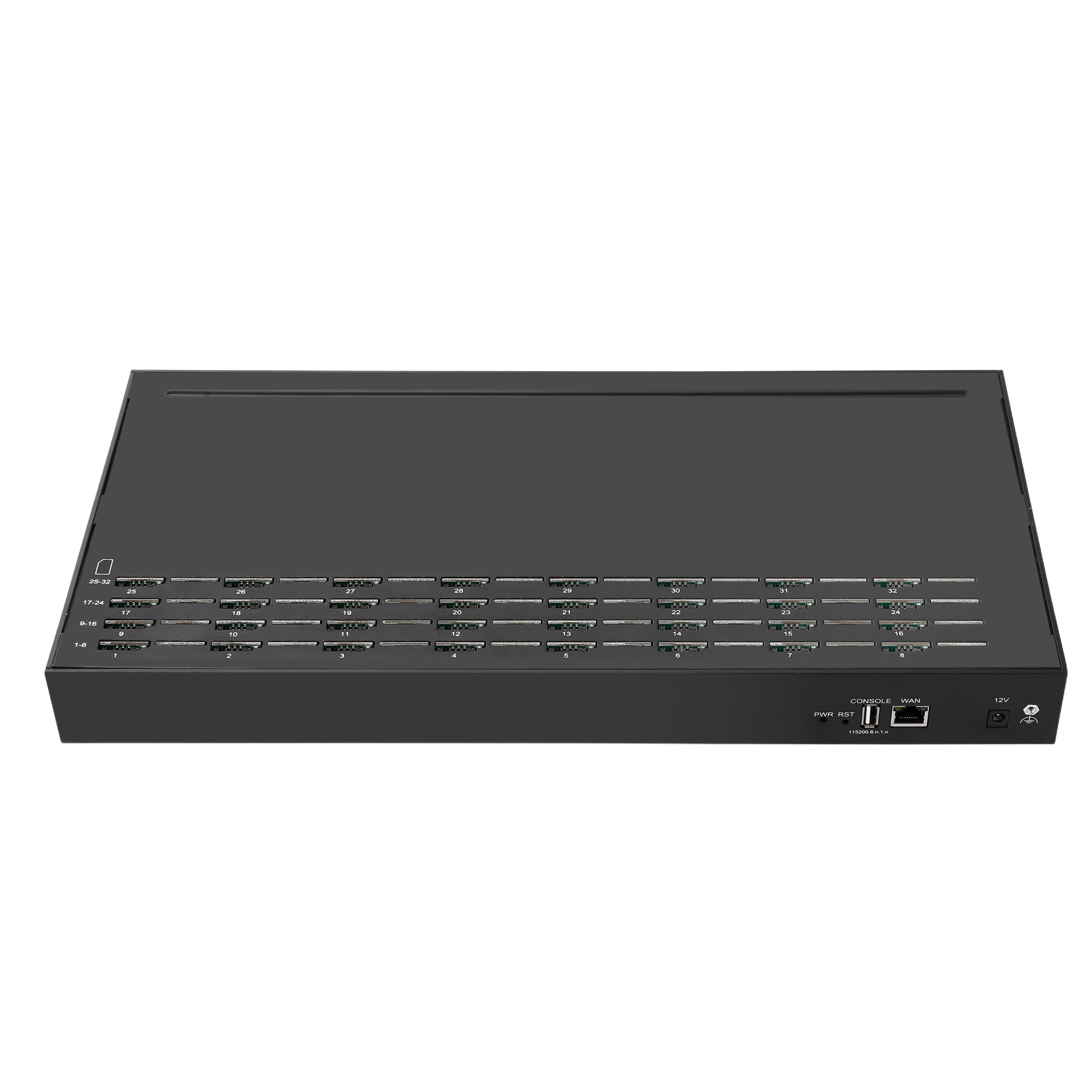
What rack and power conditions does 32 channels need?
Power for simultaneous transmission; thermal headroom.
Both requirements are measured under load, and neither appears in an idle reading.
Power should be sized for the case where every channel is active, because that is what a peak produces. A supply sized on idle draw experiences a voltage dip during a peak, and radios that see the dip deregister rather than failing outright, which presents as a network fault rather than a power one. Supply the device from a protected circuit and leave capacity for expansion, since estate growth is normal at this tier.
Thermal behaviour should be verified after the enclosure has reached steady state under sustained load, not at the moment the equipment is switched on. The widely used environmental guidance for data processing environments published by ASHRAE is a reasonable reference when the operating envelope has to be stated in a specification, and the environmental test standards published by the International Electrotechnical Commission cover the equipment side.
Antenna placement belongs in the same plan. A rack-mounted device enclosed in metal can register on a network and deliver unreliable audio, and the symptom is intermittent enough to be attributed to the carrier. Decide the antenna position before the device is mounted and verify signal quality at the installed position rather than at the rack door.
How do you verify concurrency before go-live?
Drive sustained calls at the codec you intend to run.
A concurrency figure is meaningful only with its configuration attached.
- Baseline. Place one call and record audio quality, setup time and the codec negotiated.
- Step up. Increase concurrent calls in defined increments, recording the same three measures at each step.
- Identify the break point. Note where setup time rises or audio degrades, rather than where the last call connects.
- Sustain. Hold the deployment at that point for an hour, because a device that manages a peak for a minute may not manage it for an hour.
- Repeat at the operating SIM ratio. Run the peak test with the SIM estate at the allocation you intend to operate, since SIM behaviour under load is part of the capacity.
- Record. Keep the result with the serial number and firmware version, so a later comparison is between two known states.
Items three and four are the ones that produce a defensible figure. A capacity statement that says “32 concurrent calls, at this codec, with this SIM allocation, sustained for an hour, before setup time exceeded this threshold” is something a capacity plan can use and a supplier conversation can be resolved against.
Where the deployment serves several business lines from one estate, the SIM allocation should be recorded against the line rather than against the channel. When a device is replaced, an allocation keyed on the commercial structure follows the customer, while an allocation keyed on ports has to be rebuilt from the configuration before the old device is removed.
Where the requirement is a single voice estate with a straightforward port count, the simpler SK VOIP Gateway range entries above this tier cover the same endpoint model without the SIM estate planning.
Where the deployment must cite an equipment framework in a procurement document, the ETSI standards catalogue covers the network and equipment side of the same specification work.
Conclusion
The 32-port, 512-SIM configuration describes two independent capacities, and the port count is the one that limits simultaneous calls. SIM slots determine how widely traffic can be distributed across numbers, which matters where a per-number policy applies and does nothing for channel capacity. The price step from the 32-32 configuration at $1,550.00 to the 32-512 at $2,520.00 buys sixteen times the numbers with the same 32 channels, and whether that is worth paying is a policy decision that can be reduced to a division.
Verification should produce a figure with its configuration attached: concurrency at a stated codec, with a stated SIM allocation, sustained for an hour, with the break point identified. Power and thermal planning should be sized for that loaded condition rather than for idle, and the antenna position should be verified at the installed location before the deployment carries live traffic.
Identify whether channels or numbers limit your deployment before ordering. Send your peak concurrent calls, per-number policy and codec requirement to service@telarvo.com, or review the published tiers on the VoIP gateway solution pages.
FAQ
Does a 512-SIM gateway support more simultaneous calls?
No. Simultaneous calls are limited by the port count, because each call occupies one channel for its duration. The SIM slots determine how many numbers the estate can hold and how widely traffic can be distributed across them. A 32-port configuration carries at most 32 concurrent calls whether it holds 32 SIMs or 512.
Should I buy 32-32 or 32-512?
It depends on your per-number policy rather than on call volume. Divide peak hourly call traffic by the maximum volume you are willing to place from one number: where the result exceeds 32, the higher SIM tier is required. Where it does not, the extra slots would sit unused and the 32-32 configuration at $1,550.00 is sufficient.
What codec configuration should capacity be measured at?
The one you intend to run in production. Transcoding between codecs the two ends do not share consumes processing capacity and can reduce the sustainable concurrency below the nominal port count. A capacity figure without its codec configuration cannot be compared with another device’s figure, so record both together in the acceptance results.
Why does concurrency fall during a long test?
Thermal behaviour is the usual reason: a device that manages a peak briefly may behave differently once the enclosure reaches steady state. Channel teardown and SIM re-registration also reduce availability at the margins. The remedy is to measure over an hour rather than a minute, and to verify the installed position rather than a bench.