Updated
Start with the service the application or PBX needs. This guide compares relevant eight-port configurations, separates channel count from inventory, and turns an attractive catalogue description into an RFQ and a controlled acceptance test. It does not assume every eight-port device supplies both a production SMS API and a production voice interface.
Which 8-port GSM gateway matches the business workload?
Match the hardware family to the required service first.
Specify SMS submission and reception, PBX voice routing or both. Verify each required interface, carrier arrangement and active-channel limit on the exact quoted configuration.
An application sending notifications needs an observable messaging workflow with defined errors and delivery information. A PBX adding cellular calls needs supported SIP signalling, audio handling and number routing. A combined project must specify both workflows and whether they can operate together under the intended load.
Do not infer the service from a GSM label or assume all SK, GoIP and TYH products expose the same controls. Eight USB-connected modems and eight network-managed gateway channels create different host and recovery requirements. Ask for the physical connections, software dependencies and interface documents before comparing price.
The Telarvo SMS gateway collection and VoIP gateway collection provide separate product families. Keep those distinctions in the quotation. If the project needs only one service, a specification tailored to that service is easier to test than a broad request for every feature mentioned across the website.
Compare eight-port configurations by capacity and interface
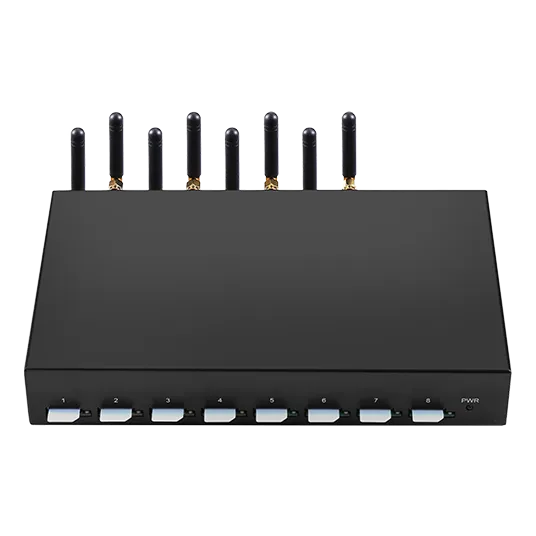
Telarvo offers SK-SMS Gateway 8-8 and 8-32, SK VOIP Gateway 8-8 and 8-32, and GOIP8. The model names identify candidates, but the selected radio revision and firmware still require confirmation. A product family’s capabilities should not be assigned to every candidate without the relevant interface specification.
Use the same comparison fields for every supplier, including Telarvo. Ask for nominal active channels, stored SIM provision, simultaneous service rules and the equipment required to reach the application. Exclude prices until these differences are clear enough to compare like-for-like offers.
| Candidate | Nominal configuration | Main evaluation focus |
|---|---|---|
| SK-SMS Gateway 8-8 | 8 ports / 8 SIM slots | SMS API behaviour and usable message capacity |
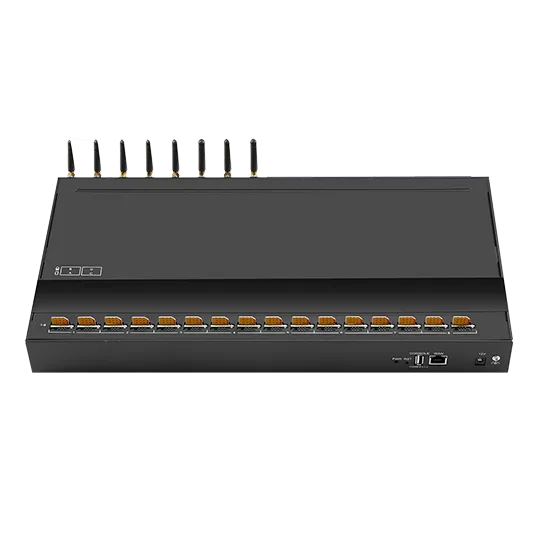
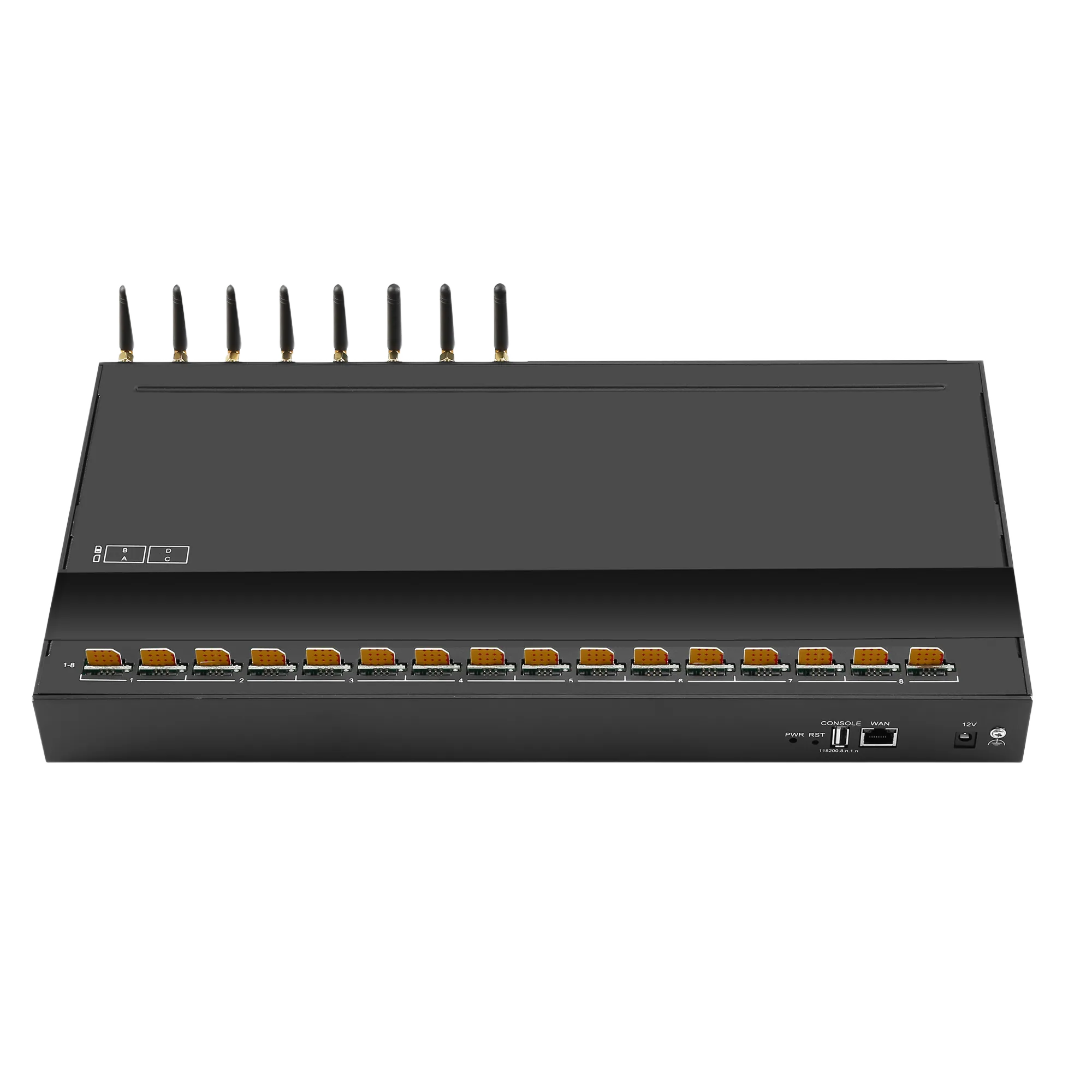
| SK-SMS Gateway 8-32 | 8 ports / 32 SIM slots | Allocation workflow and inventory management |
| SK VOIP Gateway 8-8 | 8 ports / 8 SIM slots | Cellular voice, SIP and PBX routing |
| SK VOIP Gateway 8-32 | 8 ports / 32 SIM slots | Voice plus documented SIM allocation |
| GOIP8 | Eight-channel model class | Exact cellular revision and PBX interface |
Telarvo is the supplier behind this guide. This is a specification comparison, not an independent ranking or a claim that a named model has passed a particular deployment test.
What do eight ports and thirty-two SIM slots mean?
Active channels and stored SIM inventory are different.
An eight-port, thirty-two-slot design does not imply thirty-two simultaneous calls or message submissions. Confirm which subscriptions can be assigned and used at the same time.
Inventory can be useful when an authorised operation manages several subscriptions, countries or service plans. It does not bypass the channel limit or establish carrier permission for automated traffic. Ask how the device assigns a subscription to a radio and how staff observe that assignment.
Specify the effect of changing an assignment while work is queued or a call is active. Does the operation wait for the channel to become idle, reject the request or interrupt service? Obtain the documented behaviour and test it with non-production subscriptions. An interface that displays many cards can hide important limits on their simultaneous use.
ETSI TS 102 221 covers the UICC-terminal interface. It is useful background for the subscriber interface, not evidence that unrelated SIM banks and gateways are compatible. Accessory pairing still requires an explicit model, controller and firmware combination.
Establish cellular compatibility for the site and intended lifetime
Specify the countries, carriers and services that the installed unit must support. Request the full module part number and its supported bands, alongside the supplier’s evidence for the proposed carrier arrangement. A selectable 2G or 4G option is not enough information to approve a deployment.
Registration, SMS and voice are separate acceptance outcomes. An LTE data connection does not alone prove permitted cellular voice service. Likewise, a successful call does not establish the application’s SMS-status workflow. Test the subscription functions the business will actually use.
For legacy hardware, include the carrier’s network-retirement plan and the proposed service lifetime. For a replacement, verify whether the alternative radio requires different antennas, firmware or approvals. Use the Quectel module comparison for the component-selection questions; do not assume those modules are fitted to a particular Telarvo SKU.
At the site, test each intended carrier in the proposed installation position. Preserve the antenna arrangement and observed service results. A survey performed outdoors beside a window does not validate a metal cabinet in a basement equipment room.
Size SMS work by segments and delivery deadline
Define a message workload before requesting throughput. Include the number of recipients, content encoding, multipart proportion, arrival pattern and deadline. An accepted API request and a completed delivery are different events, so the capacity result must say which one was measured.
Twilio’s SMS character-limit documentation explains common GSM-7 and Unicode segmentation boundaries. One short business message can require more than one network segment after a character or content change. Validate the device’s handling of the actual templates instead of translating a headline message rate directly into delivered notifications.
For an illustrative acceptance workload, consider 900 authorised notifications released over fifteen minutes. If each uses one segment, the application is offering 60 segments per minute on average. If every notification becomes two segments, the offered workload becomes 120 segments per minute. These are arithmetic inputs, not a performance claim for an eight-port gateway.
Measure queue age and outcomes against the notification deadline. Evenly dividing a workload by eight assumes every channel is available and equally usable, which a real carrier mix may not support. Keep unavailable channels and failed deliveries in the record.
Require an SMS interface that the application can operate
The interface must support more than a successful demo send. Obtain the request format, authentication, identifiers, error responses, receive-message handling and the status lifecycle. Ask whether events arrive through callbacks, polling or another mechanism, and what happens when the application is temporarily unavailable.
Twilio’s outbound message-status guide illustrates the separation between submission, sending and delivery outcomes. It is a provider example, not Telarvo’s API specification. Require the supplier to map its own states and errors so your application does not mistake queue acceptance for delivery.
Before automatic retries, specify how the application reconciles an uncertain result. A timeout after submission can leave a job accepted by the device even though the application received no confirmation. Blindly sending it again can duplicate a notification. Use the documented identifiers and retry semantics rather than assuming an idempotency feature exists.
Also define expiry. A time-sensitive message left in a queue should not become misleading when service returns. Confirm whether the device enforces expiry or whether the application must prevent stale jobs from being resubmitted.
Size voice channels independently from SMS traffic
For cellular voice, use observed simultaneous calls and the required direction mix. Eight active voice channels are not eight extensions, eight destinations or eight minutes of daily use. The PBX can serve many extensions while a smaller trunk capacity limits concurrent external calls.
Specify whether inbound and outbound calls share the same channels, how an incoming call maps to an extension or queue, and what happens when all eligible channels are busy. If SMS and voice coexist, ask whether either operation occupies or delays the other on the selected radio and firmware.
RFC 3261 defines SIP session signalling. It does not guarantee a supplier’s default registration mode, number mapping or authentication arrangement. Request the PBX integration instructions for the exact revision rather than copying another model’s menu settings.
Test answered calls, unanswered calls, caller hangup, remote hangup and transfer behaviour. Confirm that the channel becomes available afterwards. A lingering busy state can reduce usable capacity without a failed registration alarm. Save the relevant call identifiers and timestamps so the supplier can reproduce the fault.
Validate media, DTMF and the actual network path
A green SIP registration indicator does not prove two-way speech. Place authorised test calls through the complete path and listen from both ends. Include overlapping speech, quiet sections and the IVR destinations the business needs. Separate media failures from call-setup failures in the report.
RFC 3550 describes RTP transport and reporting. Use available media observations to investigate packet loss and jitter, while recognising that measurements on the LAN do not cover every cellular or downstream network stage. Record where each observation was collected.
If the PBX and gateway sit behind different address boundaries, review their signalling and media configuration. The Asterisk NAT documentation shows why advertised addresses and media behaviour need deliberate configuration. Avoid changing several parameters at once without preserving the known working state.
DTMF, codec support and any encryption requirement belong in the RFQ. Require an actual interoperability result for the relevant PBX and carrier route. A generic claim of HD voice cannot substitute for negotiated codecs and a tested end-to-end audio path.
Plan power, placement and local access as operating requirements
For an illustrative office deployment, place the gateway where the approved antenna arrangement works and the network remains manageable. Do not automatically put it beside the PBX if that room has poor carrier coverage. If the chosen position needs a longer network connection or different maintenance access, include that work in the installation quotation. The accepted design should describe the final position, not a temporary bench arrangement that cannot be maintained after commissioning.
Specify the approved power supply, installation position, ventilation and maintenance access. The device must operate in its intended environment, not only on an open bench during procurement. Use the supplier’s limits for the exact chassis and radio configuration rather than inventing a universal temperature or power figure.
Power continuity should include the network switch, PBX or application host needed to use the gateway. Protecting only the gateway can leave it registered to the carrier but disconnected from the business application. Document the shutdown and restoration behaviour after a loss of power.
Restrict management to the intended administrative network and authorised accounts. Confirm how configuration backups are obtained and restored. If remote access is required, define the approved path instead of exposing the management interface for convenience.
The service record should identify the site, installed revision, antenna arrangement, subscriptions and configuration baseline. Keep sensitive subscriber information under appropriate access controls. This record makes later troubleshooting and replacement more practical than relying on a purchase invoice that says only eight-port GSM gateway.
Test recovery and reduced-capacity operation
Select faults that reflect the actual deployment: an unavailable subscription, a lost application connection, a network interruption and a controlled restart. Use authorised test traffic and preserve the starting configuration. Each test should have an expected result and an owner for restoring service.
Observe both the gateway and application. The gateway may recover its carrier registration while the application still holds an obsolete session or a stale status. Check queued SMS, inbound reception, released call channels and any required API or SIP reconnection after the fault.
Where routing can avoid an unavailable channel, confirm the documented behaviour and remaining capacity. Eight subscriptions are not automatically eight independent failure domains. The radios may share a chassis and power, and several SIMs may rely on the same carrier. Independence needs a specific design.
Write down which work failed, expired or was delayed. Do not clear logs or delete queue entries simply to make recovery appear clean. A successful return to normal should reconcile the work submitted before the interruption, not merely accept a new test message or call afterwards.
Request a quotation with comparable acceptance conditions
Compare an eight-slot and a thirty-two-slot offer using an explicit inventory requirement. If the operation needs eight stable subscriptions with no routine reassignment, extra inventory may add little value. If it manages a larger authorised subscription set, price the documented allocation workflow and staff effort alongside the additional slots. This comparison isolates the benefit actually purchased without confusing a subscription-management task with more active radio capacity.
An RFQ should state the service, active channels, stored inventory, countries, carriers, network generation, interfaces and business workload. Add the required installation conditions and recovery outcomes. Ask suppliers to mark each condition supported, unsupported or subject to confirmation.
Require the bill of materials to identify the gateway, modules, antennas, power supply, software licences and any controller or accessory. Compare recurring subscription, support and application-host costs alongside the equipment price. Treat missing costs as unresolved inputs rather than zero.
Ask for sample interface documentation and the proposed firmware baseline before ordering a pilot unit. The pilot should represent the production configuration, including the intended carrier subscriptions. A different radio version or a demonstration server cannot prove the supplied production system’s behaviour.
Preserve agreed acceptance terms in the purchase record. Where a supplier proposes an alternative, have it explain the effect on the workload and service boundary. That is more useful than evaluating generic statements about industrial reliability or global SIM compatibility without supporting specifications.
Approve the eight-port design against the service it delivers
Choose the configuration that satisfies the SMS or voice workflow with understandable limits. The useful outcome is a working interface, permitted carrier service, adequate capacity and recoverable operation. Additional stored SIMs are valuable only when their management solves an identified requirement.
Keep the accepted workload and failure tests as a baseline for later changes. Recheck relevant outcomes when firmware, radio revision, carrier service or application behaviour changes. A model name alone does not preserve every earlier interoperability result.
For a small deployment, this disciplined specification can be compact. A workload sample, a compatibility record and a short acceptance checklist are enough to expose most material differences between offers. They also let procurement and engineering review the same decision instead of interpreting a port count differently.
Request a Telarvo eight-port specification review with your required SMS or voice service, carrier list, interface and peak workload. Ask for the exact configuration and a representative pilot quotation.
FAQ
Does buying an eight-port unit require activating all eight subscriptions immediately?
Not necessarily, but the supported configuration and commercial terms must allow the staged deployment you intend. Ask whether unused channels can remain disabled and whether licences or accessory requirements depend on the final configuration. Test the initial subset without assuming it proves all channels will behave identically. Keep expansion conditions in the quotation so additional subscriptions, carrier arrangements and application routes can be commissioned deliberately rather than activated together without a fresh capacity or interoperability check.
Can an eight-port device send SMS while handling a voice call on the same channel?
That is a model, radio, firmware and service question, not a guarantee associated with the port count. Request documented coexistence behaviour for the selected configuration, then test the intended call and message overlap. Observe submission delays, received messages and channel release after the call. If simultaneous operation is essential, make it an acceptance condition. If it is unsupported, separate the workloads or provide another suitable route rather than assuming additional stored SIMs resolve the interaction.
What should a supplier provide when an antenna must be installed away from the gateway?
Ask for the approved antenna arrangement, supported cable and installation guidance for the actual radio configuration. Cable loss, connectors, location and environmental exposure can affect the result. The supplier should identify the relevant constraints rather than recommending an unspecified long extension. Test service at the final installation position and retain that arrangement in the acceptance record. Where building or electrical work is required, include the appropriate installer and local requirements in the project plan.
How should a business handle a later firmware update?
Obtain release information and confirm that the update applies to the installed hardware revision. Preserve the existing configuration and agree on rollback or recovery procedures before changing production equipment. Repeat the tests affected by the release, including the application’s status handling or the PBX’s call behaviour where relevant. Keep a record of the new baseline and unresolved changes. An update that installs successfully has not, by that fact alone, passed the operational acceptance conditions of the original deployment.