Most search results on reducing SIM block risk describe SIM-swap fraud, which is a different threat against a different victim, and the advice they give does not transfer to an operator running a pool of numbers for its own messaging. The useful framing is that block risk is a volume and health problem rather than a concealment problem.
This article sets out what causes an operator to act on a number in a bulk-messaging pool, the three controls that keep risk low, how to spot a degrading number before it fails, and the one thing no hardware feature can prevent. It closes with a policy template you can fill in per market instead of per incident.
How is bulk messaging SIM blocking different from SIM swapping?
They share a vocabulary and nothing else.
SIM swapping is fraud committed against a subscriber to take over their number, while SIM blocking in a messaging pool is a network-side decision about how one subscription has been used.
The confusion is worth resolving early, because the top results for this query describe account-takeover fraud and recommend steps such as carrier PINs and account locks that have no bearing on a pool of numbers you own. In the messaging case the subscriber is not the victim; the operator is responding to a pattern of traffic. Guidance on swap attacks addresses credential theft and identity takeover, and a pool operator faces a different problem with a different remedy.
What the two cases do share is the underlying signalling: both involve the network’s view of a subscriber and its entitlement to service. The message delivery path itself is standardised in ETSI TS 123 040 and 3GPP TS 23.040, and the numbering that identifies the sender and recipient follows the ITU-T E.164 plan. A pool operator who understands that path can reason about what the network sees, which is the only basis for controlling risk.

What actually triggers an operator to act on a number?
Three things: volume, pattern and complaint.
Operators act on sustained volume that exceeds a tariff’s profile, on sending patterns that match abuse rather than human use, and on recipient complaints that identify a sender.
Volume is the trigger that pool operators understand and underestimate, because the ceiling is not published. A number that sends uniformly at a high rate for hours looks like automation, and automation on a consumer tariff is what the operator is protecting against. The threshold is commercial rather than technical, which is why a well-run deployment sets its own ceiling well below what the network will physically accept.
Pattern is the second trigger and the one that is easiest to fix. Identical message intervals, repeated destinations in a fixed order, and traffic concentrated in narrow windows all describe a machine, and the network can see the shape of the traffic even when it cannot read the content. Introducing variation in interval and in ordering is not evasion; it is the difference between a burst and a campaign, and campaigns are what tariffs are written for.
Complaints are the third trigger and the only one that arrives with a name attached. Where a recipient complains, the operator acts quickly and the remedy is usually commercial rather than technical, which is why consent records matter to a pool operator even though they are a legal requirement rather than an engineering one.
How much volume per number is safe when reducing SIM block risk?
Less than the network will accept.
The workable approach is to set a per-number daily ceiling from observed delivery behaviour, hold it, and add numbers rather than raise the ceiling when demand grows.
There is no universal number, and any figure quoted without reference to tariff and market should be treated with suspicion. What can be standardised is the method: run a new number at a conservative rate for the first week, record its delivery ratio and its failure reasons, then raise the rate in steps while watching for a change in either. The point at which the delivery ratio begins to move is the practical ceiling, and it is usually well below the point at which the network intervenes.
The reason to add numbers rather than raise the ceiling is risk distribution. A pool of twenty numbers each at a modest rate fails one number at a time, and the operator absorbs the loss of five per cent of capacity. A pool of four numbers each pushed hard fails as soon as one number is withdrawn, and the recovery conversation is the same either way. Distribution is the cheaper form of insurance.
| Control | What it protects | How to set it |
|---|---|---|
| Per-number daily ceiling | Against the volume trigger | From observed delivery ratio, then held |
| Interval variation | Against the pattern trigger | From the interval distribution of normal traffic |
| Pool size | Capacity when one number is withdrawn | Enough numbers that any single loss is survivable |
| Consent records | Against the complaint trigger | Linkable to the number messaged, not to a campaign |
Rest periods and rotation policy
Rest periods are the simplest control available to a pool operator and the one most often skipped, because an idle number looks like wasted capacity. In practice a number that sends continuously accumulates risk with every message, while a number that alternates load with rest behaves like a subscription used by a person, which is what its tariff assumes.
A workable rotation policy assigns every number a maximum daily volume and a minimum rest window between sending sessions, then enforces both in the platform rather than in an operator’s habit. Enforcement matters more than the specific values. A policy that lives in a document is a policy that gets violated the first time a campaign runs late.
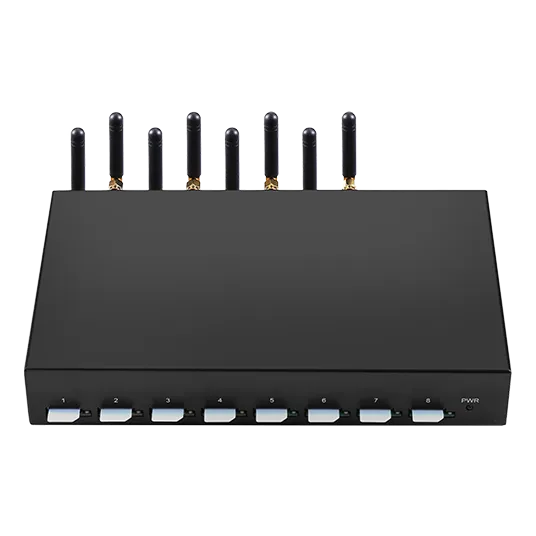
Where the deployment uses SIM pool or SIM bank hardware, rotation becomes an operational routine rather than a manual task, and the reassignment of a card between slots is recorded. That record is what makes the policy auditable, and it is also what allows a pool to grow without a proportional growth in administration.
Signal quality and its effect on retries
Marginal signal turns one message into several attempts, and the attempts are visible to the network. A slot operating at the edge of coverage retries far more often than a slot with a clean link, and each retry is another submission associated with the same subscription. The operator sees a subscriber that sends repeatedly with irregular success, which is a pattern, not merely a volume.
The practical remedy is to fix the radio rather than to accept the retries. Antenna placement, cable routing and module position affect the retry rate, and a slot that is failing intermittently is worth investigating before the pool’s volume is raised. Two measurements make the case: the retry count per slot and the delivery ratio per slot. Where both are worse than the pool average, the problem is physical and local.
How do you detect a degrading number before it fails?
Watch the delivery ratio trend, not the failure count.
A number that is heading for trouble shows a slow decline in delivery ratio and a slow rise in retries several days before traffic stops, and both movements are visible in per-number data.
The reason a trend works where a threshold does not is that the network’s decision is cumulative. By the time failures are obvious the number has usually been degrading for some time, and intervening at the midpoint of that trend costs less than intervening after the block. Record the delivery ratio per number per day, plot it, and treat a sustained decline of any size as a reason to review that number’s volume rather than a reason to wait.
Two supporting signals are worth collecting. The first is the mix of failure reasons, since a change in the distribution precedes a change in the total. The second is the interval distribution, because compression of intervals is the earliest visible sign that a campaign is being pushed. Network-side refusal reasons are described with standardised cause codes, and ITU-T Q.850 is the vocabulary for discussing them with an operator.
Keep the record long enough to see the trend. Log retention practice for this kind of operational record is covered in NIST SP 800-92, which is a useful reference for deciding what to keep and for how long.
What no hardware feature can prevent
Hardware cannot prevent an operator’s commercial decision. No gateway feature changes what a subscription is permitted to do, and none removes the pattern that the network observes. What hardware can do is make the controls practical: enforce a ceiling, hold an interval, rotate cards on a schedule and record what happened.
The tempting alternative is to treat the block as an engineering problem and look for a setting that hides the traffic. That path has a ceiling that moves with each enforcement action, and it converts a manageable commercial risk into a regulatory one. The durable approach is the boring one: fewer messages per number, honest intervals, documented consent, and a pool large enough that losing one number is an inconvenience rather than an outage.
A policy template to record per market
Policy differs by market, so the template is the deliverable rather than the numbers inside it. Each row should record the market, the operator, the tariff, the confirmed permitted use, the internal per-number ceiling, the minimum rest window, the consent basis, and the review date.
The value of writing it down is that it makes the internal control auditable against the operator’s terms. When a number is withdrawn, a deployment with a written policy can show what it was sending and why, and the conversation becomes a review of the policy rather than a defence of the traffic. Where consent is the basis for sending, the European framework for electronic communications provides the reference point in the ePrivacy Directive, alongside national implementations that differ in detail.
Set the ceiling before the campaign, not after the block. Send your per-number volume plan and pool size to service@telarvo.com, or review the published configurations on the SK-SMS Gateway range and the SMS gateway solution page. Telarvo publishes the SIMBANK and SIMPOOL ranges on its product pages, and the configurations referenced above come from those listings.
FAQ
Can I unblock a blocked SIM?
Sometimes, through the operator rather than through the device. Reinstatement depends on the operator process and on whether the traffic is permitted on the tariff, so the practical first step is to establish why the number was actioned. A gateway can show what was sent and when, which is the evidence the conversation needs. Without that history the request becomes a general appeal rather than a specific case.
Is there a safe number of messages per SIM per day?
No universal figure applies, because the limit depends on the tariff, the market and the traffic pattern. The workable method is to run a number conservatively, watch its delivery ratio, and raise the rate in steps until the ratio moves. The ceiling you then hold is the one derived from observed behaviour rather than from a general rule. Review the ceiling whenever the traffic profile changes.
Does rotation reduce risk or just spread it?
A good rotation policy reduces risk, because it lowers the load and the continuity on every number in the pool. Spreading traffic across more numbers without lowering the per-number volume merely creates more numbers to lose. The control that matters is the per-number ceiling; rotation is what makes that ceiling practical to hold at scale. Cooldown periods and the retirement rule are what turn the ceiling into an operating policy.
What should we do when one number in the pool starts failing?
Reduce its volume and watch the delivery ratio for several days rather than replacing it immediately. A declining ratio that recovers after a rest indicates a load problem; one that continues indicates the number is likely to be withdrawn. Either way, record the sequence, because the trend is the evidence you will need. Retiring the card on a trend rather than on a failure keeps the change planned.