The smallest tier attracts two opposite mistakes. It is bought for a requirement that needs twenty channels and fails under load, or it is dismissed as a toy when it would have carried the deployment comfortably. Both mistakes come from the same place: nobody counted the simultaneous requirement before choosing.
This guide sets the boundary precisely. It covers what four channels can actually carry, how many SIMs a four-channel deployment needs, three scenarios that suit it and three that do not, and how the step to the next tier changes the operating model rather than only the capacity.
What can a four-channel device actually handle?
It carries four simultaneous calls or sends.
The ceiling is concurrency rather than volume, and the distinction determines whether four channels is generous or insufficient.
Four channels handles four conversations or four concurrent transmissions at any instant. Over an hour that represents a substantial number of short interactions and a modest number of long ones. The questions that decide suitability are therefore about concurrency and duration rather than about daily totals: how many interactions may overlap, and how long each occupies a channel.
Two reductions apply in practice. A channel is briefly occupied during teardown before it can be reused, and a channel whose SIM is re-registering is unavailable for the duration. Neither is a defect, and both mean the practical figure sits slightly below the nominal one. Where the requirement lands exactly on four, the deployment has no margin for either.
How many SIMs does a four-channel deployment need?
Enough to satisfy your per-number policy, not just four.
The device accepts one SIM per channel, and the estate may legitimately be larger where numbers are rotated.
Two configurations are possible. A fixed mapping, where each channel has its own SIM and never changes, which is the simplest arrangement and appropriate where the number does not need to rotate. And a rotating estate, where more than four numbers serve four channels, which requires an external SIM bank once the count rises beyond what the device holds.
The arithmetic that decides which applies is a division. Divide peak traffic by the maximum volume you are willing to place from one number: where the result exceeds four, the estate is larger than the device and an external SIM arrangement becomes necessary. Where it does not, the on-board slots are sufficient and simpler to operate.
A related consideration is identity. Where recipients should recognise the number, fixed mapping is the correct choice and rotation should be excluded. Where the number carries no meaning and load distribution matters more, rotation within the boundary of four channels is workable, and the SIMBANK128 at $1,600.00 provides the external capacity where the estate outgrows the device.
Which scenarios suit a four-channel unit?
Single-site notifications and integration testing.
The tier is correct more often than its reputation suggests, provided the requirement is stated in concurrency terms.
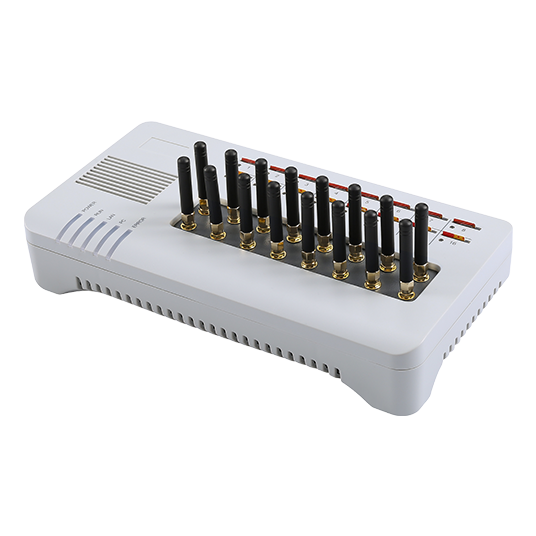
Three scenarios fit it well. A single-site notification flow where interactions are short and rarely overlap, such as appointment reminders for one clinic or delivery notices for one depot. A small outbound line where one or two people place calls and the rest arrive inbound. And an integration test position, where the deployment validates an API, a routing rule or a bundle configuration before the estate is purchased.
In each case the enabling condition is the same: the number of interactions that may overlap is within four, including the one in teardown. Where that holds, the device is not a compromise but the correct size, and the entry price of $100.00 for the GOIP1 or the model above it makes the tier inexpensive to adopt and inexpensive to outgrow.
Which scenarios do not?
High concurrency, number pools, or redundancy.
Three requirements exceed the tier regardless of how modest the daily volume appears.
High-concurrency calling is the first: a call centre where eight agents may be on external calls simultaneously needs eight channels, and the daily volume is irrelevant to that count. Number pools are the second: where traffic must be distributed across many numbers for policy or customer reasons, the constraint is the SIM estate rather than the channels, and the answer is a device with a different slot ratio rather than a smaller one. Redundancy is the third: a deployment that must not stop when one unit fails needs two paths, which means either a second device or a tier with spare capacity.
A fourth case belongs on the list because it is easy to overlook: any deployment whose requirement is expressed as never rejecting a call. A four-channel device rejects the fifth simultaneous caller, and rejection is a failure rather than a degraded state. Where that is unacceptable, the tier is wrong no matter how low the average load.
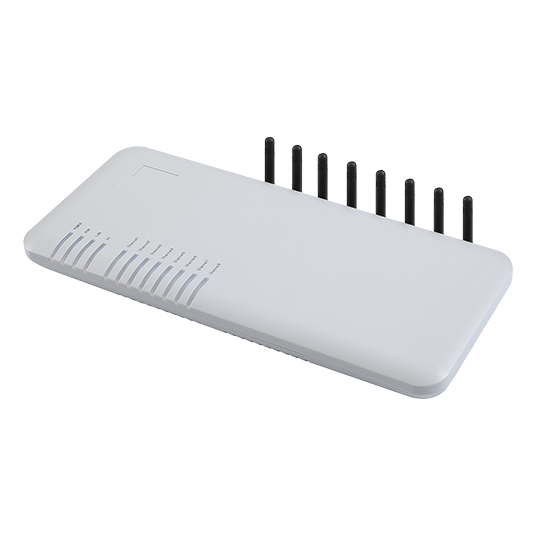
How does the step to eight channels change things?
It doubles the concurrent ceiling and adds a SIM decision.
The change is one of degree for capacity and one of kind for the SIM estate.
Eight channels doubles the simultaneous capability and, at published prices, costs $278.00 more than the single-channel entry point and less than the gap between two higher tiers. The operating model does not change: the same mapping strategy, configuration approach and acceptance tests apply. What changes is the SIM estate, because eight numbers require more management than four, and the point at which an external SIM arrangement becomes worthwhile arrives sooner.
The decision rule is the same division applied at a larger denominator. Where peak traffic divided by the per-number limit exceeds eight, the estate is larger than the device and the SIM layer should be planned separately. Where it does not, the on-board slots remain the simpler answer.
Where the requirement is uncertain, the higher tier defers the decision without changing any integration work, and the difference in entry price is smaller than the cost of replacing a device within a year.
What should the acceptance test cover?
Concurrency at the stated ceiling, and the failure paths.
A single successful message proves that the device works and nothing about whether the tier is correctly sized.
- Per-channel operation. Exercise every channel and confirm each carries traffic and reports it against the expected SIM.
- Concurrency at the ceiling. Drive the deployment to the number of simultaneous interactions the busiest hour requires, not to the average.
- Behaviour at the limit. Submit one more than the ceiling and confirm the refusal is clean and recorded rather than silent.
- Mapping accuracy. Confirm each channel uses the SIM the documentation says it does, because a mapping error changes which number a recipient sees without producing any error.
- Failure path. Remove a SIM from service and confirm the device reports the channel as unavailable rather than silently dropping traffic.
- Recorded baseline. Record the concurrency figure and the firmware version so a later comparison is between known states.
Item three is the one that answers the sizing question the purchase was meant to settle, because a clean refusal at the limit is a predictable behaviour while a silent drop is not. Item four is the one that catches the most common silent defect at this tier.
Where the deployment operates in a facility with an environmental specification, the guidance published by ASHRAE is the normal reference for the operating envelope, the environmental test standards published by the International Electrotechnical Commission cover the equipment side, and the ETSI standards catalogue covers the network side. The messaging behaviour behind the channels is specified by 3GPP.
What should be recorded for handover?
Channels, SIM ratio, mapping, and the test results.
The record is what makes a later fault diagnosable rather than traceable.
Five fields are sufficient. The channel count and the SIM estate in use. The mapping strategy, whether fixed or rotating, and the reason for the choice. The per-number policy the estate was sized against. The firmware version at acceptance. And the acceptance results, including the behaviour observed at the limit.
Recording the policy is the field most often omitted and the one that explains the estate size to whoever inherits it. An estate that looks oversized to a later engineer was probably sized against a policy that is no longer written down, and the omission invites the numbers to be reallocated for a purpose they were not sized for.
A final point concerns the software that drives the channels. Where the bundled tool is used, the channel count is a configuration parameter rather than a code change, and the same tool serves every tier in the range.
Where the deployment must reference a market or equipment framework, the ETSI standards catalogue covers the network and equipment side of the same requirement.
Conclusion
A four-channel device is correct wherever the simultaneous requirement fits within four channels plus teardown, and the requirement is a count of overlapping interactions rather than a daily total. It is the wrong choice for high concurrency, for number pools, for redundancy, and for any deployment that must never reject a caller, regardless of how modest the average load appears.
The step to eight channels doubles the ceiling without changing the operating model, and the SIM estate decision arrives sooner at the higher tier rather than differently. Sizing both the channels and the estate from a division rather than from a daily volume is what prevents the tier from being either over-purchased or discovered as insufficient, and the published entry points from $100.00 upward make the comparison inexpensive to test.
Count overlapping interactions before choosing the tier. Send your peak concurrency, per-number policy and redundancy requirement to service@telarvo.com, or review the published models on the GoIP gateway solution pages.
FAQ
How many messages can a four-channel GoIP gateway send per day?
The daily figure depends on how long each send occupies a channel and how the software paces the queue, so a channel count does not determine it. What four channels determines is that no more than four transmissions can be in progress at once. Measure your own throughput with a defined batch rather than extrapolating from a daily total.
Can a four-channel device use more than four SIM cards?
Not on board, but the estate can be larger than the device where numbers rotate or where a per-number policy limits each number. That requires an external SIM arrangement, which becomes worthwhile when the estate outgrows the on-board slots. The test is a division: peak traffic divided by the per-number limit, compared against four.
When should I move to eight channels instead?
When the number of interactions that may overlap exceeds four including the one in teardown, or when the deployment must never reject a caller. The higher tier doubles the ceiling without changing the mapping strategy, configuration approach or acceptance tests, and the entry-price difference is smaller than the cost of replacing a device within a year.
What is the most common defect at this tier?
A mapping error, where a channel uses a different SIM from the one the documentation specifies. It produces no error at all: traffic still flows, from an unexpected number. Verifying each channel against the mapping record, rather than confirming that messages send, is the acceptance test that catches it.