Fixing SIM blocking on a 4G GSM gateway starts with one question: which of four causes is this? A blocked number rarely announces itself. The radio still shows registered, the console still lists the card, and the first real symptom is a queue that stops draining or an integration partner asking why verification codes stopped arriving.
By that point, the useful question is not how to force a card back into service. It is how to tell a carrier-side suspension apart from an account problem, a traffic-pattern problem or a hardware fault, because only three of those are inside your control. This guide sets out a fifteen-minute diagnostic order, the per-SIM fields that separate the causes, and the levers a messaging operator can legitimately change: pacing, rotation policy and volume per number.
What does a SIM block actually mean on a 4G GSM gateway?
A SIM block is a carrier action against one number.
The network refuses to carry traffic for that subscriber while the gateway continues to report the card as present and registered, so the fault looks like silence rather than an error.
Understanding who imposes the block explains why device-side remedies usually fail. Short message delivery depends on the carrier’s short message service centre, standardised in ETSI TS 123 040 and its 3GPP equivalent 3GPP TS 23.040. When a subscription is suspended, the suspension lives in the operator’s systems. The gateway keeps doing what it did the minute before: it attaches and reports state.
Attachment itself is a separate layer again, governed by the bearer and session behaviour described in ETSI TS 123 018. That is why the symptom appears as a delivery problem at the application layer rather than a connectivity problem at the device layer. Messages submitted over SMPP or the HTTP API receive no delivery receipt, or receive one with a failure status, while signal strength and registration look normal. An operations team that only monitors device health will see a healthy installation and a shrinking delivery rate at the same time.
Number formatting is a related trap. Subscriber numbers are structured under the ITU-T E.164 numbering plan, and a gateway log that stores destination addresses as free text rather than normalised numbers makes it far harder to group the failures that actually share a cause.
Which four causes can you verify in fifteen minutes?
Most suspensions trace to traffic pattern or account state.
Four checks cover volume per number, sending behaviour, the operator’s view of the account, and the physical path between the card and the radio module.
The order matters, because the cheap checks eliminate the expensive ones. Start with what the number has actually sent in the last 24 hours, then look at how it sent it, then confirm the account state with the operator, and only then disturb the hardware. A card that has sent at a steady rate for weeks and stops abruptly is a different case from one pushed to a volume ceiling in an hour.
| Cause | What you observe | How to verify | What it usually means |
|---|---|---|---|
| Volume per number | Delivery stops after a sustained burst on one SIM | Export per-SIM submitted and delivered counts for the last 24 hours | The number carried more traffic than its profile supports |
| Sending behaviour | Failures cluster on one number while the pool is healthy | Compare inter-message intervals and repeat destinations for that SIM against the pool average | The pattern, not the volume, triggered the response |
| Account state | Registration succeeds, no traffic moves, receipts are absent | Check balance, plan status and any notice from the operator for that subscription | A commercial or account action sits behind the block |
| Hardware path | One slot behaves differently from every other slot | Move the same card to a second slot, then a second known-good card into the original slot | Slot, holder or module fault rather than a network action |
Two of those four rows are yours to fix. The other two are information you need before you spend engineering time on a card the operator has already decided about.
How do you check per-SIM state from the device console?
Read registration, signal and session counters per SIM.
Device-level status hides the SIM that is failing, so the console view has to be read at the slot level, and the last successful send matters more than the current signal reading.
A console exposes several layers of state, and only some are useful here. Radio state tells you whether the module is attached. Signal strength tells you whether the link is marginal. Neither tells you whether the operator will accept the next message. The fields that carry diagnostic weight are the per-SIM counters: messages submitted, messages delivered, failed attempts, and the timestamp of the last successful delivery.
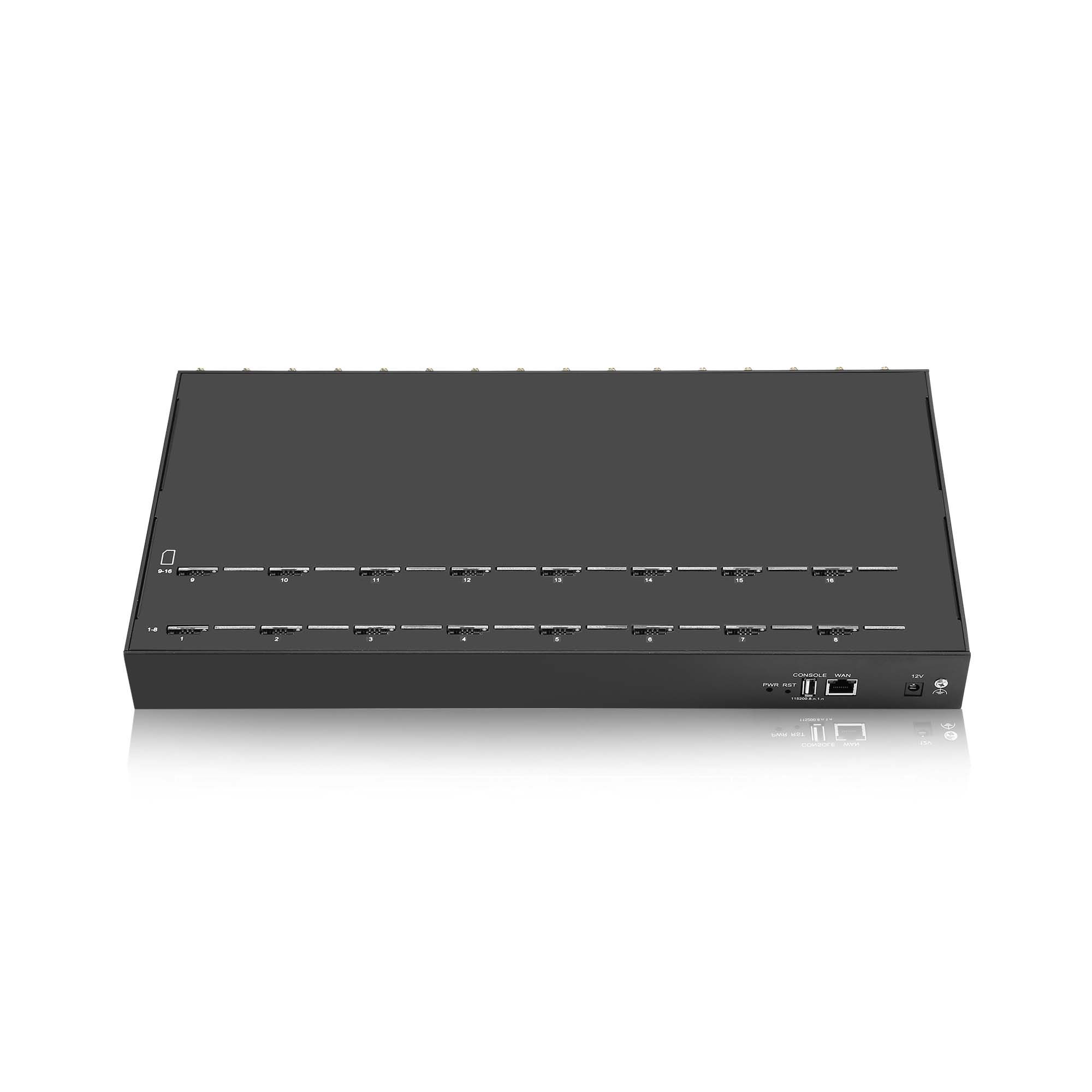
Where a platform logs per-message status with carrier latency and retry counts, that record becomes the primary evidence. The SK-SMS Gateway range, for example, ships with a web management interface and API access that log message-level status; the SK-SMS Gateway 16-16 is listed at $645, and the family runs from the 4-4 at $238 to the 64-64 at $1,880. The practical point is not the ladder but the logging layer: without a per-message record, a suspension and a queueing problem look identical from the outside.
Read the counters in this order: last successful delivery per slot, failed attempts per slot, then signal. A slot whose last delivery is hours old while its neighbours delivered a minute ago is a candidate for the swap test below, not for a signal-optimisation project.
Is this a carrier action or a device fault?
Move the SIM to another slot and watch what happens.
If the problem follows the card, the card or its subscription is implicated; if the problem stays with the slot, the hardware path is implicated.
The swap test is the cheapest way to break the tie, and it needs to be run as two observations rather than one. First, move the suspect SIM into a slot that is known to be delivering. Second, put a SIM that is known to be delivering into the original slot. Run both before drawing a conclusion, and give each test enough traffic to produce a receipt, because a single message proves very little on a network that retries.
A fault that stays with the card, combined with normal account state, points to a carrier-side action and moves the conversation to the operator. Network-side release reasons are standardised, and the ITU-T Q.850 cause codes are the vocabulary your operator’s support team will use when they describe why a request was refused. A fault that stays with the slot, or that appears in the module, is an engineering problem you can act on with a spare slot, a replacement card holder or a service request. Where the gateway carries a warranty, open that conversation early rather than late.
One outcome deserves a separate label: the card that delivers in another device but not in the gateway. That pattern usually reflects an account-level limit tied to the device profile rather than a hardware fault, and it is the case where an hour of module swapping produces nothing.
What can you legitimately change to fix SIM blocking on a 4G GSM gateway?
Change pace, rotation policy and volume per number.
These three levers determine how much traffic one number carries and how much breathing room it gets between messages, and they are the only ones that stay inside the operator’s terms.
Pacing is the first lever. A pool that submits into the gateway as fast as the application can write, then relies on internal queues to smooth the traffic, has no real control over the interval between messages on any single SIM. Interval control has to be expressed per SIM and enforced before the queue, not inside it.
Rotation policy is the second. Spreading traffic across more cards lowers the load on each one, but only if the rotation is even and if every card in the pool is genuinely able to send. A pool of twenty cards where four carry ninety per cent of the traffic behaves like a pool of four, with sixteen spares that add cost and no capacity.
Volume per number is the third. A per-number daily ceiling, agreed internally and enforced by the platform rather than by memory, turns an invisible constraint into a visible one. Where a deployment includes SIM bank or SIM pool hardware, the release and reassignment of cards becomes an operational routine rather than a manual intervention, which is what makes a ceiling practical to hold.
| Control | What it changes | Direction to move first |
|---|---|---|
| Inter-message interval per SIM | How one number looks over time | Raise the interval before adding cards |
| Rotation spread | Load carried by each card in the pool | Even out delivery counts before increasing pool size |
| Per-number daily ceiling | Worst-case load on a single subscription | Set the ceiling from observed delivery, then hold it |

What you cannot change, and should not attempt
You cannot change the operator’s decision, and you cannot change the identity of a card without stepping outside both the operator’s terms and, in most markets, the law. Altering the device identity a network sees is not a configuration option; it is a different regulatory category, and it carries consequences that no messaging business should take on for the sake of delivery throughput. The same applies to any technique whose purpose is to defeat a control the carrier has deliberately applied.
This matters commercially as much as legally. Bulk messaging, SIM-based routing and termination are regulated differently across jurisdictions, and several carriers block traffic that arrives by routes outside their commercial agreements. A deployment whose performance depends on remaining undetected has no floor under it: a single enforcement action resets delivery rates, customer relationships and hardware utilisation at once. The practical alternative can show an operator, on request, what it sends, to whom, with what consent and at what rate.
Scope note: this section describes engineering and commercial boundaries, not the licensing position in any particular market. Confirm the applicable rules with the operator and the regulator for each country you send into.
Building a per-number health log
A per-number health log turns a suspension from an event into a trend, and the fields that matter are few. Record the date, the SIM slot, the number in normalised form, messages submitted, messages delivered, the delivery ratio, the interval distribution, and the timestamp of the last successful receipt. Six weeks of that record answers the question every operator conversation eventually reaches: what changed, and when.
Keep the log per number rather than per device. Device-level totals hide exactly the pattern that precedes a suspension, and they cannot be compared with the operator’s own view of a subscription. Where the platform exposes API logging, export the raw records on a schedule and keep them beyond the retention window of the interface, because availability investigations usually begin weeks after the event. If you need a reference for what an audit record should contain, the control families in NIST SP 800-53 Rev. 5 are a reasonable starting point even outside a regulated environment.
| Field | Why it matters | Granularity |
|---|---|---|
| Normalised number | Groups failures that share a cause | Per subscription |
| Submitted and delivered counts | Separates a queue problem from a block | Daily, per number |
| Interval distribution | Shows the pattern, not just the volume | Per number, rolling 24 hours |
| Last successful receipt | Dates the change precisely | Per number, to the minute |
| Slot assignment | Separates a card fault from a slot fault | At every change |
When should a card be retired rather than reinstated?
Retire a card once reinstatement fails twice.
Two failed reinstatement attempts across separate incidents is the practical threshold, because each attempt costs operator goodwill and a third attempt rarely changes the outcome.
Retirement has a commercial tail. Moving the volume to a fresh number preserves the route, but the new number starts without history, and if it is pushed to the previous card’s peak within a day it will follow the same path. Bring a replacement in at a conservative pace, hold it there for the first week, and only then let it take a share of the pool’s load.
Keep the retired number’s log. It is the evidence base for two later decisions: whether the pool size is adequate for the traffic profile, and whether the operator relationship needs a commercial conversation rather than an operational one.
Before you retire cards, confirm what the platform actually records. Send your port count, SIM count and current per-number interval to service@telarvo.com, or review the published configurations on the SK-SMS Gateway range and the SMS gateway solution page. Telarvo publishes the SIMBANK and SIMPOOL ranges on its product pages, and the configurations referenced above come from those listings.
FAQ
Can you unblock a SIM from the gateway itself?
No. A suspension sits in the operator systems, above your equipment, and no gateway setting removes it. The gateway can show you which number stopped delivering and when, and it can stop sending so the situation does not worsen, but reinstatement is an operator process. Treat the console as evidence rather than as a control, and keep the delivery history it produced for the reinstatement request.
How quickly does a block show up in the message logs?
Usually within minutes, because delivery receipts stop arriving rather than arriving with a failure status. If your platform records submitted and delivered counts per number, the gap appears in the counter comparison before anyone reads an error message. Teams that monitor only device health typically lose hours before noticing. Per-number delivery ratio is the metric worth alerting on, with a threshold set from your own baseline rather than from a general figure.
Does moving a blocked SIM to another gateway help?
Rarely. The suspension travels with the subscription, so a card that is blocked in one unit is normally blocked in the next. The swap test still has diagnostic value, because it distinguishes a card problem from a slot problem, but treat it as a test rather than a remedy and record the result for the operator conversation. A slot that fails with a working card is a hardware fault; a card that fails in a working slot is a subscription matter.
What should we keep as evidence when a number is suspended?
Keep the normalised number, the slot it occupied, the submitted and delivered counts for the preceding days, the interval distribution, the timestamp of the last successful delivery, and the operator notice if one was issued. That set is enough to show what the deployment did and to support either reinstatement or a commercial discussion. Add the tariff reference and the name of the person who confirmed the permitted use, because the conversation usually turns on both.