Verification traffic is the one workload that punishes a capacity plan twice. It arrives in unpredictable spikes, and every code that is late generates a second attempt, so the peak grows because of the delay it caused.
This article sets out how verification traffic breaks capacity plans built on averages, how to derive capacity from the peak signup rate, why latency rather than throughput is the metric to hold, and how to design the redundancy and fallback that keep a signup flow moving.
Why do verification traffic patterns break capacity plans?
Because the peak is partly created by the system.
A delay causes users to retry, and each retry adds load to the peak that produced the delay, so a plan built from the arrival rate understates the load the estate has to carry.
Three properties compound it. Verification arrivals are bursty, following marketing activity, product launches, app updates and time of day. The window is short, so the estate has to deliver the peak rate within seconds rather than smoothing it across an hour. And the retry amplification is proportional to the delay, which means a deployment that is slightly undersized degrades faster than the arithmetic suggests.
The practical implication is that a verification estate needs headroom as a design decision rather than as a margin at the end. The headroom figure should be derived from the retry behaviour observed at the measured peak, which makes it a measurement rather than an estimate. The message framework that carries the traffic is defined in ETSI TS 123 040 and 3GPP TS 23.040.
| Input | Where it comes from | Why it moves the plan |
|---|---|---|
| Peak signup rate | Busiest minute in a representative week | Sets the required delivery rate |
| Retry amplification | Measured from the same logs | Grows the peak when delivery is slow |
| Delivery window | Product decision | Converts volume into a rate requirement |
| Per-SIM rate | Measured on the operators in use | Converts the rate into an estate size |
| Headroom | Derived from amplification and cover | Covers a port or a route being unavailable |
How do you derive capacity from the peak signup rate in large-scale app verification SMS setup?
Multiply the peak by the amplification, then divide.
Divide the effective peak per minute by the measured per-SIM completion rate, then add headroom for retries and for a port out of service.
The calculation is short, and its two inputs are both measurements rather than assumptions. The peak signup rate comes from the application log at the busiest minute of a representative week, and the amplification figure comes from counting retries per unique request in the same window. Where the amplification is unknown, it is worth measuring deliberately: force a short delay in a staging environment and count the retries, which produces a figure that can be used in the plan.
The per-SIM rate is the second input and the one most often assumed. It depends on the operator and the tariff, and it varies by market, so it should be measured per market rather than taken from a specification. The interface that exposes per-slot state and rates is standardised in ETSI TS 127 005, and the resulting estate size should be recorded with the measurements that produced it.
Why is latency the metric that matters?
Because the flow abandons a code that arrives late.
Throughput describes how much the estate can deliver; latency describes how quickly a user gets a code, and only the second one is visible to the signup flow.
That distinction changes what is monitored. A deployment that watches queue depth sees a busy system, while the users see a slow one, and the two can diverge for reasons that queue depth does not explain: a route that has slowed down, a destination network that is accepting more slowly, or a pacing policy that is too conservative for the moment. The useful measures are the delivery time distribution per destination area and the completion rate of the verification flow, because both are visible to the user.
Recording the distribution rather than the average is what makes it actionable. A median of two seconds with a ninety-fifth percentile of forty seconds describes a flow that most users complete and a minority abandon, and the minority is the part the support desk hears about. Reference points for delay in speech applications, such as ITU-T G.114, are not applicable to messaging, and it is worth being explicit about that rather than borrowing a voice threshold.
Redundancy for the verification path
Two independent routes, and the queue above both.
A verification path fails in three ways: the estate, the connectivity and the operator relationship, and each needs its own answer.
Estate redundancy is the simplest and the least useful on its own, because a second unit on the same operator does not survive an operator problem. Route redundancy — a second operator, or a cloud path — addresses the failure that actually takes a verification flow down, and it is what most deployments should design first. The queue has to live above the paths so that a failure leaves the work where the surviving path can collect it, and submissions in flight have to be suppressed for duplicates during a switch.
The switch should be triggered by evidence rather than by a timer alone. A timer that fires while the primary path is still delivering produces unnecessary routing changes; a trigger based on the delivery time distribution responds to the condition users are experiencing. Where both are used, the timer should be the backstop and the distribution the primary signal. The subscription states involved after a switch are defined in 3GPP TS 24.301.
Fallback channels and their sequencing
The sequence should be decided before the first incident.
A verification flow can fall back to a second messaging route, to a voice call or to a retry on the same route, and the sequence determines both the customer experience and the load.
Three questions settle the sequence. How long the user is willing to wait before a different channel is worth trying. Whether the alternative channel reaches the same population, since a voice fallback does not help a user whose handset cannot receive calls, and a data-based channel does not help one who is offline. And what each channel may authorise, because a weaker channel should not be given the same weight as a code in a high-value flow. Guidance on how different factors are classified is set out in NIST SP 800-63B.
Where a second route is used, the resend must be suppressed for messages that already arrived. That requires the institution’s own request identifier on every submission, and it is the same identifier the reconciliation job uses, which is why generating it in the application rather than accepting one from a device is worth the small effort.
Recording the model with its inputs is what makes it usable later. A capacity figure without the peak rate, the amplification factor and the measured per-SIM rate behind it cannot be re-checked when the product changes, and the re-check is the moment the model earns its place. Keep it with the deployment record rather than in a project file.
Numbers, sender identity and abuse handling
Verification traffic attracts abuse, and the controls are economic.
Because each verification message costs money and reaches a number the requester supplies, a signup form is a target, and the estate is what absorbs the cost.
The controls that work are the same ones that apply to any messaging estate, applied at the form rather than at the gateway. Rate limiting by source and by destination prefix removes the ability to generate volume quickly. A check that costs the requester something raises the price of each attempt. And a completion measure — how many of the codes sent were actually used — is the signal that separates an attack from a busy day, because pumped traffic has almost no completion. The numbering conventions that make prefix-level analysis possible are described in ITU-T E.164.
The sender identity belongs in the same design. A verification message from an identity the user does not recognise is more likely to be reported as spam, and reports affect the whole estate. Consistent identity, a message that states the action rather than a link, and a record of what was sent are the three controls that keep a verification channel in good standing, and record-keeping practice for the logs involved is covered in NIST SP 800-92.
A capacity model
The model derives the capacity a verification flow needs from the peak signup rate and the amplification that retries and fallbacks add. Each input is a measurement from the application rather than an assumption, and the output is a rate the deployment has to sustain rather than a port count.
- Peak signup rate: verifications requested per minute at the busiest minute of a representative week.
- Retry amplification: retries per unique request in the same window.
- Effective peak: the peak multiplied by the amplification.
- Per-SIM rate: measured per market on the operators in use.
- Estate size: effective peak divided by the per-SIM rate, plus a defined headroom share.
- Latency target: the delivery time by which the flow must complete, with the distribution recorded rather than the average.
- Fallback: which route, triggered by what evidence, and how quickly.
- Abuse controls: the ceiling and velocity limits applied, and the completion measure used to detect an attack.
The model produces a plan that can be re-run as the product grows, which matters because verification volume in a growing application changes faster than hardware is replaced. Re-running it after each significant change to the signup flow is cheaper than discovering the new peak during a launch.
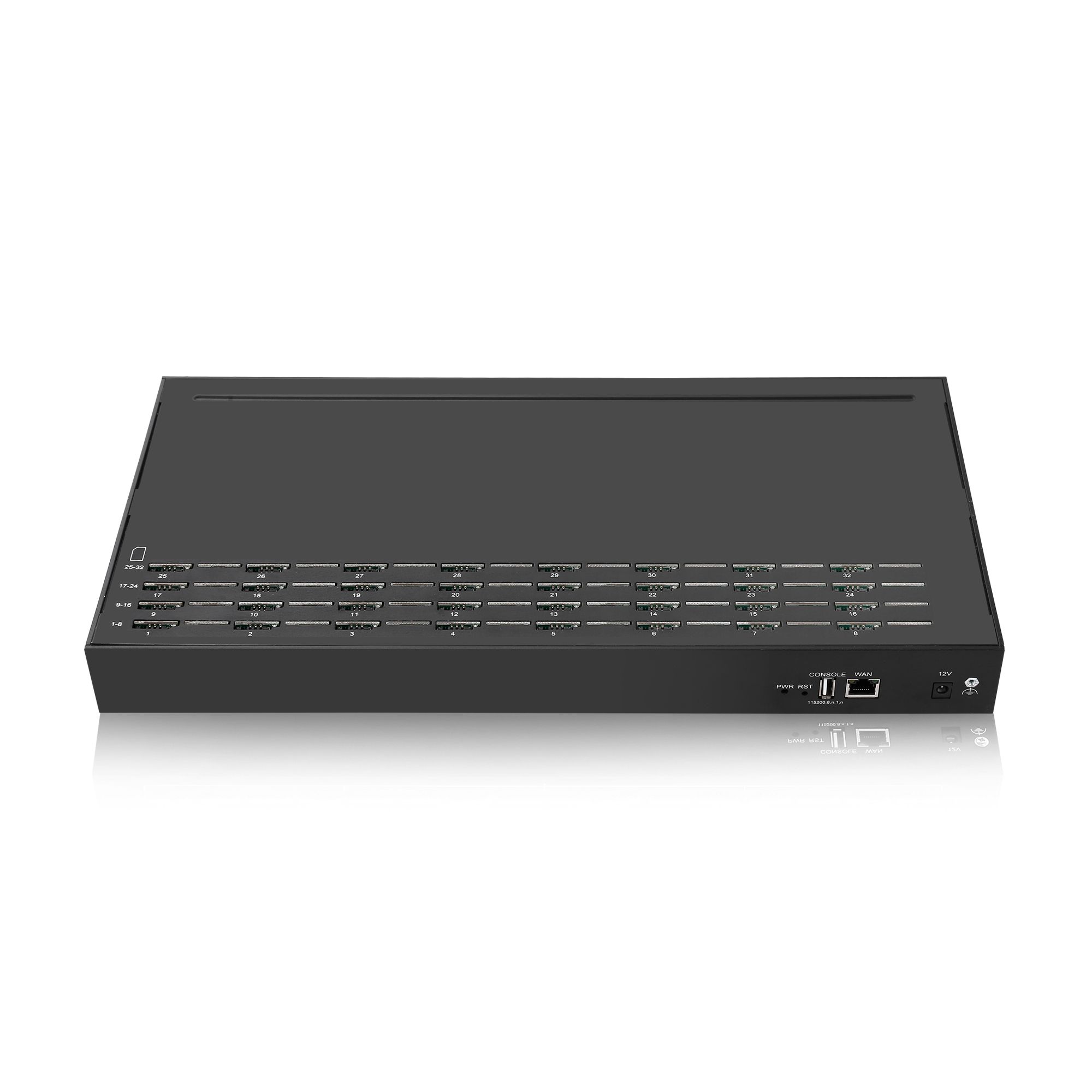
Plan from the effective peak, and watch latency rather than depth. Send your peak signup rate, retry factor and latency target to service@telarvo.com, or review the published configurations on the SK-SMS Gateway range and the SMS gateway solution page. Telarvo publishes the SIMBANK and SIMPOOL ranges on its product pages, and the configurations referenced above come from those listings.
FAQ
Is an SMS API free for verification?
Free paths exist and are not suitable for production verification, because they offer no delivery commitment, no per-message record and no commercial relationship behind the route. What a verification flow needs is a predictable rate at the peak and a record that can be reconciled afterwards, and neither is available from a free service. The requirement is evidence as much as capacity.
How many ports does a large-scale verification service need?
The answer comes from the effective peak divided by the measured per-SIM rate, with headroom added. There is no useful rule of thumb, because the per-SIM rate varies by market and the amplification factor depends on the flow. Run the calculation with measured figures rather than adopting a port count. Re-run it when the flow or the market changes. Keep the calculation with the deployment record so that a later capacity question starts from evidence.
Why did verification resend and duplicate a code?
Usually because a retry was issued while the first submission was still in flight and its outcome unknown. Retries should be triggered only after the previous attempt has definitively finished, and submissions with unknown outcomes should be parked rather than resent, so that the customer receives one code per request. The retry rule belongs in the integration design. Record the retry rule in the integration documentation, because it is the item most often changed without review.
Should verification share the estate with campaign messaging?
It can share hardware and should not share a queue or a routing policy. A campaign occupying the queue delays codes, and the delay triggers retries that make the peak worse. Reserve capacity, or a separate path, for verification traffic and treat the separation as part of the design. Test the separation during a real campaign rather than in a quiet period.
{
“@context”: “https://schema.org”,
“@type”: “FAQPage”,
“mainEntity”: [
{
“@type”: “Question”,
“name”: “Is an SMS API free for verification?”,
“acceptedAnswer”: {
“@type”: “Answer”,
“text”: “Free paths exist and are not suitable for production verification, because they offer no delivery commitment, no per-message record and no commercial relationship behind the route. What a verification flow needs is a predictable rate at the peak and a record that can be reconciled afterwards, and neither is available from a free service. The requirement is evidence as much as capacity.”
}
},
{
“@type”: “Question”,
“name”: “How many ports does a large-scale verification service need?”,
“acceptedAnswer”: {
“@type”: “Answer”,
“text”: “The answer comes from the effective peak divided by the measured per-SIM rate, with headroom added. There is no useful rule of thumb, because the per-SIM rate varies by market and the amplification factor depends on the flow. Run the calculation with measured figures rather than adopting a port count. Re-run it when the flow or the market changes. Keep the calculation with the deployment record so that a later capacity question starts from evidence.”
}
},
{
“@type”: “Question”,
“name”: “Why did verification resend and duplicate a code?”,
“acceptedAnswer”: {
“@type”: “Answer”,
“text”: “Usually because a retry was issued while the first submission was still in flight and its outcome unknown. Retries should be triggered only after the previous attempt has definitively finished, and submissions with unknown outcomes should be parked rather than resent, so that the customer receives one code per request. The retry rule belongs in the integration design. Record the retry rule in the integration documentation, because it is the item most often changed without review.”
}
},
{
“@type”: “Question”,
“name”: “Should verification share the estate with campaign messaging?”,
“acceptedAnswer”: {
“@type”: “Answer”,
“text”: “It can share hardware and should not share a queue or a routing policy. A campaign occupying the queue delays codes, and the delay triggers retries that make the peak worse. Reserve capacity, or a separate path, for verification traffic and treat the separation as part of the design. Test the separation during a real campaign rather than in a quiet period.”
}
}
]
}