A route that performs well in a spreadsheet can behave differently once it terminates on the network the recipient is actually attached to. That is the observation behind most local SIM projects, and it is also where most of them go wrong, because the decision is treated as a hardware purchase when it is really a site, carrier and measurement project.
A local SIM SMS gateway is not simply a cheaper version of a cross-border route. It changes which network originates the message, which changes what you can measure, what you must register, and what you must operate at the destination. This guide works through that chain in the order it appears in a deployment: what local termination changes, how to choose a carrier and meet registration requirements, what the site needs, how local and cross-border paths should coexist, and how to prove the result before you scale it.
What does a local SIM SMS gateway change about delivery?
It changes the originating network, not the message itself.
With local termination, the message enters the mobile network in the destination country rather than arriving as an inbound international message. That difference affects routing, cost structure, and how the receiving operator classifies the traffic.
The important discipline here is to separate mechanism from outcome. The mechanism is well defined: a message submitted through a SIM registered on a local network is handled as domestic-originated traffic by that operator. The outcome is not guaranteed by the mechanism, because delivery depends on the destination operator’s handling of application-to-person traffic, the sender identity in use, and the consent basis behind the message.
That is why any claim about improved delivery rates should be treated as a hypothesis to be measured in your own deployment rather than a property of the hardware. Local termination removes one category of risk — the treatment that inbound international traffic sometimes receives — and leaves the others in place.
What local termination reliably changes is visibility. Once you operate the origination point, you can see per-SIM registration state, per-message submission and delivery status, carrier latency and retry counts in your own console rather than inferring them from an aggregate report. For teams whose current problem is that they cannot explain a delivery failure to a customer, that visibility is often worth more than the routing change itself.
Two constraints come with it. First, you inherit the operational responsibilities of a local presence: SIM acquisition, registration, site power and connectivity. Second, you inherit the obligations that attach to sending commercial messages in that market, which are the destination’s rules rather than your own.
How do you choose a carrier and meet registration requirements?
Start with coverage, then registration, then price.
Coverage comes first, because a SIM that registers reliably in your equipment room is worth more than a cheaper one that does not. Test it inside the enclosure, not in the corridor outside.
Registration is the second filter, and it is the step that most often delays a project because it depends on a third party. Requirements vary by market and they change. In some countries, registration is tied to the end user of the SIM; in others, obligations attach to the entity sending commercial traffic or to the sender identity presented to recipients. Where a national regulator publishes the applicable framework, that publication is the authoritative source: the Telecom Regulatory Authority of India is one example of a regulator that publishes subscriber and commercial-messaging requirements in detail, and the ITU Telecommunication Standardization Sector publishes the numbering and signalling standards that national frameworks reference.
The third filter is commercial: what the carrier permits for the traffic you intend to send. Operators differ in how they treat application-to-person messaging and in what they require of senders, and those policies change. Ask the question directly, in writing, and keep the answer — a documented carrier position is far more valuable during an incident than an assumption made at procurement time.
Numbering deserves a mention because it is a registration artefact. International mobile numbers are assigned under the ITU E.164 numbering plan, and the number a recipient sees should match a sender identity you can actually defend. If the sender identity and the registered owner of the SIM diverge without documentation, that gap becomes the first question in any complaint.
What site conditions does a local SIM deployment need?
Coverage, stable power and a network path you control.
A local deployment is judged by its worst hour rather than its average, and the three site conditions below are the ones that produce the worst hour.
Radio coverage at the installed position. This is the single most common cause of a local deployment that underperforms its pilot. Signal quality varies within a building, and a device in a metal cabinet or a basement plant room can register while still delivering unreliably. Decide the mounting position deliberately, verify it with the actual device rather than a phone, and record the observed registration and signal state per SIM as a baseline.
Power continuity. A gateway that loses power loses its queue, and a message that disappears during a restart is indistinguishable from a message that was never sent unless the device reports it. Where the delivery commitment does not tolerate that, the deployment needs power protection sized to the length of outage you claim to survive.
Thermal conditions and continuous operation. Equipment that runs continuously in a warm room behaves differently from equipment tested for an hour. The environmental expectations you write into a specification can reference the thermal guidance published by ASHRAE for data processing environments, and the mechanical and environmental standards published by the International Electrotechnical Commission.
Network and administrative access. The device needs an outbound path to the carrier network and a management path for your team. Define which one may fail. Where the site is not yours — a partner office or a hosted facility — confirm both in writing before shipping hardware, because the most expensive local deployment is the one that arrives at a site where the management path was never agreed.
How do local SIM routes and cross-border routes combine?
Keep both paths live and split the traffic deliberately.
The choice is not binary. Treating it as one produces either stranded hardware or over-reliance on a single route, and both are avoidable at design time.
A practical division assigns high-frequency, regularly recurring traffic to local termination, where the cost per unit falls with volume and the traffic pattern is predictable. Cross-border or provider routes take the remainder: campaigns with a short life, markets you have not yet entered, and the overflow that occurs when local capacity is saturated. The point of keeping both live is continuity; a local deployment that cannot fail over to another path has converted a routing improvement into a single point of failure.
Two operational rules make the combination work. First, define the overflow condition in advance — queue depth, delivery failure rate, or a manual decision — so that switching is a documented behaviour rather than an improvisation during an incident. Second, keep routing decisions in your application rather than in the device, so that the same logical send can be directed to either path without changing the caller.
The regulatory dimension belongs in this section as well, because the two paths do not carry identical obligations. Industry guidance on consent, sender identification and opt-out handling, such as the material published by M3AAWG, applies to the message rather than to the route, and it does not become lighter because the traffic originates locally. If anything, operating the origination point makes the obligation more visible, because the sending infrastructure is now traceable to your organisation.

How do you manage gateways across several countries?
Standardise what you can, and localise only what you must.
A multi-country deployment fails in one of two directions: it either standardises so aggressively that local realities break the configuration, or it localises so freely that no two sites are comparable. The workable middle is a standard hardware and software baseline with a small, documented set of local variables.
The standard layer should cover the device model and firmware version, the API contract your application uses, the naming convention for SIMs and slots, and the alarm thresholds that trigger an alert. Standardising these makes a site comparable to every other site and lets a single operations team cover many locations.
The local layer contains what genuinely differs: the carrier and its coverage profile, the registration requirements and the evidence you hold, the sender identity used in that market, and the site contact who can physically intervene. Keep these in one document per market, and make the carrier’s written position on your traffic one of the fields.
Two practices make the difference at scale. The first is centralised log collection: export each site’s delivery records to one store so that a performance question can be answered across markets rather than one console at a time. The second is a single SIM inventory that knows where each number is, what it is used for, and when it was last seen active. Where a deployment holds hundreds of locally registered numbers, that inventory is the artefact that prevents numbers from being lost, duplicated or reused without authorisation.
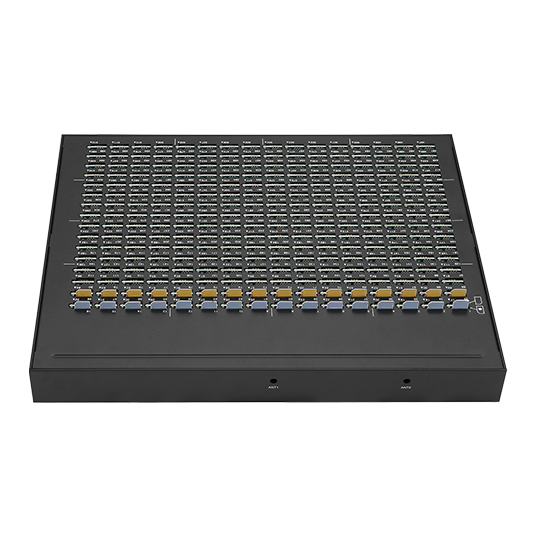
For deployments whose SIM estate outgrows the device, centralising the SIM layer is the usual next step. The published SK SIMPOOL range provides integrated SIM storage from 128 slots at $1,800.00 to 512 slots at $5,400.00, with compatibility stated for the SK gateway range, which allows the radio equipment to sit where coverage is good while the SIM estate sits where access is controlled.
What does local SIM infrastructure cost compared with cloud routes?
Compare fixed local cost against variable route cost.
Local deployment converts a per-message charge into capital, supply and operational effort; the crossover depends on the volume you route through it.
What makes local termination different is that part of the benefit is not financial, which means a purely cost-based comparison can mislead.
| Component | What it covers | Source of the figure |
|---|---|---|
| Gateway capital | Device at list price for the port and SIM configuration chosen | Published list price, for example SK-SMS Gateway 16-512 at $1,160.00 |
| SIM layer | SIM acquisition, registration and replacement in the destination market | Your carrier or SIM supplier in that market |
| Site | Rack or cabinet space, power, cooling and connectivity at the local site | Your facilities cost model for that location |
| Operations | Monitoring, incident response and SIM logistics in local time | Measured effort at your loaded cost per hour |
| Alternative path | The cross-border or provider route kept live for overflow and continuity | Your existing route rate card |
The row most often omitted is the last one. A local deployment that keeps a provider route available for overflow carries both cost structures, and that is a deliberate design choice rather than a failure of the business case: the alternative path is what makes the local capacity safe to depend on.
Where the local route competes on price alone, the crossover is a division: the local fixed cost divided by the difference per message between the two paths gives the volume at which the local deployment is cheaper. Where the local route competes on visibility and on the treatment of domestic traffic, the comparison needs a second column for what the current path cannot currently tell you. Regional connectivity and mobile market data from the ITU-D statistics programme are a reasonable starting point for understanding how markets differ, and trade coverage such as RCR Wireless News reports on how operators approach this traffic, but neither replaces your own measurement.
Which tests should a local SIM deployment pass before go-live?
Measure the local path against the one it replaces.
Run the same message set through both paths at the same time of day and compare the results. The purpose is to replace a claim about local termination with evidence from your own deployment.
- Registration and coverage baseline. Record the registered network and observed signal state for every SIM at the installed position.
- Side-by-side delivery comparison. Send an identical set through the local path and the existing path, and compare delivery outcomes message by message rather than in aggregate.
- Latency distribution. Record the time from submission to delivery for both paths, and look at the tail rather than the average, because the slowest decile is what customers notice.
- Inbound behaviour. Confirm that replies arrive and that they can be matched to the originating conversation on the local path.
- Overflow behaviour. Saturate the local capacity deliberately and confirm that traffic moves to the alternative path as documented.
- Restart and power event. Confirm what happens to queued messages during a restart, and that the device recovers without manual intervention.
- Compliance evidence. Confirm that the registration records, the sender identity used and the carrier’s written position on the traffic are all held in your documentation.
Test two is the one that decides whether the deployment should scale. If the local path does not outperform the existing path on your own traffic, the case for expansion rests on visibility, cost or control rather than on delivery — and that is a legitimate case to make, provided it is the case you are actually making.
Conclusion
Local termination changes the originating network, and it changes what you can see. Neither of those is the same as a guaranteed delivery improvement, and the deployments that scale are the ones that measured the difference on their own traffic rather than accepting it as a property of the hardware. The prerequisites are unglamorous and decisive: coverage verified at the installed position, registration completed with evidence, power and thermal conditions that match continuous operation, and a management path agreed in writing.
The architecture that holds up under growth keeps both paths alive. Local capacity carries the predictable, recurring traffic; a provider route absorbs campaigns and overflow; the application decides which path a given message takes. Within the local estate, the SIM layer deserves as much design attention as the radio layer, because it is where numbers, identities and registration evidence accumulate. The published capacity steps run from 128 SIM slots at $1,800.00 to 512 SIM slots at $5,400.00 in the SIMPOOL range, and from 4 SIM slots at $238.00 to 512 SIM slots at $2,480.00 across the SK-SMS Gateway range.
Size the local estate against the traffic you actually route. Send the destination markets, expected monthly volume and the ports or SIM slots you need to service@telarvo.com, or review the published configurations on the SMS gateway solution pages.
FAQ
Is there a free way to run a local SIM SMS gateway?
Not for production traffic. SIM acquisition, site power and monitoring all carry a cost, and free tiers and open-source stacks address software only. They are useful for validating an integration before hardware arrives, but a deployment that sends commercial messages needs a registered sender identity, a carrier position you can evidence, and a delivery path you can support on the day it fails.
How do I find the gateway address for a local SIM deployment?
In a self-hosted deployment the address is one you assign. The device receives a private address on your management network, and the API endpoint your application calls is either that address or a published endpoint on your own infrastructure. For inbound callbacks the gateway needs a reachable route to your application, which is why the management path and the application path should be designed together rather than separately.
Does local termination remove the need for consent and opt-out handling?
No. Consent obligations attach to the message and the sender identity, not to the route it takes. Operating the origination point makes the sending infrastructure more directly traceable to your organisation, so the evidence requirement becomes more visible rather than less. Keep the consent record, the sender identity used and the carrier position documented per market.
How many SIM cards does one local deployment need?
Enough to distribute the traffic at the rate your carrier and your own policy permit per number, plus headroom for maintenance. This is a policy calculation before it is a hardware one: start from the maximum sending rate you are willing to apply to a single number, divide your peak traffic by it, and add spare capacity for SIMs removed from service. The published range from 4 SIM slots to 512 SIM slots covers most starting points.