One device carrying both proxy traffic and SMS is an attractive consolidation, because the SIM estate, the power and the rack space are already paid for. The difficulty is that both workloads use the same cellular channels, and the scheduling question that follows has no default answer.
This guide covers how the two workloads contend, how to prioritise between them, when the conclusion is physical separation rather than configuration, and how to size a combined deployment without discovering the limit in production.
How do proxy traffic and SMS contend for a channel?
They compete for the radio, asymmetrically.
A proxy session holds a connection for as long as the client needs it; an SMS transmission occupies the channel briefly but at a moment it cannot choose.
Three effects follow. A long-lived proxy session can occupy a radio for minutes or hours, during which an SMS submitted on the same port waits. An SMS burst can consume the radio at a moment when a proxy client expects low latency, producing a delay that the client reports as network instability. And a channel that is transmitting SMS may be briefly unavailable for data, not because the radio has failed but because it is busy.
The asymmetry matters because the two workloads measure different things. Proxy clients measure latency and throughput; messaging measures delivery time against a window. A deployment that satisfies one may violate the other without either measurement showing a fault, which is why contention on a combined device appears as an unexplained performance complaint rather than as an alarm.
How should priority be configured?
Reserve capacity rather than rely on scheduling.
Scheduling helps at the margin; separation solves the problem.
Two approaches work. Port reservation assigns a subset of ports to messaging and excludes them from proxy use, so messaging always has a radio available. Concurrency capping limits how many proxy sessions may run simultaneously, leaving headroom for SMS bursts. Both are configuration rather than equipment, and both are cheaper than the incident they prevent.
Where the device supports per-port policy, reservation is the stronger option because it makes the guarantee structural rather than statistical. Where it does not, concurrency capping is the fallback, and it should be set from measurement: raise the proxy concurrency until messaging latency begins to rise, then set the cap below that point and record it.
Whichever mechanism applies, the policy should be per port group rather than global, because messaging and proxy workloads rarely have the same requirement on every port. A device serving several customers will need several policies, and a single global setting will be wrong for most of them.
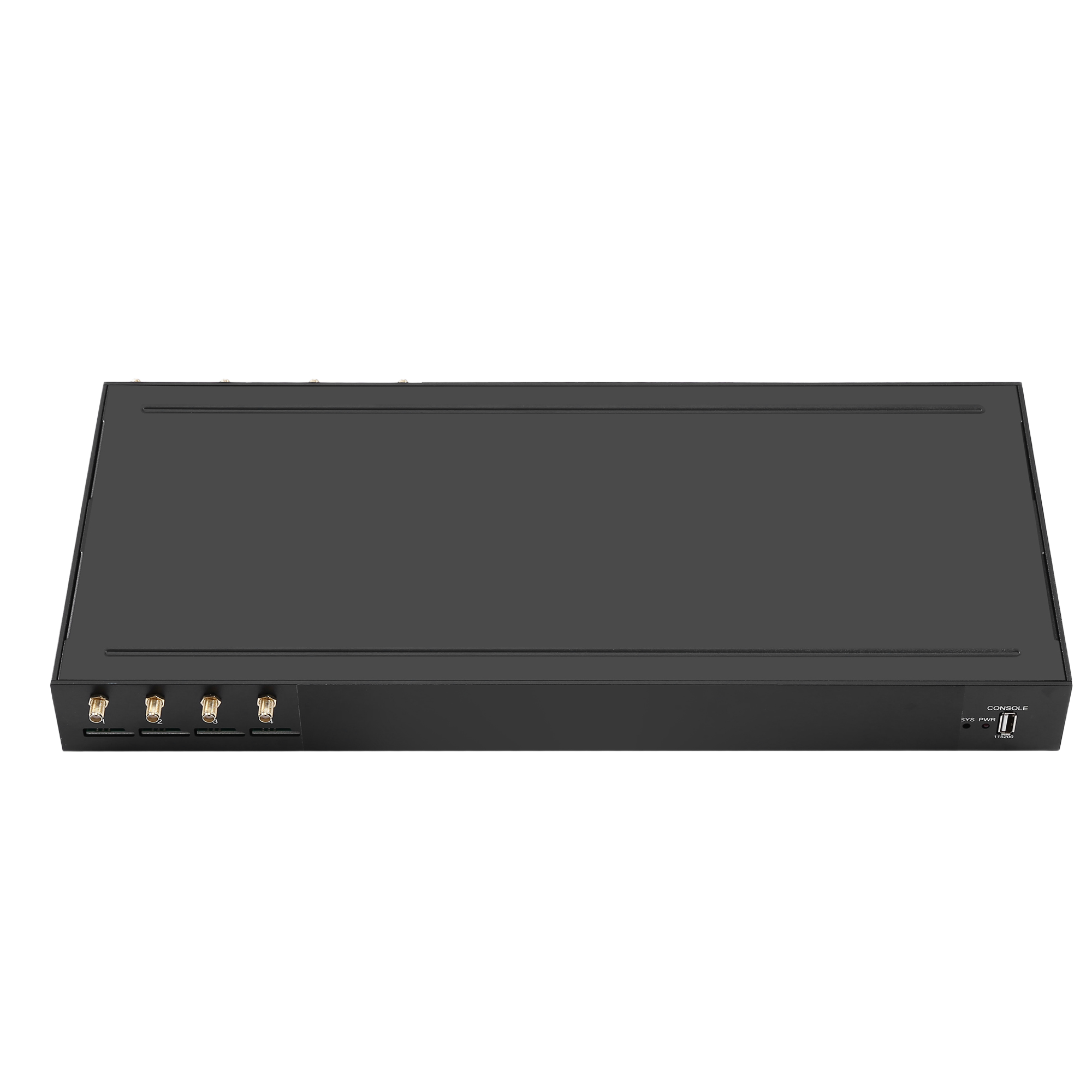
The published SK Multi-WAN models support both proxy functions and SMS send and receive, with configurations from four ports at $410.00 to sixteen at $1,380.00, and per-port configuration is what makes reservation practical on the larger tiers.
When should the two workloads be separated?
When either has a commitment the other can break.
Separation is the right answer more often than consolidation, because the cost of a second device is usually lower than the cost of a missed commitment.
Three conditions justify separate hardware. Where messaging has a published delivery window that proxy load could exceed. Where proxy latency is contractually measured and SMS bursts would appear in it. And where the deployment must be able to demonstrate, during an investigation, that one workload did not affect the other, which is difficult when both share a radio and a log.
Where those conditions do not apply, consolidation is reasonable, and the practical approach is to reserve ports rather than to separate. The decision should be revisited whenever either workload’s commitment changes, because a configuration that was adequate at one volume may not be at another.

How do you size a combined deployment?
Size for the sum of the workloads, then reserve.
The common error is to size for the larger workload and assume the smaller fits.
A workable method has four steps. Establish the peak concurrent proxy sessions the deployment must support and the corresponding address requirement. Establish the peak SMS submission rate and the latency the messaging workload can tolerate. Reserve enough ports to satisfy the messaging requirement independently, since that workload cannot tolerate queuing behind a long session. Then choose a configuration whose remaining ports satisfy the proxy requirement.
The result is frequently a higher tier than either workload alone would need, which is the correct outcome rather than an over-purchase. Where the arithmetic suggests the reserved portion is a large share of the device, the two workloads are better separated, because a device whose main purpose is reserving capacity for a secondary workload is not the efficient answer.
What should the acceptance test cover?
Confirm the reservation holds at peak.
A test that runs the workloads sequentially proves nothing about a combined deployment.
- Reservation. Confirm the ports assigned to messaging are not used by proxy sessions, under load.
- Messaging latency at peak. Submit SMS while proxy traffic is at its configured maximum and measure delivery time against the messaging window.
- Proxy latency during an SMS burst. Measure proxy response times while a batch is transmitting, and compare against the figures from a quiet period.
- Attribution. Confirm the log distinguishes the two workloads per port, so that a later investigation can separate them.
- Recovery. Restart the device with both workloads active and confirm each returns to service without intervention.
Items two and three are the decisive ones, because they measure each workload’s commitment while the other is at peak. Where either fails, the conclusion is a larger reservation or separate hardware, and both are cheaper than discovering the limit in production.
How should the two workloads be scheduled?
By port group, enforced rather than assumed.
Scheduling is a configuration decision that follows from the classification of each workload, not a device behaviour to be discovered afterwards.
The workable arrangement assigns each workload to a port group, reserves the messaging group from proxy use, and applies a concurrency cap to the proxy group that leaves headroom for message bursts. Where the device supports per-port policy, the reservation is a configuration object rather than a convention; where it does not, the cap is the only lever and it should be set from measurement rather than from judgement.
Scheduling also has a temporal dimension. A proxy workload with a diurnal pattern and a messaging workload with a campaign pattern overlap at unpredictable moments, which is why a reservation that holds at average load is not sufficient. The acceptance test that matters drives both workloads to their configured maximum simultaneously and checks each one’s commitment, because that is the only condition in which the scheduling decision is actually tested.
Where the deployment operates across markets, the numbering that recipients see follows ITU Recommendation E.164, and the messaging behaviour underneath is specified by 3GPP.
Documenting the reservation is part of the design rather than an administrative follow-up. A later operator who finds ports idle and reallocates them reintroduces the contention the reservation exists to prevent, and the symptom will be a latency complaint rather than an obvious misconfiguration. Recording which ports are reserved, and why, turns that decision into something a successor can evaluate rather than something to be overridden by default.
A final consideration is where the two workloads are likely to diverge. Proxy usage tends to grow with the number of clients; messaging tends to grow with the number of recipients. Where growth rates differ, the proportion of the device each workload needs changes over time, and a reservation sized for today’s balance becomes wrong within a year. Reviewing the allocation whenever either workload changes materially is cheaper than rediscovering the contention.
Where the deployment carries commercial messaging, the operational expectations are described by M3AAWG and, for the North American market, by the CTIA. The equipment side is covered by the ETSI standards catalogue, the messaging behaviour by 3GPP, and the numbering that recipients see by ITU Recommendation E.164.
Where the deployment is expected to carry both workloads for several years, the design should include a review trigger rather than a one-off decision. A useful trigger is a material change in either workload’s volume, because the balance between them determines whether the reservation remains proportionate. Reviewing the allocation at that point keeps the configuration aligned with the requirement, and it is far cheaper than rediscovering contention during a peak.
Conclusion
Running SMS and proxy traffic on one gateway is a channel contention problem with an asymmetric answer: proxy sessions hold a radio while SMS needs it briefly, and the workload with a delivery commitment cannot queue behind the one without. Port reservation makes the guarantee structural, concurrency capping makes it statistical, and separation removes the question entirely.
Size for the sum of both workloads and reserve before allocating, accepting that the result may be a higher tier than either alone would need. Where the reserved share is large, separate hardware is the more efficient answer. The published range from four ports at $410.00 to sixteen at $1,380.00 supports per-port configuration across the tiers, and the acceptance test that matters measures each workload’s commitment while the other is at peak.
Size for both workloads before choosing a tier. Send your peak proxy sessions, messaging rate and latency commitments to service@telarvo.com, or review the published models on the proxy gateway solution pages.
FAQ
Can one gateway carry SMS and proxy traffic at the same time?
It can, provided the port allocation reserves capacity for whichever workload has a delivery commitment. The two compete for the same radios, and a long proxy session can occupy a channel while an SMS message waits. Reserve ports for messaging rather than relying on the device to schedule between workloads of different sensitivity.
Does running SMS affect proxy speed?
It can, because both use the same cellular channels. An SMS burst briefly occupies a radio that a proxy client expects to be available, and the client reports the result as latency rather than as an error. Measure proxy response times during a batch and compare them against a quiet period to establish whether the effect is material for your workload.
How many ports should be reserved for messaging?
Enough to satisfy the messaging commitment independently of proxy load. Start from the peak submission rate and the latency the messaging workload can tolerate, and reserve the ports needed to meet both without queuing behind proxy sessions. The correct figure is frequently higher than the messaging volume alone would suggest, because the reservation is about isolation rather than throughput.
Should SMS and proxy be on separate devices?
Where either workload has a commitment the other could break, yes. Separation costs one device and removes the contention question entirely, and it makes investigations simpler because each workload has its own radio and its own log. Where neither has such a commitment, port reservation on one device is the economical answer.
{
“@context”: “https://schema.org”,
“@type”: “FAQPage”,
“mainEntity”: [
{
“@type”: “Question”,
“name”: “Can one gateway carry SMS and proxy traffic at the same time?”,
“acceptedAnswer”: {
“@type”: “Answer”,
“text”: “It can, provided the port allocation reserves capacity for whichever workload has a delivery commitment. The two compete for the same radios, and a long proxy session can occupy a channel while an SMS message waits. Reserve ports for messaging rather than relying on the device to schedule between workloads of different sensitivity.”
}
},
{
“@type”: “Question”,
“name”: “Does running SMS affect proxy speed?”,
“acceptedAnswer”: {
“@type”: “Answer”,
“text”: “It can, because both use the same cellular channels. An SMS burst briefly occupies a radio that a proxy client expects to be available, and the client reports the result as latency rather than as an error. Measure proxy response times during a batch and compare them against a quiet period to establish whether the effect is material for your workload.”
}
},
{
“@type”: “Question”,
“name”: “How many ports should be reserved for messaging?”,
“acceptedAnswer”: {
“@type”: “Answer”,
“text”: “Enough to satisfy the messaging commitment independently of proxy load. Start from the peak submission rate and the latency the messaging workload can tolerate, and reserve the ports needed to meet both without queuing behind proxy sessions. The correct figure is frequently higher than the messaging volume alone would suggest, because the reservation is about isolation rather than throughput.”
}
},
{
“@type”: “Question”,
“name”: “Should SMS and proxy be on separate devices?”,
“acceptedAnswer”: {
“@type”: “Answer”,
“text”: “Where either workload has a commitment the other could break, yes. Separation costs one device and removes the contention question entirely, and it makes investigations simpler because each workload has its own radio and its own log. Where neither has such a commitment, port reservation on one device is the economical answer.”
}
}
]
}