A 512-slot SIM bank is bought for capacity and operated for faults. The capacity question is answered by a comparison table; the operational question — what happens when one card fails at three in the morning, and whether you can find it without disturbing the other 511 — is answered only by the design of the system around it.
This guide covers the operational side of a large SIM estate: how faults are isolated when hundreds of cards share a chassis, what hot-swap actually requires in practice, how the estate is topologised across several gateways, and how to keep a register of five hundred numbers that remains accurate six months after installation.
How does a 512-slot chassis isolate faults?
It isolates by slot, if you can tell which slot.
Fault isolation in a large chassis is a visibility problem rather than a redundancy problem.
The mechanism is the same as in a smaller unit: each SIM sits in a slot, the bank reports slot state, and the gateway sees the SIMs that the bank presents. What changes at this scale is the consequence of ambiguity. In an eight-slot chassis, an unlabelled slot costs minutes; in a 512-slot chassis, it costs an access visit, a search, and the risk of touching a card that was working.
Three properties make isolation practical. Per-slot state reporting, so that a failure is attributed to a slot rather than to the chassis. A slot identification scheme that a person can read at the equipment without consulting a database. And a test that can exercise a single slot without affecting others, so that a suspected fault can be confirmed in place.
The design consequence is that slot identity and SIM identity must both be recorded, and they are not the same thing. A SIM that moves between slots carries its identity with it, so a register keyed only on slot number becomes wrong the first time a card is moved. Recording both, with the SIM as the primary key, survives movement.
What does safe hot-swapping require?
A slot-level operation, not a card-level one.
Hot-swap capability means a slot can be taken out of service without disturbing the rest of the chassis, and the practice matters more than the feature.
Three rules apply. Take the slot out of service first. A card removed while the slot is active may interrupt traffic in progress and may leave the bank in an inconsistent state. Confirm the slot identity before touching it. In a dense chassis, adjacent slots look identical, and the cost of removing the wrong card is that you create the fault you were investigating. Record the change. A swap that is not recorded makes the register wrong, and a wrong register is worse than no register because it is trusted.
Physical handling deserves attention too. SIMs at this density are frequently stored in adapters or carriers, and a carrier inserted incorrectly produces a slot that reports as faulty when the fault is mechanical. Confirm the insertion convention once, document it, and check the first few insertions of any new batch against a known-good carrier.
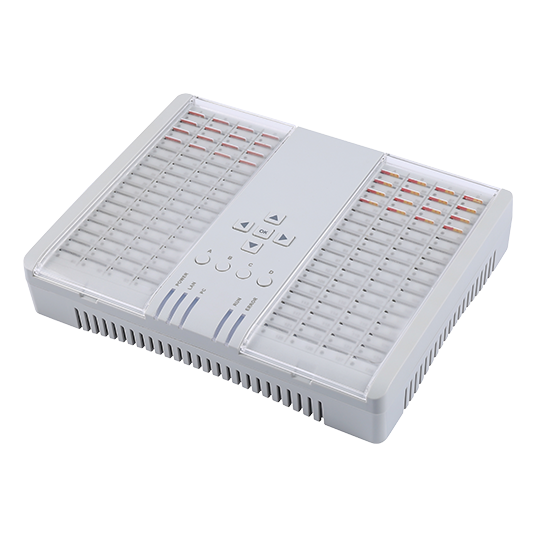
The published SIMBANK128 at $1,600.00 supports hot-swapping, dynamic SIM allocation and failover for GoIP gateways, which are the features that make slot-level operations safe rather than merely possible.
How should several gateways share one bank?
Assign slots to gateways in blocks, not in a pool.
Block assignment makes the topology comprehensible and keeps one gateway’s failure from affecting another’s slots.
Three topologies cover most deployments. Dedicated blocks give each gateway a contiguous range of slots, which makes the mapping easy to document and easy to reason about under pressure. Shared pool with dynamic allocation lets the bank assign slots as needed, which maximises utilisation and makes the mapping a runtime property rather than a documented one. Layered assignment reserves a block per gateway for its fixed numbers and shares a common block for overflow.
The trade is between utilisation and comprehensibility. Dedicated blocks waste capacity when one gateway is underused, but they mean that an engineer can answer a question about which SIM serves which traffic without querying a system. Shared pools use capacity better and make every investigation a database exercise.
Where the deployment operates mixed strategies, record which topology applies to which block. The failure mode to avoid is a bank that is documented as dedicated while the allocation software treats it as shared, because the resulting mismatch appears as traffic from an unexpected number rather than as an error.
How do you keep a register of 500 numbers accurate?
Key it on the SIM, and update it at the moment of change.
A register that is updated later is a register that is wrong in the interval that matters.
The structure that survives scale has four fields as a minimum: the SIM identifier, the current slot, the purpose it serves, and the date it was last changed. The purpose field is what makes the register useful rather than merely accurate, because it answers which traffic a card carries without reference to another system.
Two practices keep it current. First, make the update part of the physical operation rather than a separate task, so that a swap is not complete until the register reflects it. Second, reconcile periodically against the bank’s own slot state, because a register can drift when a card is replaced in an emergency and the paperwork follows a day later. The reconciliation is cheap; the drift it catches is expensive.
A third practice matters when the estate spans sites. Record the site as an attribute of the slot rather than of the SIM, because a SIM can move between sites while a slot cannot. That distinction keeps a site-level report meaningful after a card has been replaced.
How do you test a slot without disturbing the estate?
Exercise the slot in isolation.
A test that affects other slots produces a second fault while investigating the first.
The sequence is short. Identify the slot from its recorded position. Confirm the bank reports the slot as present and the SIM as registered. Send a single message or place a single call from the paired channel and confirm the number presented matches the register. Then confirm the outcome appears in the log against the same SIM. Only then change anything.
Where the fault follows the SIM rather than the slot, the card is the problem and the remedy is replacement. Where it follows the slot, the bank or the pairing is the problem. Moving the card to a spare slot separates the two cases in one step, and it is the most informative test available because it converts an ambiguous symptom into a definite answer.
How does a bank compare with an integrated pool?
A bank separates the estate from the radio.
The choice follows from whether SIM access or SIM capacity is the binding constraint.
| Consideration | Separate SIM bank | Integrated SIM pool |
|---|---|---|
| Access control | Estate can sit in a controlled location | Access follows the radio location |
| Radio placement | Radios sit where coverage is adequate | Same constraint as the radio |
| Failure domain | Adds a link between bank and radios | Single element |
| Entry cost | SIMBANK128 published at $1,600.00 | SIMPOOL 128 published at $1,800.00 |
| Scaling | One bank serves several gateways | Capacity scales with the unit |
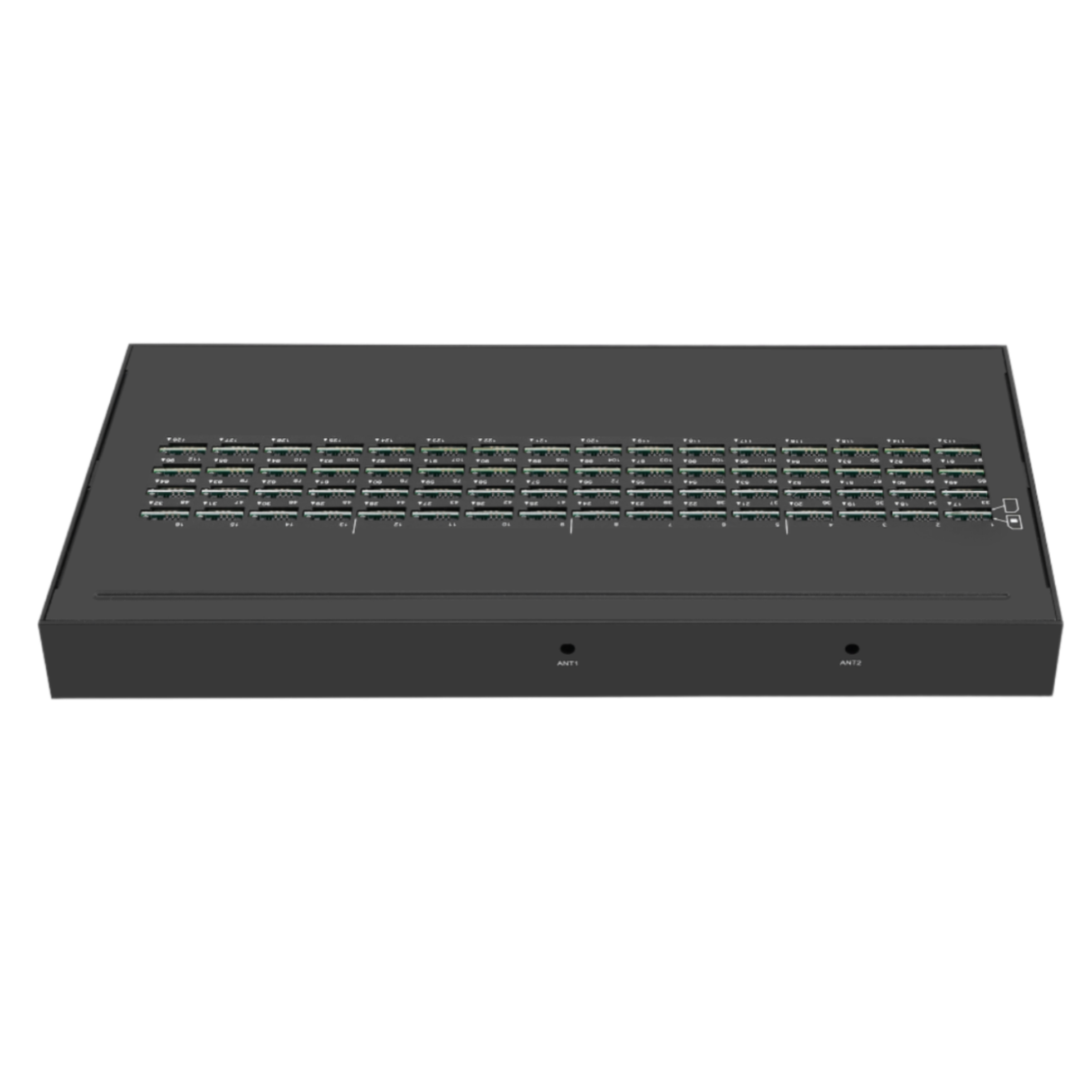
Where radios must sit where coverage is good and that location is not where you want to handle cards, the separation is the point. Where both can sit together and access is not a constraint, an integrated pool is simpler because it removes the link from the failure domain. The published SIPOOL range runs from the 128-slot configuration at $1,800.00 through the 256-slot at $3,000.00 to the 512-slot at $5,400.00.
What should the acceptance test cover?
Confirm slot identity, pairing accuracy, and recovery.
At this scale, a mapping error is silent and a recovery failure is systemic.
- Slot inventory. Confirm the bank reports every populated slot and that the register matches.
- Pairing accuracy. Exercise one slot per block and confirm the presented number matches the register rather than the physical slot order.
- Single-slot disturbance. Remove one slot from service and confirm the rest of the estate is unaffected.
- Link recovery. Disturb the link between bank and radios and confirm automatic recovery without manual intervention.
- Register reconciliation. Compare the register against the bank’s reported state and resolve every difference before go-live.
Item two catches the majority of real defects at this scale, because a mismatch between documented and physical order changes which number presents without producing any error. Item five is the one that keeps the estate operable afterwards.
Where the estate supports commercial messaging, the obligations attached to consent and identification are described in operational terms by M3AAWG and, for the North American market, by the CTIA. The numbering that recipients see follows ITU Recommendation E.164, the messaging behaviour is specified by 3GPP, and the equipment side is covered by the ETSI standards catalogue.
Conclusion
At 512 slots the design question shifts from capacity to operability. Fault isolation depends on per-slot state reporting and a register keyed on the SIM rather than the slot, hot-swapping is safe only when the slot is taken out of service and the change is recorded, and multi-gateway topologies should be chosen for comprehensibility rather than for maximum utilisation. A register that is updated at the moment of change, and reconciled periodically against the bank, is what keeps a large estate diagnosable.
The separation decision follows from constraints rather than preference. Where SIM access must be controlled and radios must sit for coverage, a bank such as the SIMBANK128 at $1,600.00 delivers the separation for a modest capital cost; where both can sit together, an integrated configuration from the SIMPOOL range removes a link from the failure domain. In either case, the acceptance test that matters most is pairing accuracy, because a wrong pairing changes which number the recipient sees without producing any error at all.
Confirm slot-to-channel pairing before the estate goes live. Send your slot count, gateway count and access constraints to service@telarvo.com, or review the published configurations on the SIMPOOL pages and the SIMBANK128 page.
FAQ
How do I identify which SIM has failed in a 512-slot bank?
From per-slot state reporting, combined with a register keyed on the SIM identifier rather than on the slot number. The bank reports the slot; the register tells you which SIM is in it and what it does. Without both, a failure in a dense chassis costs an access visit and a search, and the search itself risks disturbing working slots.
Is it safe to remove a SIM while the bank is running?
It is safe when the slot is taken out of service first and the change is recorded. Removing a card from an active slot can interrupt traffic in progress and may leave the bank in an inconsistent state. Confirm the slot identity before touching it, since adjacent slots in a dense chassis are easy to confuse, and update the register as part of the swap rather than afterwards.
Should each gateway have its own block of slots?
Dedicated blocks trade utilisation for comprehensibility. They make the mapping easy to document and easy to reason about during an incident, at the cost of wasted capacity when one gateway is underused. Shared allocation uses capacity better and makes every investigation a database query. Whichever you choose, record which topology applies to which block.
Do I need a separate SIM bank or an integrated pool?
The decision follows from constraints. Where radios must sit for coverage and the SIM estate must be controlled separately, a bank delivers that separation at the cost of one more link in the failure domain. Where both can sit together and access is not a constraint, an integrated pool is simpler because there is one element instead of two.