A 512-slot configuration is quoted as a capacity, and the number that decides whether it works is the peak electrical draw. At this density the deployment stops being a device purchase and becomes a facilities question, and the two figures that matter are the power drawn when every slot is active and the heat that leaves the enclosure as a result.
This guide covers the planning that belongs with a 512-slot estate: what the configuration actually provides, how to budget power and cooling, how it pairs with gateways, how the estate expands beyond 512 slots, and what to verify before the deployment carries live traffic.
What does a 512-slot configuration provide?
Number capacity, not concurrent channel capacity.
The figure describes how many numbers the estate can hold, and it says nothing about how many can be used at once.
Three properties follow. The estate can hold 512 numbers, which matters where a per-number policy limits how much traffic each may carry. The concurrency is still set by the radios the slots are paired with, so a 512-slot store serving a small number of gateways provides number capacity rather than throughput. And the management burden scales with the estate rather than with the ports, because each number has a registration state, a purpose and a history.
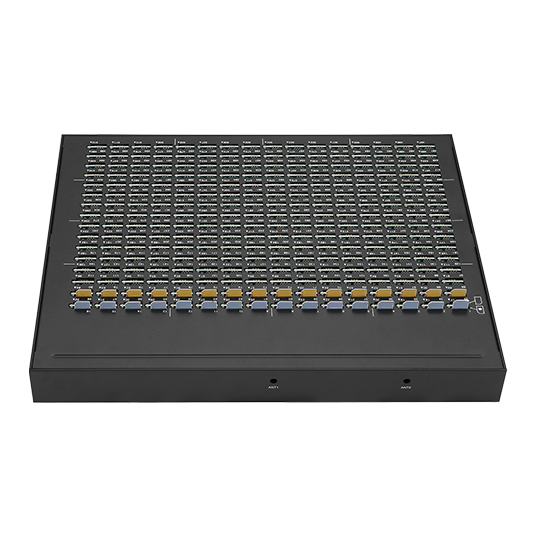
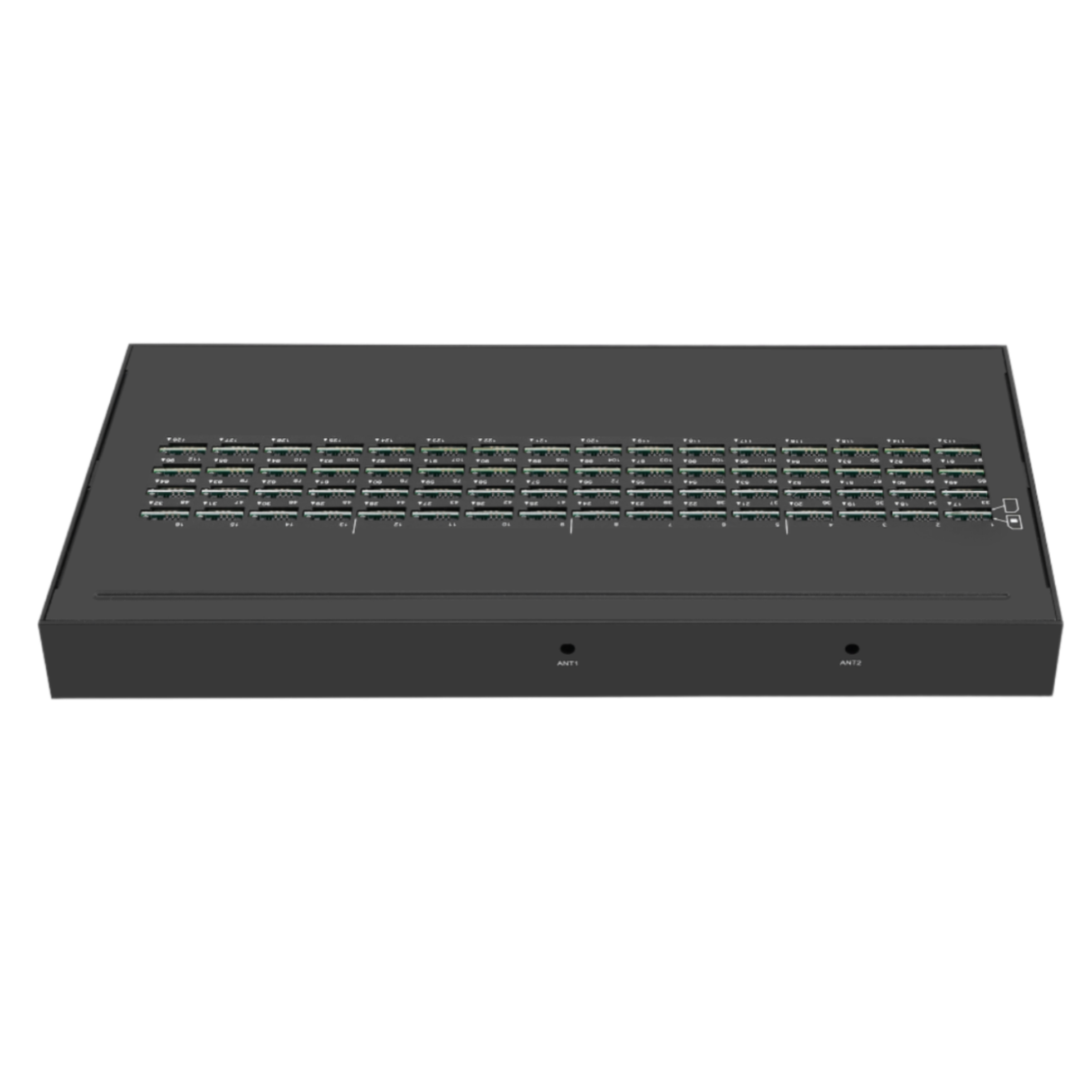
The published SK SIMPOOL 512 at $5,400.00 provides integrated SIM storage at this density with compatibility stated for the SK gateway range, and the TGW-SMS Gateway 64-64 at $1,715.00 provides 64 ports and 64 on-board slots as the chassis at the other end of the pairing. Reading both figures together is what prevents the estate from being sized against the wrong constraint.
How much power does it draw at peak?
Size from simultaneous transmission, not idle.
The ratio between idle and peak is what catches deployments out, and it varies by module generation.
Three rules keep the supply adequate. Size the supply for the case where every paired radio transmits at once, because that is what a batch produces. Confirm the peak figure with the vendor rather than deriving it from an idle specification, since a derived figure will be wrong in one direction or the other. And leave capacity in the circuit rather than filling it, because an estate at this density is rarely at its final size.
Where the SIM layer and the radios are powered separately, both circuits belong in the same calculation. A store that draws little at idle may draw materially more while slots are being allocated or cards re-registered, and the radios draw their peak during transmission. Sizing the two independently and adding them produces a figure that is wrong on the days both peak together, which are the days that matter.
The environmental envelope for the equipment is worth stating in the specification rather than assuming. The widely used guidance for data processing environments published by ASHRAE is a reasonable reference, the environmental test standards published by the International Electrotechnical Commission cover the equipment side, and the ETSI standards catalogue covers the network side of the same requirement.
How should rack space and cooling be planned?
Power becomes heat, and heat sets the layout.
The thermal load is the peak power figure converted to heat, and the layout follows from where that heat goes.
| Input | What to establish | Note |
|---|---|---|
| Rack units | Height of the store plus the paired radios | Leave vertical space between populated units |
| Peak power | Both elements transmitting or allocating simultaneously | Confirm with the vendor rather than inferring |
| Thermal load | Peak power converted to heat rejected into the rack | Intake temperature, not room temperature |
| Antenna route | How the paired radios reach usable signal | The requirement most often overlooked |
| Circuit headroom | Capacity left for the next expansion | An estate at this density rarely stops growing |
The antenna route row is the one that decides whether the deployment works at all. A store holding 512 slots is a deliberate asset, and the radios paired with it still need coverage; a position selected for convenience rather than signal produces an estate that is intact, powered and unable to carry traffic. Establish the route before the hardware is mounted rather than after.
How do you pair it with gateways?
By block, recorded against the consumer.
The pairing decision determines whether a fault can be located without opening the rack.
Three practices make a large pairing operable. Assign slots to gateways in contiguous blocks, so that a question about which gateway serves a number can be answered by reading the range. Record the allocation against the consumer or business line rather than against the device, so that a replacement does not require reconstructing the mapping. And keep a defined share unallocated, because an estate at full allocation has no room for a new gateway or a withdrawn block.
The link between the store and the paired radios belongs in the same decision. It carries SIM signalling rather than user traffic, so throughput is not the constraint and stability is; the requirement is a short, segmented and stable path, sized for the number of gateways it will serve rather than the number it serves today. An undersized link presents as intermittent SIM behaviour rather than as a capacity message.
How do you expand beyond 512 slots?
By adding a second store rather than extending the first.
The step is a topology decision, and it should be taken deliberately rather than reached as a limit.
Three paths exist. A second store at the same tier, which keeps the operating model identical and doubles the estate. A larger store where the supplier offers one, which requires migrating the existing estate. And redistributing the traffic policy so that the same numbers carry more, which is a policy decision rather than a hardware one and is sometimes the correct answer where the per-number limit was set conservatively.
The path that preserves the operating model is usually the second store, because it extends the arrangement rather than replacing it. Migrating to a larger unit introduces a project, and redistributing the policy requires the assumption behind the original limit to be revisited, which may be appropriate but is a different kind of change.
Whichever path applies, the link capacity and the allocation record should be extended before the new store is commissioned, because both are easier to change while the estate is still small. Extending after the fact means changing something that live traffic already depends on.
What should the acceptance test cover?
Slot inventory, pairing accuracy, and recovery.
At this scale a mapping error is silent, and a recovery failure is systemic.
- Slot inventory. Confirm the store reports every populated slot and that the register matches it.
- Pairing accuracy. Exercise one slot per block and confirm the number presented matches the register rather than the physical order.
- Block isolation. Remove one gateway from service and confirm the other blocks are unaffected.
- Link under load. Run traffic on every paired gateway simultaneously and confirm no SIM becomes intermittently unavailable.
- Thermal behaviour. Repeat the inventory and pairing checks after the enclosure has reached steady state under load.
- Recovery. Disturb the link or a power feed and confirm the estate recovers without manual intervention.
Items two and five are the ones that catch the most consequential defects. A pairing error changes which number a recipient sees without producing any error, and a thermal problem at this density appears only after the equipment has run long enough to reach temperature.
What should be recorded at handover?
The allocation, the pairing, the baselines.
The record is what allows an estate of this size to be operated by anyone other than its designer.
| Item | What to record |
|---|---|
| Slot allocation | Which consumer owns which slot range, and why |
| Pairing map | The order in which slots map to gateway channels |
| Electrical plan | Peak draw per element, and the circuit headroom available |
| Link topology | The path between store and radios, and its segmentation |
| Antenna route | Where the radios get signal from, and the observed state per carrier |
| Baselines | Registered slot count and thermal behaviour observed at acceptance |
Where the estate carries commercial traffic, the operational expectations for consent and identification are described by M3AAWG and, for the North American market, by the CTIA. The numbering that recipients see follows the ITU Recommendation E.164 numbering plan, and the messaging behaviour behind the traffic is specified by 3GPP.
Where the estate is expected to grow, validate the pairing and allocation practice on a smaller configuration first. Exercising block assignment, link behaviour and thermal planning at 128 slots is materially cheaper than discovering a gap at 512, and the operating model is identical across the tiers.
Conclusion
A telecom gateway with 512 SIM slots provides number capacity rather than channel capacity, and at this density the planning question moves from the device to the facility. Power should be sized from simultaneous transmission for both the store and the paired radios, cooling should follow from the peak figure converted to heat, and the antenna route should be established before the hardware is mounted because a store with no usable signal is an estate that cannot carry traffic.
The pairing should be by block and recorded against the consumer, with a defined share left unallocated and the link sized for the estate it will serve rather than the one it serves today. Expansion is normally a second store at the same tier, which preserves the operating model, and both the link capacity and the allocation record should be extended before the new store is commissioned because live traffic will depend on them.
Plan the electrical load and the antenna route before ordering. Send your slot count, gateway pairing and site conditions to service@telarvo.com, or review the published configurations on the SIMPOOL pages.
FAQ
Does 512 SIM slots mean 512 simultaneous channels?
No. The slot count determines how many numbers the estate holds, while concurrency is set by the radios the slots are paired with. A 512-slot store serving a small number of gateways provides number capacity rather than throughput. Read the two figures together, because the practical limit is the lower of them for the deployment you are planning.
How much power does a 512-slot estate need?
Size from the peak figure with both the store and the paired radios active simultaneously, and confirm the peak with the vendor rather than deriving it from an idle specification. Where the two elements are powered separately, size them together rather than independently, because a figure produced by adding two cautious estimates is wrong on the days both peak together.
How should slots be allocated across gateways?
In contiguous blocks, so that a question about which gateway serves a number can be answered by reading the range. Record the allocation against the consumer or business line rather than against the device, so a replacement does not require reconstructing the mapping, and keep a defined share unallocated so a new gateway or a withdrawn block has somewhere to go.
How do you expand beyond 512 slots?
Normally by adding a second store at the same tier, which keeps the operating model identical and extends the arrangement rather than replacing it. A larger store requires migrating the existing estate, and redistributing the traffic policy is a different kind of change that requires the assumption behind the per-number limit to be revisited first.