An eight-channel gateway is usually chosen because it is the smallest tier that looks like production rather than a test, and the decision is made before anyone counts how many people can be on a call at once. That count, rather than total call volume, is what determines whether eight channels is generous or insufficient.
This guide covers the sizing and configuration of an 8-channel SIP GSM gateway: how many concurrent calls the tier really supports, how to estimate the requirement for a small office, which SIM ratio fits, how the PBX side should be configured, and when the estate should step up to sixteen channels.
How many concurrent calls does an 8-channel gateway support?
Eight at most, and usually fewer in practice.
The nominal figure is a ceiling rather than an expectation, and the difference matters at peak.
Three effects reduce the practical figure. A channel is briefly occupied during call teardown before it can be reused. A channel whose SIM is re-registering is unavailable for the duration. And where the two ends of a call do not share a codec, transcoding consumes processing capacity that can reduce the sustainable count below the nominal one. None of those is a defect; each is a reason to size against a measured figure rather than against the product name.
The measurement is quick: increase concurrent calls in steps, and note the point at which setup time begins to rise rather than the point at which the last call connects. That point, less a margin, is the figure to plan against.
How do you estimate the requirement for a small office?
Count simultaneous talkers, then add one.
Requirements expressed as daily call volume lead to over-purchasing, because volume and concurrency are different questions.
The estimate is a count rather than a calculation. How many people may be on a call at the same moment, including calls to external numbers rather than only internal ones. Add one channel for calls in teardown and one for the occasional overlap. A small office with three or four people who may be on external calls simultaneously rarely needs more than six channels, which leaves headroom within an eight-channel unit.
Two corrections apply. Where one person may hold two calls, such as a receptionist managing a queue, they occupy two channels. And where inbound calls must never be rejected, the channel budget has to include peak inbound plus peak outbound rather than the larger of the two, unless the two peaks genuinely do not coincide.
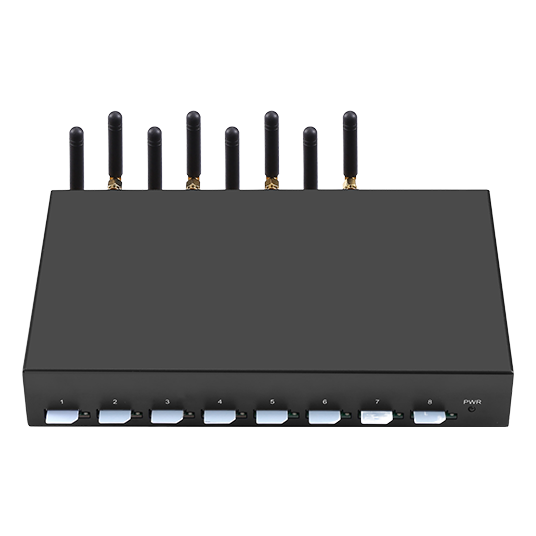
Where the estimate lands close to eight, the decision is not whether eight is sufficient today but how quickly the requirement will grow. Stepping to the next tier at purchase costs less than replacing a device in a year, and the published range reflects that: the 8-port, 8-slot configuration is $480.00 and the 16-port, 16-slot configuration is $899.00.
Which SIM ratio fits an eight-channel deployment?
One that matches your per-number policy.
The ratio determines how widely traffic can be distributed across numbers, which is a policy question rather than a capacity one.
At this tier the published configurations offer a one-to-one ratio at $480.00 and a one-to-four ratio at $620.00. The difference of $140.00 buys twenty-four additional SIM slots, which matters where the deployment distributes calls across many numbers for policy or customer reasons, and matters not at all where a handful of numbers can carry the traffic.
The arithmetic that decides it is a division. Divide peak hourly call volume by the maximum volume you are willing to place from one number, and the result is the number count. Where it exceeds eight, the higher SIM ratio is required; where it does not, the one-to-one configuration is sufficient and the extra slots would sit unused.
A second consideration is operational. More SIM slots means more cards to manage, register and replace, which is a recurring effort rather than a one-off cost. Where the estate is small and the numbers are stable, a higher ratio can add administrative work without adding capability.
How should the PBX side be configured?
As a trunk with routes for the numbers used.
The platform side is the same integration problem as at any tier, and the decisions are identical.
Four configuration elements are required. A trunk or endpoint definition matching the gateway’s registration behaviour. An outbound route with a dial pattern that matches the digits the gateway actually receives. An inbound route matching the number the gateway actually presents, with a destination that exists. And a default destination for calls that match no route, because a call that matches nothing otherwise disappears without a record.
Two conventions should be settled once and applied consistently: the number format used on the trunk, and the point at which translation occurs. Translating on both sides produces a number neither intended, and the fault appears intermittently because it depends on which conversion ran last. The international format that the presented number should follow is defined by the ITU Recommendation E.164 numbering plan.
Where the platform is open source, the documentation for Asterisk or FreeSWITCH describes how registration and failover are handled, and the signalling itself is defined by RFC 3261.
When should you step up to sixteen channels?
When calls are rejected at peak, not before.
The signal is a specific one, and it is distinguishable from a network problem.
Three signals indicate the tier has been outgrown. Calls that fail to connect while other calls are in progress, which is channel exhaustion rather than a network condition. A rising proportion of calls that fail during a known peak and succeed outside it. And a measured concurrency figure that consistently reaches the ceiling during normal operation rather than only in exceptional circumstances.
The counter-signal is equally useful: where setup time rises but calls still connect, the constraint may be contention rather than exhaustion, and the remedy may be scheduling rather than hardware. Capping concurrent calls slightly below the maximum can preserve quality at a lower cost than adding channels, and it is worth trying before the purchase.
What should the acceptance test cover?
Concurrency at peak and the failure paths.
A single successful call establishes that the integration works, and nothing about whether the tier is correctly sized.
- Registration. Confirm a completed registration in the platform log rather than a series of attempts.
- Both call directions. Place and receive a call, and confirm each reaches the intended destination.
- Audio and digits. Confirm audio flows both ways and that keypad digits register with a menu-driven service.
- Concurrency. Drive the deployment to the number of simultaneous calls the busiest hour requires, not to the average.
- Failure path. Remove the gateway from service and confirm the platform behaves as designed rather than dropping calls silently.
- Recorded baseline. Record the concurrency figure, the codec and the versions, so a later comparison is between known states.
Item four is the one that answers the sizing question the purchase was meant to settle, and item five is the one that converts an assumption into a capability. Where the deployment operates in a facility with an environmental specification, the guidance published by ASHRAE and the environmental test standards published by the International Electrotechnical Commission are the normal references, and the ETSI standards catalogue covers the equipment side.
Where the deployment is expected to grow, record the channel count that remains available before the next device is required. An eight-channel unit that reaches its ceiling in normal operation has no headroom for a peak, and the second unit is more expensive than the tier step would have been because it carries its own configuration, SIM estate and acceptance work.
A second point concerns the relationship between this tier and the one above it. The step from eight to sixteen channels costs less than the engineering time a marginal deployment usually consumes, and the operating model does not change: the same trunk, route and number-format decisions apply. Where the requirement is uncertain, choosing the higher tier defers the decision without changing any of the integration work.
Where the deployment includes a fallback path, exercise it at commissioning rather than assuming it works, since a failover configuration that has never been triggered is a statement of intent rather than a tested capability.
Conclusion
An eight-channel gateway is sized by counting simultaneous talkers rather than by estimating call volume, and the practical concurrency is below the nominal eight for reasons that are ordinary rather than defective. The SIM ratio is a separate decision that follows from a per-number policy, and at this tier the published choice is between a one-to-one configuration at $480.00 and a one-to-four configuration at $620.00.
The step to sixteen channels is justified by calls that fail during a peak while other calls are in progress, and not by rising setup times alone, which usually indicate contention that scheduling can address. Recording the measured concurrency alongside the codec and versions is what makes the next sizing decision a comparison rather than a guess, and the same integration model applies at every tier of the range.
Count simultaneous talkers before choosing a tier. Send your peak concurrent calls, per-number policy and PBX type to service@telarvo.com, or review the published configurations on the VoIP gateway solution pages.
FAQ
How many simultaneous calls can an 8-channel gateway handle?
Eight at most, and usually fewer in practice because channels in teardown and SIMs re-registering are briefly unavailable, and transcoding consumes processing capacity. Measure the sustainable figure by increasing concurrent calls in steps and noting where setup time rises rather than where the last call connects, then plan against that figure with a margin.
Do I need a higher SIM ratio with eight channels?
It depends on your per-number policy rather than on call volume. Divide peak hourly traffic by the maximum you are willing to place from one number: where the result exceeds eight, the one-to-four configuration at $620.00 is required; where it does not, the one-to-one configuration at $480.00 is sufficient and the extra slots would sit unused.
When should I move to sixteen channels?
When calls fail to connect while other calls are in progress, which indicates channel exhaustion rather than a network condition. A rising failure rate confined to known peaks points the same way. Rising setup time without connection failures is different: that usually indicates contention, and capping concurrency slightly below the maximum may resolve it without additional hardware.
What should I record from the acceptance test?
The measured concurrency, the negotiated codec, the firmware and platform versions, and the failure-path result. Together those turn a later behaviour change into a comparison between two known states. Without them, a change after a firmware update is indistinguishable from a change in network conditions, and the two lead to different responses.