A multi-SIM gateway is bought for the slots and operated for the mapping. The number of cards a device accepts is a specification; the rules that decide which card carries which message are a configuration decision that determines behaviour under load, and it is rarely documented before the hardware arrives.
This guide covers the mapping strategies available on multi-SIM GoIP hardware, the trade between on-board slots and an external SIM bank, where a small four-channel device stops being appropriate, and how to size a deployment from the traffic it must carry rather than from the slots it can fill.
How do the GoIP models differ in ports and slots?
They scale independently, so the ratio is the decision.
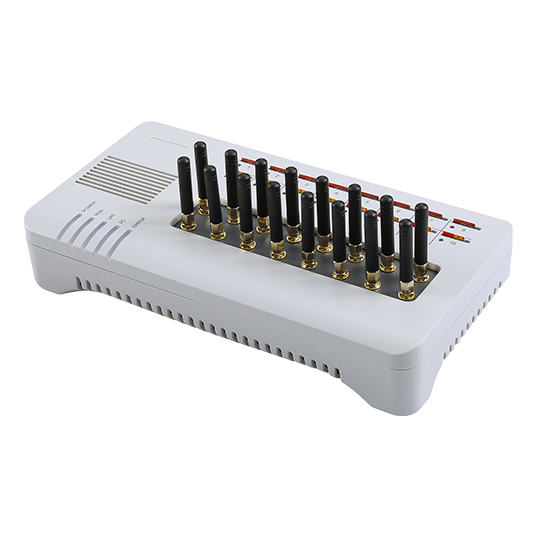
The family runs from a single-channel device to a 16-channel unit, and the slot count is not always proportional to the channel count.
| Model | Channels | SIM slots | List price (USD) |
|---|---|---|---|
| GOIP1 | 1 | 1 | $100.00 |
| GOIP8 | 8 | 8 | $378.00 |
| GOIP16 | 16 | 16 | $620.00 |
The step from one channel to eight is a change of category rather than of degree, because it moves the device from a test position into production. The step from eight to sixteen doubles the concurrent ceiling and adds a second consideration: at sixteen channels, the SIM estate is large enough that managing it by hand becomes the constraint rather than the radio.
The GOIP16 also supports pairing with SIM bank equipment, which separates the SIM estate from the radio. That separation is what allows the SIM bank to sit in a controlled location while the radios sit where coverage is adequate, and it is the configuration most deployments move towards once the slot count passes the low teens.
What are the SIM-to-channel mapping strategies?
Fixed, rotated, or grouped by business line.
Each strategy answers a different question, and the right one follows from whether a number must be recognisable.
Fixed mapping binds a SIM to a channel and leaves it there. Every call or message from that channel presents the same number, which is what a customer-facing deployment usually needs. The cost is that the load on each number is whatever that channel carries, with no redistribution.
Rotation moves SIMs between channels according to a policy, spreading load across the estate. It is appropriate where the number is not itself meaningful, and it introduces the identity consequences that any rotation strategy brings. Where the traffic is voice, rotation also affects whether a callback reaches a channel that knows the conversation.
Grouped mapping divides the estate into groups, each serving a business line or customer, with rotation inside a group only. It is the most common production configuration because it distributes load without destroying recognisability.
Whichever you choose, document the mapping and keep it in one place. Deployments that define part of the mapping in the device and part in a spreadsheet lose track of it as soon as someone leaves, and the resulting investigation is usually longer than the configuration would have been.
When should you use a SIM bank instead of on-board slots?
When the SIM estate must be controlled separately.
On-board slots are simpler until physical access to the SIMs becomes a problem.
Three triggers justify moving the SIM layer out. The first is physical access: if the radio must be mounted where coverage is good and that location is not somewhere you want to handle cards, separating the two resolves the conflict. The second is estate size: past a few dozen SIMs, replacing a card in a rack-mounted device is an operational event rather than a routine task. The third is growth: an external SIM bank can serve several gateways, so the same estate supports more radios without adding slots to each device.
The trade is complexity. An external SIM bank introduces a link between the two elements, and that link becomes part of the failure domain. Before adopting one, confirm the network requirements between the bank and the radios, and confirm the pairing documentation for the specific gateway model. The SIMBANK128 at $1,600.00 supports hot-swapping, dynamic SIM allocation and failover for GoIP gateways, which are the features that make the separation operationally worthwhile rather than merely more distributed.
What are the limits of a four-channel device?
Four channels is a real capability with a firm ceiling.
The limit is concurrent traffic, not total traffic, and the distinction decides whether four channels is enough.
Four channels handles four simultaneous conversations or four concurrent message transmissions. Over an hour that is a substantial volume of short interactions, and a modest volume of long ones. The questions that decide suitability are therefore about concurrency and duration rather than about daily totals.
Three situations fall outside the capability. A deployment that must never reject a call exceeds four channels as soon as a fifth caller arrives, and rejecting is not a degraded state but a failure. A deployment that carries long calls consumes channels for long periods, so the same four channels deliver much less over a day. And a deployment that must keep a channel free for inbound traffic has three channels for outbound work, which changes the arithmetic again.
Where any of the three applies, the GOIP8 at $378.00 is the next step, and the cost of moving up at purchase is far lower than the cost of discovering the ceiling in production.
How do you change a mapping without an outage?
Change one group at a time, when it is idle.
A mapping change moves traffic between numbers, and the safe method is the same as for any configuration change: limit the blast radius.
The sequence that avoids an outage is: identify the group you are changing; confirm the affected channels are idle rather than assuming they are; apply the change to that group only; verify one call or message in each direction on each affected channel; and only then move to the next group. Where the deployment has no idle period, apply the change during the lowest-volume window and keep the previous mapping recorded so it can be restored without reconstruction.
Two details cause avoidable incidents. Changing the entire estate at once turns a configuration error into an outage, and changing a channel that is mid-call drops that call rather than deferring the change. Both are avoided by treating the mapping as configuration rather than as a setting.
How do you size the estate from traffic?
Work backwards from per-number limits.
The calculation is a division rather than an estimate.
Start from the maximum volume you are willing to place from a single number, which is a policy decision informed by the operator’s expectations. Divide peak traffic by that figure to obtain the minimum number of SIMs. Add headroom for cards removed from service, which is typically a small percentage in steady operation and larger where registration is unstable. Then choose a model whose slots cover that number and whose channels cover peak concurrency.
The two results often point at different tiers, which is the useful part of doing the arithmetic. A deployment with low concurrency and a strict per-number policy lands in the high-slot, low-channel tier; a deployment with high concurrency and a permissive policy lands in the opposite. Buying on channels alone, which is the most common approach, systematically under-buys slots.
One external input belongs in the calculation: the registration requirement in each destination market. Where a market requires registration tied to the end user, the practical number of SIMs you can obtain is a constraint independent of your policy, and it should be checked before the estate size is fixed. The numbering framework underlying international mobile numbers is published by the ITU under Recommendation E.164, and local registration rules are the operator’s and regulator’s domain rather than the standard’s.
What should the acceptance test cover?
Confirm the mapping, not merely that messages send.
Mapping errors are silent: the traffic still flows, from the wrong number.
- Per-channel identity. Trigger traffic on each channel and record which number presented, then compare against the documented mapping.
- Directional check. Confirm both outbound and inbound traffic behave as mapped, since a mapping can be correct in one direction and wrong in the other.
- Rotation behaviour. Where rotation is configured, induce a rotation and confirm it occurs where and when documented.
- Bank link. Where an external SIM bank is used, disconnect and reconnect the link and confirm the estate recovers without manual intervention.
- Concurrency at the stated ceiling. Drive the device to its channel maximum and confirm behaviour at the limit rather than below it.
The first item is the one that catches the majority of real defects, because a mapping error changes which number a recipient sees without producing any error at all.
Where the traffic is commercial, the consent and identification expectations described by M3AAWG apply to the message rather than to the device, and they do not change because the estate is small. The numbering that recipients see is standardised under ITU Recommendation E.164, the messaging behaviour underneath it is specified by 3GPP, and the equipment side is covered by the ETSI standards catalogue.
Conclusion
Multi-SIM GoIP deployments are decided by the mapping strategy rather than by the slot count. Fixed mapping preserves identity, rotation distributes load, and grouped mapping is the compromise most production deployments settle on. The slot count sets how many numbers are available; the channel count sets how many can be active at once, and the two are bought independently.
As the estate grows, the constraint moves from the radio to the SIM layer, and that is the point at which an external bank such as the SIMBANK128 at $1,600.00 becomes worthwhile rather than merely different. Sizing should start from the per-number volume policy and work backwards, because buying on channels alone systematically under-buys slots. The mapping documentation and the per-channel identity test are what keep a correctly sized estate operating as designed.
Size the estate from your per-number policy, not from the slot count. Send your peak concurrency, daily volume and per-number limit to service@telarvo.com, or review the published models on the GoIP gateway solution pages.
FAQ
How many SIM cards can a GoIP gateway manage?
The GOIP1 carries one SIM, the GOIP8 carries eight and the GOIP16 carries sixteen on board, and the GOIP16 can be paired with SIM bank equipment to support a larger estate. The practical limit is your per-number traffic policy rather than the slot count: decide the maximum volume per number first, divide peak traffic by it, and add headroom for cards out of service.
Should SIMs rotate between channels or stay fixed?
Fixed mapping suits deployments where the recipient should recognise the number, which includes most customer-facing traffic. Rotation distributes load and is appropriate where the number carries no meaning. Grouped mapping, with rotation inside a defined group, is the usual production compromise because it distributes load while keeping replies and callbacks inside a known set of channels.
Do I need a SIM bank for a 16-channel gateway?
Not necessarily, but the reasons to add one appear around this tier. Physical access becomes a problem when radios must be mounted for coverage rather than for convenience, and replacing a card in a rack device becomes an operational event. A bank allows the estate to sit in a controlled location while the radios sit where signal is adequate, at the cost of one more link in the failure domain.
What happens to traffic during a mapping change?
It continues, which is what makes mapping changes risky. A change applied to an active channel affects the traffic in progress, and a change applied to the whole estate at once turns a configuration error into an outage. Apply changes group by group, confirm the affected channels are idle first, verify one message in each direction afterwards, and keep the previous mapping recorded so it can be restored.
{
“@context”: “https://schema.org”,
“@type”: “FAQPage”,
“mainEntity”: [
{
“@type”: “Question”,
“name”: “How many SIM cards can a GoIP gateway manage?”,
“acceptedAnswer”: {
“@type”: “Answer”,
“text”: “The GOIP1 carries one SIM, the GOIP8 carries eight and the GOIP16 carries sixteen on board, and the GOIP16 can be paired with SIM bank equipment to support a larger estate. The practical limit is your per-number traffic policy rather than the slot count: decide the maximum volume per number first, divide peak traffic by it, and add headroom for cards out of service.”
}
},
{
“@type”: “Question”,
“name”: “Should SIMs rotate between channels or stay fixed?”,
“acceptedAnswer”: {
“@type”: “Answer”,
“text”: “Fixed mapping suits deployments where the recipient should recognise the number, which includes most customer-facing traffic. Rotation distributes load and is appropriate where the number carries no meaning. Grouped mapping, with rotation inside a defined group, is the usual production compromise because it distributes load while keeping replies and callbacks inside a known set of channels.”
}
},
{
“@type”: “Question”,
“name”: “Do I need a SIM bank for a 16-channel gateway?”,
“acceptedAnswer”: {
“@type”: “Answer”,
“text”: “Not necessarily, but the reasons to add one appear around this tier. Physical access becomes a problem when radios must be mounted for coverage rather than for convenience, and replacing a card in a rack device becomes an operational event. A bank allows the estate to sit in a controlled location while the radios sit where signal is adequate, at the cost of one more link in the failure domain.”
}
},
{
“@type”: “Question”,
“name”: “What happens to traffic during a mapping change?”,
“acceptedAnswer”: {
“@type”: “Answer”,
“text”: “It continues, which is what makes mapping changes risky. A change applied to an active channel affects the traffic in progress, and a change applied to the whole estate at once turns a configuration error into an outage. Apply changes group by group, confirm the affected channels are idle first, verify one message in each direction afterwards, and keep the previous mapping recorded so it can be restored.”
}
}
]
}