The industrial 4G gateway versus consumer router comparison is usually made on specifications and decided on something else entirely: what happens in month nine, when the device has been running continuously and the plan assumed it would not.
This article compares the two on connection handling, multi-SIM management, thermal behaviour under continuous load, attribution and logging, and the management and update paths, and then states the cases where a consumer router is genuinely the right choice.
How do industrial 4G gateway and consumer router connection tables differ?
One is built for many sessions; the other for enough.
A messaging workload keeps many concurrent connections open for hours, and the table that tracks them is the first component to become a constraint under sustained load.
The symptom is characteristic and easy to misread. Connections begin to fail intermittently while utilisation looks modest, because the device has reached the limit of the sessions it can track rather than the limit of the bandwidth it can carry. A consumer router sized on throughput will therefore pass a speed test and fail under a workload that keeps many connections alive. The measurement that matters is not speed but stability over days, which is a different test.
Where the workload is a handful of connections, the difference never appears. Where it is hundreds held open, it appears within a week. Testing for it requires leaving the device in place and watching, which is why the limitation is so often discovered after deployment rather than during evaluation.
Why is multi-SIM management the real divider?
Consumer equipment assumes one SIM; messaging assumes many.
The defining difference for this workload is not the radio but the ability to manage a pool of subscriptions, their state and their traffic.
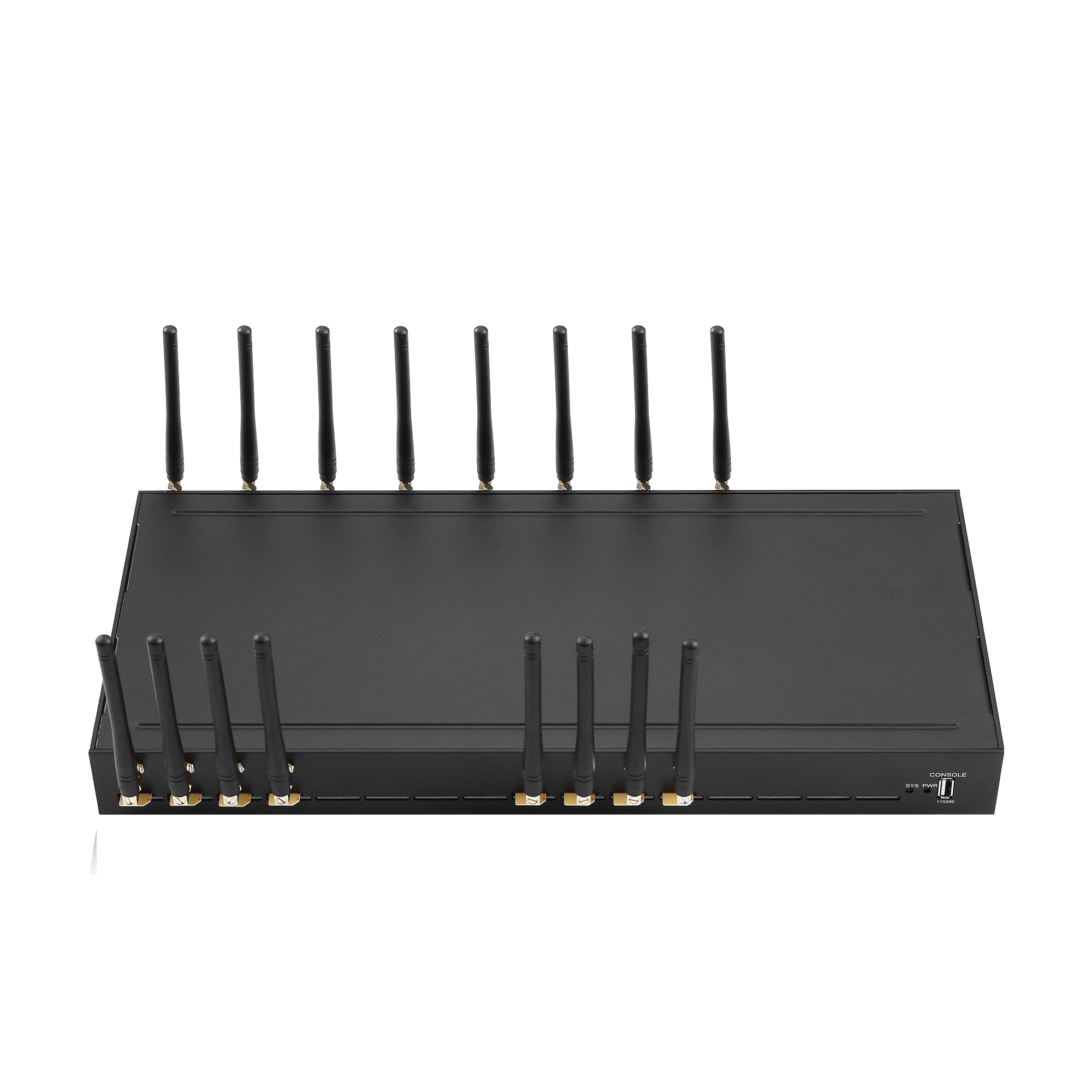
A consumer router treats the SIM as a single uplink and offers little beyond a signal reading. An industrial device built for messaging treats the SIM estate as the thing being managed, which changes what it exposes: per-slot state, per-slot counters, rotation, and the ability to associate traffic with a specific card. Those capabilities are what make a per-number policy enforceable rather than aspirational.
The interfaces that expose this state are those described in ETSI TS 127 005 and 3GPP TS 27.005, and the underlying connection behaviour is governed by the bearer and session rules in ETSI TS 123 018. A device that does not expose per-SIM state cannot be operated as a pool, whatever its throughput specification says.
| Requirement | Consumer router | Industrial messaging gateway |
|---|---|---|
| One uplink | Designed for this | Supported |
| Many long-lived sessions | Often the constraint | Sized for this |
| Multi-SIM pool operation | Not a design goal | Core capability |
| Per-SIM counters and state | Typically absent | Exposed through the interface |
| Continuous thermal load | Intermittent use assumed | Specified for continuous operation |
Thermal behaviour under continuous load
Consumer equipment is specified for intermittent use.
A router designed for a home is expected to be busy in bursts and idle much of the time, while a messaging gateway is expected to transmit continuously for weeks.
That difference shows up as thermal margin rather than as a specification number. A device with little margin operates correctly in a temperate room and fails intermittently in a warm one, and the failures look like software faults because the device recovers when it cools. The environmental expectations for telecom equipment, including the conditions it should tolerate, are the subject of ITU-T K.21, and the radio characteristics under load are described in 3GPP TS 45.005. A device that is not specified for continuous transmission at an elevated ambient temperature is not a candidate, whatever else it does well.
The practical test is to run the device at its intended load for a week in the location it will occupy, and to record temperature or, where that is unavailable, the time to first failure. A device that survives a day at the bench has demonstrated very little about a deployment that is expected to run for years. Where the equipment is certified against a harmonised terminal standard such as ETSI EN 301 511, the conditions assumed by that specification are the ones the installation has to reproduce.
The same reasoning applies to the environment the device sits in. A consumer router in a ventilated office at a moderate temperature has an easier life than the same device in a closed cabinet beside a rack, and the difference in ambient conditions is often larger than the difference in workload. Where the location is fixed and warm, the thermal margin decides the choice before any other specification is considered.
What does each one log, and can you attribute anything?
Attribution is the capability that decides most disputes.
An industrial device records per-message and per-slot events, while a consumer router records connection events and little else.
Where a customer asks which message failed and when, a device that logs per-message status answers in one query. Where the device logs only connections, the same question produces an investigation. That difference is not a convenience; it is the difference between an operator who can prove what happened and one who can only describe it. Record-keeping practice for operational logs, including what to retain, is covered in NIST SP 800-92.
Registration state is the second half of attribution. A device that exposes whether each subscription is attached and registered makes a service problem distinguishable from a network problem, and the states involved are defined in 3GPP TS 24.301. Consumer equipment typically reports a single connection state for the whole device, which merges the two cases and leaves whichever one failed invisible.
Management and update paths
One is managed by a vendor, the other by whoever bought it.
An industrial gateway receives platform updates through a supported path, while a consumer router depends on the manufacturer continuing to publish firmware for that model.
The practical risk with consumer equipment is not that it is insecure on the day it is installed but that support ends on the manufacturer’s schedule rather than yours. A model discontinued two years ago may still work and may never receive another update, and the operator inherits that outcome without deciding it. Industrial equipment is not immune to the same problem, but the support expectation is usually stated as part of the purchase rather than discovered later.
Management scale is the second difference. An estate of consumer devices is managed one at a time, while industrial equipment in the same class provides the interfaces that make automated management feasible. Where the deployment is two devices, that does not matter; where it is twenty across four sites, it is the reason the estate is manageable or not.
When is a consumer router genuinely sufficient?
When the workload is one uplink only.
A consumer router is the right answer for a temporary installation, a single low-volume connection and any case where the cost of failure is a retry rather than an incident.
Three cases qualify clearly. A temporary or pilot installation, where the equipment will be removed before the support question matters. A backup uplink that is not in the path of committed traffic. And a low-volume deployment where one connection is enough and the failure of that connection is an inconvenience rather than a customer-visible event. In each of those, spending on industrial equipment buys capability that will not be used.
The judgement to avoid is the one that treats a consumer device as an industrial one because it has a similar radio. The radio may be identical; the connection handling, the thermal margin, the management interface and the support path are not, and those are the differences that appear after the deployment rather than before it.
It is also worth separating the two failure costs. A consumer device that fails in a deployment of one costs a retry and an hour of someone’s attention. The same device failing in a deployment that supports a customer-facing service costs whatever the interruption costs, and that asymmetry rather than the hardware price is what should drive the decision.
Where the answer is genuinely marginal, the practical approach is to deploy the consumer device in the least critical position first and measure. A week of real traffic produces the evidence that a specification comparison cannot: whether the device holds its sessions, whether it runs warm, and whether the logs answer the questions the operation actually asks.
A decision table
The table is ordered so that the first question eliminates most deployments. It is written for one decision rather than for a general comparison, and it assumes the workload has already been described in terms of sessions, concurrency and required continuity. Work down until an answer appears, then stop.
- How many sessions must the device hold open simultaneously, and for how long?
- Does the deployment manage more than one SIM, and does it need per-SIM state?
- Will the device transmit continuously, in what ambient temperature, and for how long?
- Does the business need per-message attribution, and who will ask for it?
- How many devices will be managed, and by how many people?
- How long is the device expected to stay in service, and who supports it over that period?
The list is short because the decision usually turns on the second and fourth items. Where a deployment needs per-SIM state and per-message attribution, no consumer device will satisfy it, and where it does not, an industrial device is capability that will go unused.
Decide on session handling and attribution, not on radio specifications. Send your session profile, SIM count and support horizon to service@telarvo.com, or review the published configurations on the proxy gateway range and the SK-SMS Gateway range. Telarvo publishes the SK Multi WAN proxy gateway models on its product pages, and the configurations referenced above come from those listings.
FAQ
Can a consumer router handle a small SMS deployment?
It can, where the deployment is one connection carrying low volume and the cost of a failure is a retry. It becomes unsuitable as soon as the deployment depends on per-SIM state, per-message attribution or continuous operation, because those are capabilities it was not designed to provide. The point at which it stops being adequate is a requirement, not a preference.
Are industrial gateways simply routers with a metal case?
No. The case is the least significant difference. Connection table sizing, thermal margin for continuous transmission, multi-SIM management and per-message logging are separate design decisions, and a consumer device in a metal case would still lack them. Judge the design rather than the enclosure, because the enclosure is the cheapest part to change. Compare the capabilities that follow from the design, not the enclosure that surrounds it.
How do we test for the session limit before deploying?
Run the intended workload against the device for at least a week and watch for intermittent connection failures at modest utilisation. A throughput test will not reveal it. Record the failure pattern, because occasional failures under sustained load are the signature of a table limit rather than a bandwidth limit. The pattern also tells you which table is filling. Note the time of day and the load at each failure, because the pattern is what identifies the cause.
Doesn’t the radio module determine performance?
The radio determines what the network will accept, not what the device can manage. Two devices with the same module can behave completely differently under load because of their connection handling, their thermal design and what they expose for management. Judge the device, not the part number. The same module in two designs is two products. A specification that names only the module describes the network acceptance rather than the device.
{
“@context”: “https://schema.org”,
“@type”: “FAQPage”,
“mainEntity”: [
{
“@type”: “Question”,
“name”: “Can a consumer router handle a small SMS deployment?”,
“acceptedAnswer”: {
“@type”: “Answer”,
“text”: “It can, where the deployment is one connection carrying low volume and the cost of a failure is a retry. It becomes unsuitable as soon as the deployment depends on per-SIM state, per-message attribution or continuous operation, because those are capabilities it was not designed to provide. The point at which it stops being adequate is a requirement, not a preference.”
}
},
{
“@type”: “Question”,
“name”: “Are industrial gateways simply routers with a metal case?”,
“acceptedAnswer”: {
“@type”: “Answer”,
“text”: “No. The case is the least significant difference. Connection table sizing, thermal margin for continuous transmission, multi-SIM management and per-message logging are separate design decisions, and a consumer device in a metal case would still lack them. Judge the design rather than the enclosure, because the enclosure is the cheapest part to change. Compare the capabilities that follow from the design, not the enclosure that surrounds it.”
}
},
{
“@type”: “Question”,
“name”: “How do we test for the session limit before deploying?”,
“acceptedAnswer”: {
“@type”: “Answer”,
“text”: “Run the intended workload against the device for at least a week and watch for intermittent connection failures at modest utilisation. A throughput test will not reveal it. Record the failure pattern, because occasional failures under sustained load are the signature of a table limit rather than a bandwidth limit. The pattern also tells you which table is filling. Note the time of day and the load at each failure, because the pattern is what identifies the cause.”
}
},
{
“@type”: “Question”,
“name”: “Doesn’t the radio module determine performance?”,
“acceptedAnswer”: {
“@type”: “Answer”,
“text”: “The radio determines what the network will accept, not what the device can manage. Two devices with the same module can behave completely differently under load because of their connection handling, their thermal design and what they expose for management. Judge the device, not the part number. The same module in two designs is two products. A specification that names only the module describes the network acceptance rather than the device.”
}
}
]
}