The 32-port versus 64-port decision is usually made on price per port, which is the one comparison that does not answer the question. What decides it is whether the extra capacity will be used, and how often the deployment is willing to run at its limit.
This article sets out the two figures that decide the tier, the published prices and what the step actually buys, the cost of capacity that sits idle, and a worked comparison that you can re-run with your own numbers rather than adopting.
Which two figures decide 32-port versus 64-port modem pool ROI?
Peak concurrency and the rate the network accepts.
The tier is decided by how many ports must transmit at the same time during the busiest minute, and by how fast each subscription can carry messages.
Those two figures multiply rather than add, which is where most estimates go wrong. A deployment that needs forty messages per minute with each SIM able to carry two per minute needs twenty simultaneously active ports, not forty. A deployment that needs forty per minute with each SIM carrying one needs forty ports, and the same target now requires the larger tier. The difference between the two estimates is entirely in the per-SIM figure, which is measured rather than assumed.
Peak concurrency is the second figure and is usually larger than the average suggests. Campaign traffic arrives in bursts, and a pool sized on the daily average will saturate during the hour that matters. Measuring the simultaneous count of transmitting ports during a real campaign gives a figure that can be planned against; estimating it from the daily total does not.
| Question | Where the answer comes from | Why it decides the tier |
|---|---|---|
| Messages per minute at peak | Campaign profile | Sets the required aggregate rate |
| Messages per minute per SIM | Measured delivery behaviour | Converts the rate into a port count |
| Simultaneously active ports at peak | Observation during a campaign | Sizes the pool rather than the average |
| Growth expectation | Commercial plan | Decides whether headroom is bought now or later |
Published tier prices and what the step buys
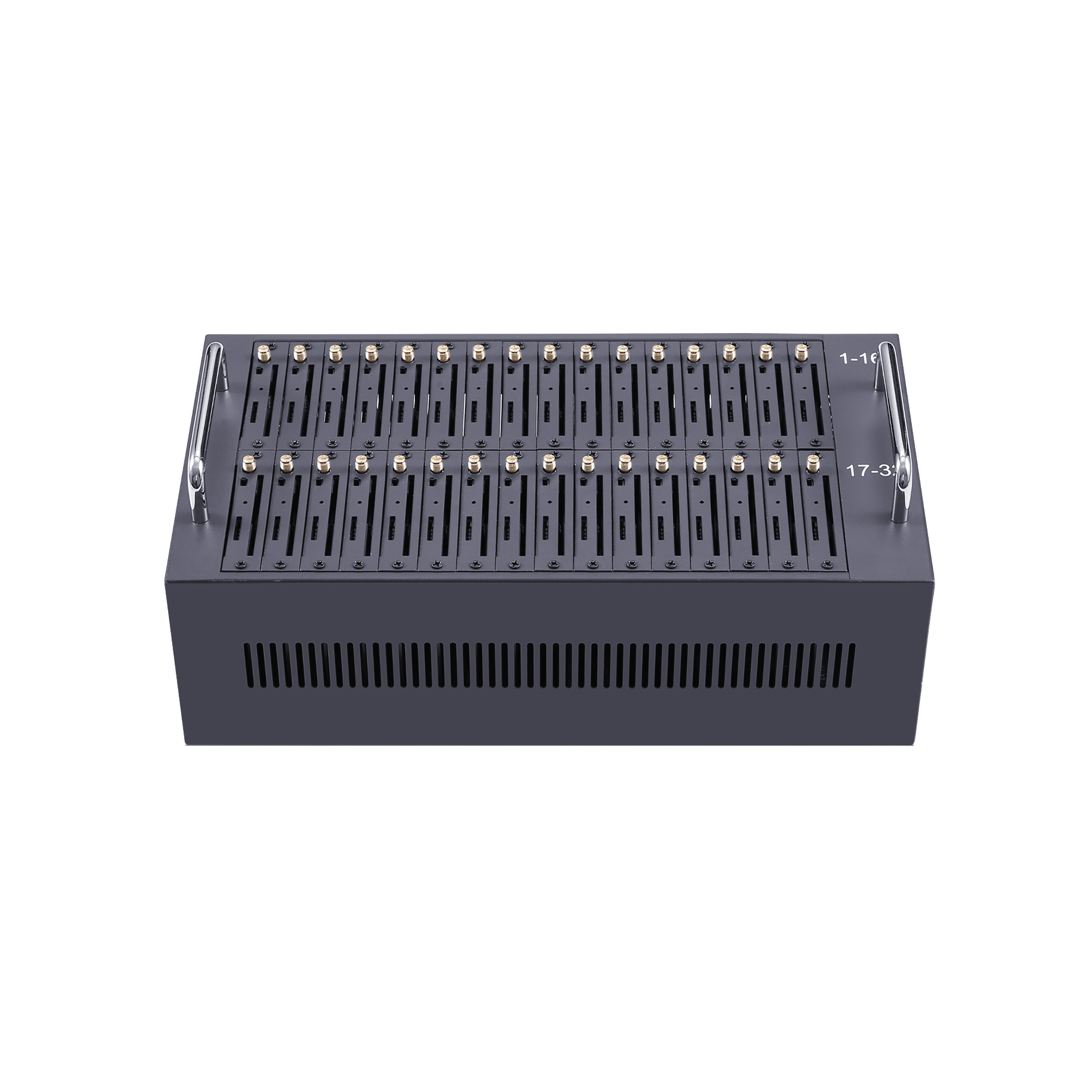
The step is a doubling of ports for a known difference in list price.
The TYH modem pool family publishes list prices of $113 for the 8-port, $148 for the 16-port, $270 for the 32-port and $579 for the 64-port model as displayed on the site.
The arithmetic that matters is the step from one tier to the next rather than the price of either tier alone. Moving from the 32-port at $270 to the 64-port at $579 costs $309 in list price and doubles the port count, so the additional ports cost a little under $10 each at list. Read the other way, the larger tier costs about 2.1 times the smaller one for twice the capacity, which is the usual shape of a hardware ladder and is the reason the larger tier is often quoted as better value per port.
What the step does not buy is worth stating. It does not buy more per-SIM rate, more coverage, a second site, or any reduction in the operating work. It buys ports, and ports only become useful if the traffic profile can fill them. The listed prices are list prices as displayed on the site and should be confirmed at the time of purchase, and the same check applies to any accessory or SIM storage purchased with them.
What does idle capacity actually cost?
More than the purchase price.
Unused ports consume rack space, power, cooling and the maintenance attention that any installed unit requires, whether or not they carry traffic.
The direct cost is visible in the invoice and the indirect cost is not, which is why pools drift toward overcapacity. A unit that is installed but idle still has to be monitored, updated and included in the spares plan, and those activities scale with the number of devices rather than with the number of messages. The idle cost is therefore larger than the difference in list price suggests.
The mitigation is staging. A pool that can be expanded by adding a unit rather than by replacing one lets capacity follow demand, and the ladder within a modem pool family exists for exactly that reason. Where the deployment expects a two-year growth path, buying the smaller tier now and stepping later is usually cheaper than buying the largest tier immediately, unless the step price rises faster than the cost of capital.
Operating cost per port at each tier
Per-port cost falls with density, up to a point.
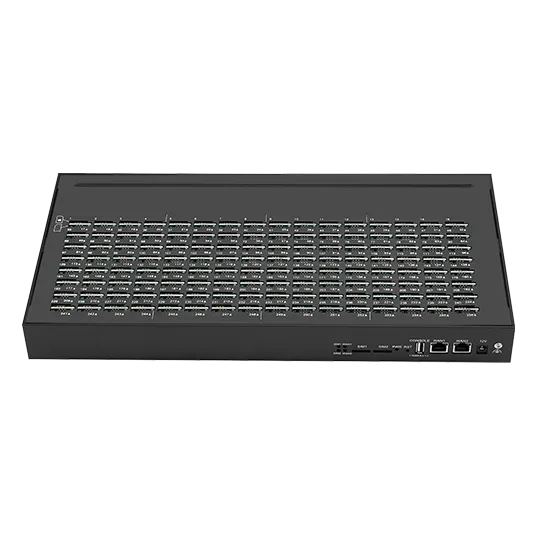
Power, enclosure and management overhead are shared across more ports in the larger tier, so the per-port operating cost is lower, while the consequences of a single fault are larger.
Two entries dominate the operating cost and neither appears in the list price. The first is the SIM tariff behind each port, which is a commercial relationship rather than a hardware cost and therefore scales with the number of active cards rather than with the number of slots. The second is the engineering time to operate the pool, which scales with the number of devices and the number of interfaces to monitor. A single 64-port unit reduces the second figure relative to two 32-port units and leaves the first unchanged.
The per-port figures only become usable when they can be compared with what the carrier charges. Recording destination numbers in the form described by ITU-T E.164 and card identifiers in the form described by ITU-T E.118 is what makes that comparison possible, and the operational records behind it are the subject of NIST SP 800-92. Without consistent identifiers, a per-port cost calculation and a carrier invoice describe two different estates.
When is the larger tier cheaper over three years?
When the smaller pool stays near its limit.
If the smaller tier is saturated for much of the working week, the larger tier spreads the same traffic across more ports and avoids the cost of a second unit later.
The calculation is straightforward once the utilisation figure is known. A pool that runs at ninety per cent utilisation most weeks will need the next tier within the planning horizon, and buying it now avoids the second installation, the second support relationship and the migration work. A pool that runs at forty per cent will not need it, and the purchase is capacity that could have funded a tariff or a spare instead.
Three years is a useful horizon because it is longer than a campaign cycle and shorter than the life of the equipment, so it captures the migration costs without pretending to forecast beyond the useful period. Within that horizon the largest single variable is the growth rate rather than the list price, which is why a modest difference in list price rarely decides the outcome on its own.
When it is not
When capacity would sit idle or when the constraint is elsewhere.
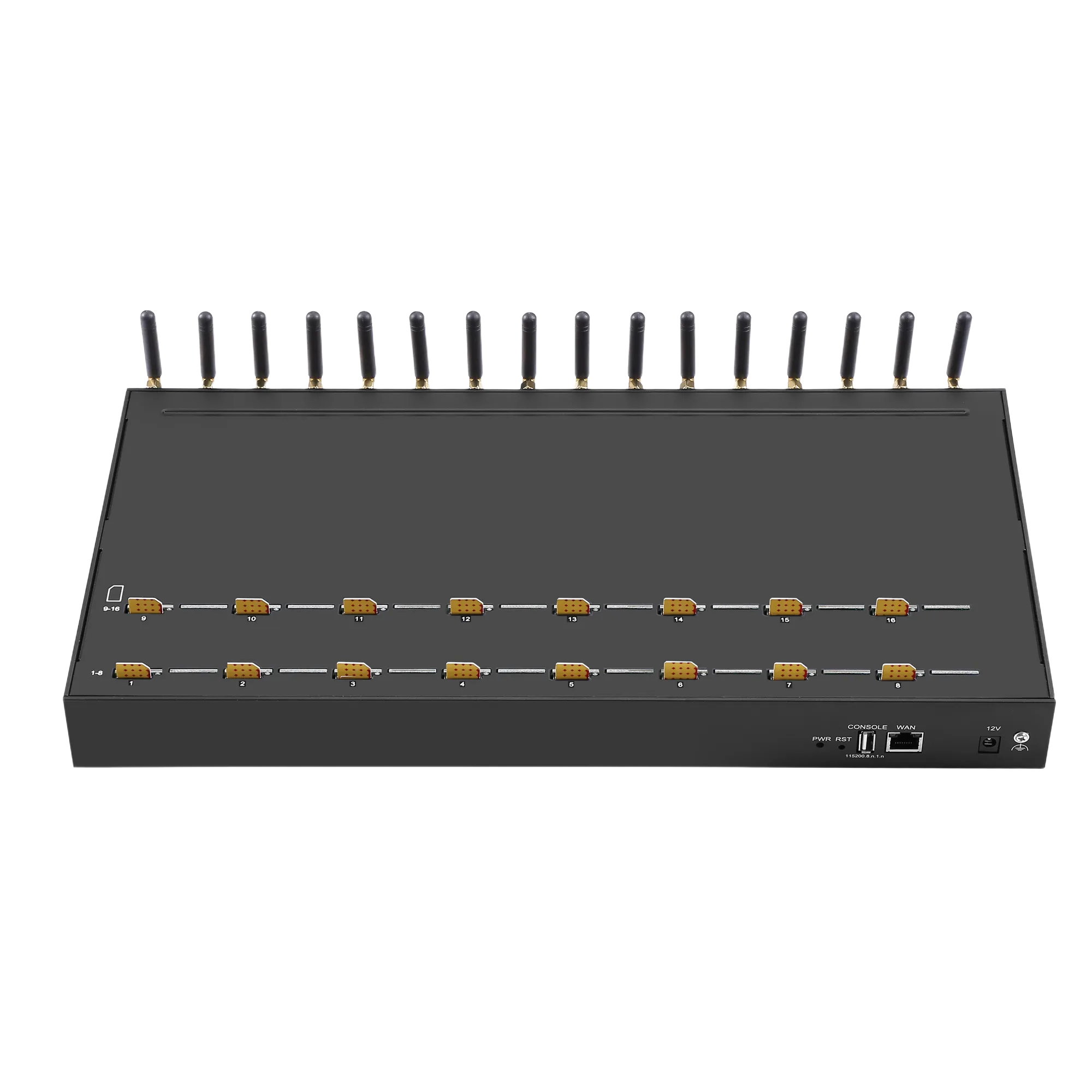
The larger tier is the wrong purchase when the pool never approaches saturation, when the bottleneck is the subscription rate rather than the port count, or when the estate is single-site and a fault would take everything regardless of size.
The second condition is the one most often missed. If each SIM can carry only a small fraction of what the port count implies, adding ports does not raise throughput, and the correct investment is a larger SIM estate or a different subscription profile rather than more hardware. The interfaces that expose per-SIM rates and per-port state, described in ETSI TS 127 005 and 3GPP TS 27.005, are what make that diagnosis possible rather than a matter of opinion.
The third condition is a failure-domain question rather than a cost one. Where the whole pool is one device, a larger device concentrates more capacity into the same failure domain, and the availability consequence may outweigh the per-port saving. Delivery and status reporting that would reveal the effect of that concentration is defined in ETSI TS 123 040 and 3GPP TS 23.040.
A worked comparison
The comparison is arithmetic once the assumptions are written down. For a deployment that must send 3,000 messages in a two-hour window, the required rate is 25 messages per minute. If each SIM delivers two per minute, thirteen ports are active at peak and a 32-port pool has ample headroom; if each delivers one per minute, the requirement is 25 active ports and the 32-port tier is tight while the 64-port tier is comfortable.
At list prices as displayed on the site, the difference between the two tiers is $309, which is roughly $12 per additional port. The question is then whether the deployment expects to reach the point where the 32-port pool is saturated, and how long that would take. Where the answer is within the planning horizon, the larger tier avoids a second purchase, a second installation and a migration; where it is beyond the horizon, the $309 is better spent on the SIM estate that actually sets the rate.
Write the assumptions down with the calculation. A comparison that cannot be re-run after the traffic profile changes is a decision, not a method, and traffic profiles change more often than hardware is replaced.
Size the pool from measured per-SIM rate, not from the port ladder. Send your peak rate, per-SIM delivery figures and growth plan to service@telarvo.com, or review the published configurations on the SMS modem range and the TGW gateway page. Telarvo publishes the SK-SMS gateway range, the TYH modem pools and the TGW SMS machine on its product pages, and the configurations referenced above come from those listings.
FAQ
Is the 64-port pool always better value per port?
At list price it is usually cheaper per port, because enclosure and management overhead is shared across more ports. Value depends on use rather than on unit price, and a pool that never approaches saturation carries the same overhead for less traffic. Compare utilisation, not price per port. The useful figure is cost per delivered message, not cost per port.
What utilisation should we plan for?
Plan to a peak rather than an average, and keep the sustained figure below the point at which queueing appears. Many deployments plan for roughly seventy per cent of the measured peak as a working ceiling and treat anything above it as a signal to add capacity rather than to push harder. The figure should come from your own delivery data.
Can we add a second 32-port unit instead of buying a 64-port one?
Yes, and it is often the better answer because it distributes the failure domain. Two smaller units cost more per port and give you a pool that keeps delivering when one fails. Where availability matters more than unit economics, that trade is worth making deliberately. The comparison should include the service cost of the outage you are avoiding. Record the reasoning, because the availability argument is reviewed more often than the price is.
Our throughput did not improve after adding ports. Why?
Because the constraint is probably the per-SIM rate rather than the port count. Ports determine how many cards can transmit at once; the subscription and the network determine how fast each one can go. Measure the per-SIM rate during a campaign before buying more hardware. A ceiling set by the tariff will not move when the port count does. Where the tariff sets the ceiling, the next unit of capacity comes from a different subscription rather than a bigger chassis.
{
“@context”: “https://schema.org”,
“@type”: “FAQPage”,
“mainEntity”: [
{
“@type”: “Question”,
“name”: “Is the 64-port pool always better value per port?”,
“acceptedAnswer”: {
“@type”: “Answer”,
“text”: “At list price it is usually cheaper per port, because enclosure and management overhead is shared across more ports. Value depends on use rather than on unit price, and a pool that never approaches saturation carries the same overhead for less traffic. Compare utilisation, not price per port. The useful figure is cost per delivered message, not cost per port.”
}
},
{
“@type”: “Question”,
“name”: “What utilisation should we plan for?”,
“acceptedAnswer”: {
“@type”: “Answer”,
“text”: “Plan to a peak rather than an average, and keep the sustained figure below the point at which queueing appears. Many deployments plan for roughly seventy per cent of the measured peak as a working ceiling and treat anything above it as a signal to add capacity rather than to push harder. The figure should come from your own delivery data.”
}
},
{
“@type”: “Question”,
“name”: “Can we add a second 32-port unit instead of buying a 64-port one?”,
“acceptedAnswer”: {
“@type”: “Answer”,
“text”: “Yes, and it is often the better answer because it distributes the failure domain. Two smaller units cost more per port and give you a pool that keeps delivering when one fails. Where availability matters more than unit economics, that trade is worth making deliberately. The comparison should include the service cost of the outage you are avoiding. Record the reasoning, because the availability argument is reviewed more often than the price is.”
}
},
{
“@type”: “Question”,
“name”: “Our throughput did not improve after adding ports. Why?”,
“acceptedAnswer”: {
“@type”: “Answer”,
“text”: “Because the constraint is probably the per-SIM rate rather than the port count. Ports determine how many cards can transmit at once; the subscription and the network determine how fast each one can go. Measure the per-SIM rate during a campaign before buying more hardware. A ceiling set by the tariff will not move when the port count does. Where the tariff sets the ceiling, the next unit of capacity comes from a different subscription rather than a bigger chassis.”
}
}
]
}