Two-way messaging projects rarely fail at the API. They fail where a mobile-originated message has to leave the cellular network and land somewhere your application can trust. Choosing an SMS gateway for inbound SMS is a routing and reliability decision before it becomes a purchasing decision, and the hardware you buy determines how much of that reliability you have to build yourself.
The practical question is not how many messages a device can send. It is whether the gateway can hold a message long enough for your endpoint to acknowledge it, what happens when that acknowledgement never arrives, and whether your own outbound traffic can starve the inbound path. Those three questions decide the architecture, and the architecture decides which SK-SMS Gateway model fits.
How does an SMS gateway for inbound SMS sit between a SIM and your application?
It turns a mobile message into a durable IP event.
The gateway holds the SIM, receives the message over the cellular network, stores it locally, then pushes it to your endpoint. That store-and-forward stage is what makes delivery survivable when your application is briefly unavailable.
A mobile-originated (MO) message first reaches the base station, then the carrier’s short message service centre, and only then the SIM in your gateway. Everything up to that point is outside your control. What you control is the second half: how the gateway buffers the message, in what format it hands the message over, and how it behaves when the handover fails.
This is why a bare SIM in a USB modem is not equivalent to a gateway. A modem exposes a serial or AT-command interface; the receiving software must poll it, parse the storage, and manage the SIM storage index. A gateway with an HTTP API and a web management interface performs that buffering and parsing internally, and exposes a durable event your application can consume. The difference matters most at exactly the moment you cannot afford to lose a message: a deployment restart, a network blip, or a burst of replies after a campaign.
Numbering matters here too. International mobile numbers are assigned under the ITU E.164 numbering plan, and an inbound implementation that stores the originating address as free text rather than in normalized E.164 form will eventually fail to match replies to the right conversation. Choosing an SMS gateway for inbound SMS is therefore a data-modelling decision as much as a hardware one.
What are the four practical ways a gateway can deliver inbound messages?
Four delivery paths exist, and each shifts the burden.
Most gateways offer one or more of four delivery mechanisms, and each carries a different operational burden. The right choice depends on whether your application can expose a public endpoint and how much latency you can tolerate.
HTTP callback is the default for most integrations. The gateway posts the message as a webhook to a URL you nominate, and your service returns a success status. It is simple, stateless from the gateway’s point of view, and easy to log. Its weakness is that it assumes connectivity in one direction and gives you only what the HTTP response tells you.
SMPP is the protocol most messaging platforms already speak. Instead of a webhook, your application binds to the gateway as an ESME and receives messages over a persistent session. This suits platforms that already run an SMS stack, but it introduces session state: binds drop, windows fill, and reconnect logic becomes your responsibility. Because text messaging itself is specified inside the 3GPP core network specifications, the message semantics your platform relies on are standardised even when the vendor API is not. Practical guidance on binding modes and recovery is covered in our SMS gateway solution pages.
Database polling asks the gateway to write into a table your application already reads. It avoids exposing an endpoint to the network and fits legacy systems well. The cost is latency equal to your polling interval, plus the risk of duplicate reads if two pollers run at once.
File export writes messages to a shared location on a schedule. It is the least elegant option and is usually reserved for batch reconciliation rather than live traffic, because it cannot support a conversational response time.
In practice, production two-way deployments use HTTP callbacks for live traffic and one of the other three for reconciliation. That combination gives you a fast path and a slow but dependable safety net.
Why do inbound callbacks fail, and how do you make retries safe?
Callbacks fail when recovery retries duplicate the message.
A correct callback design therefore needs two things at once: a retry schedule that outlasts your application’s shortest outage, and a key that lets the receiver discard a repeat without discarding a genuine second message.
The retry side is arithmetic. If your application can be unavailable for 90 seconds during a deployment, a gateway that retries three times over 30 seconds will drop messages that a gateway retrying for five minutes would have delivered. Ask the vendor what the retry window is and whether it is configurable, because this single setting determines whether routine maintenance becomes message loss.
The deduplication side is a design pattern, not a feature. Mobile-originated and mobile-terminated messages carry identifying fields that a gateway can pass through, and a gateway that records per-message status makes those fields available for reconciliation. The receiving service should compute an idempotency key from the message identity plus the originating address, store it, and treat a repeat key as an acknowledgement rather than as new work. If your inbound path also carries one-time codes, the authentication guidance in NIST SP 800-63B sets out how out-of-band channels should be treated, including replay resistance.
A practical implementation shape looks like this: on receipt, look up the idempotency key; if it exists, return success immediately without reprocessing; if it does not, persist the message and the key in one transaction, then return success. Keep the key retention window longer than the gateway’s retry window, otherwise you will regenerate the duplicate you just learned to suppress.
Two failure modes are worth naming because they are easy to miss. First, a gateway that retries on any non-2xx response will amplify a genuine application error into a retry storm; distinguish retryable failures from permanent rejections. Second, a callback that performs slow work synchronously will time out and be retried, so accept the message, queue it, and process it asynchronously.
How do you stop outbound traffic from starving inbound messages on the same SIM?
Give each direction its own capacity.
A SIM slot is a single cellular channel, and an outbound burst occupies that channel for the duration of the send. Replies arriving during the burst wait.
A SIM slot is a single cellular channel, and an outbound burst occupies that channel for the duration of the send. Replies arriving during the burst wait. If your response-time commitment is measured in seconds, that wait is the whole problem.
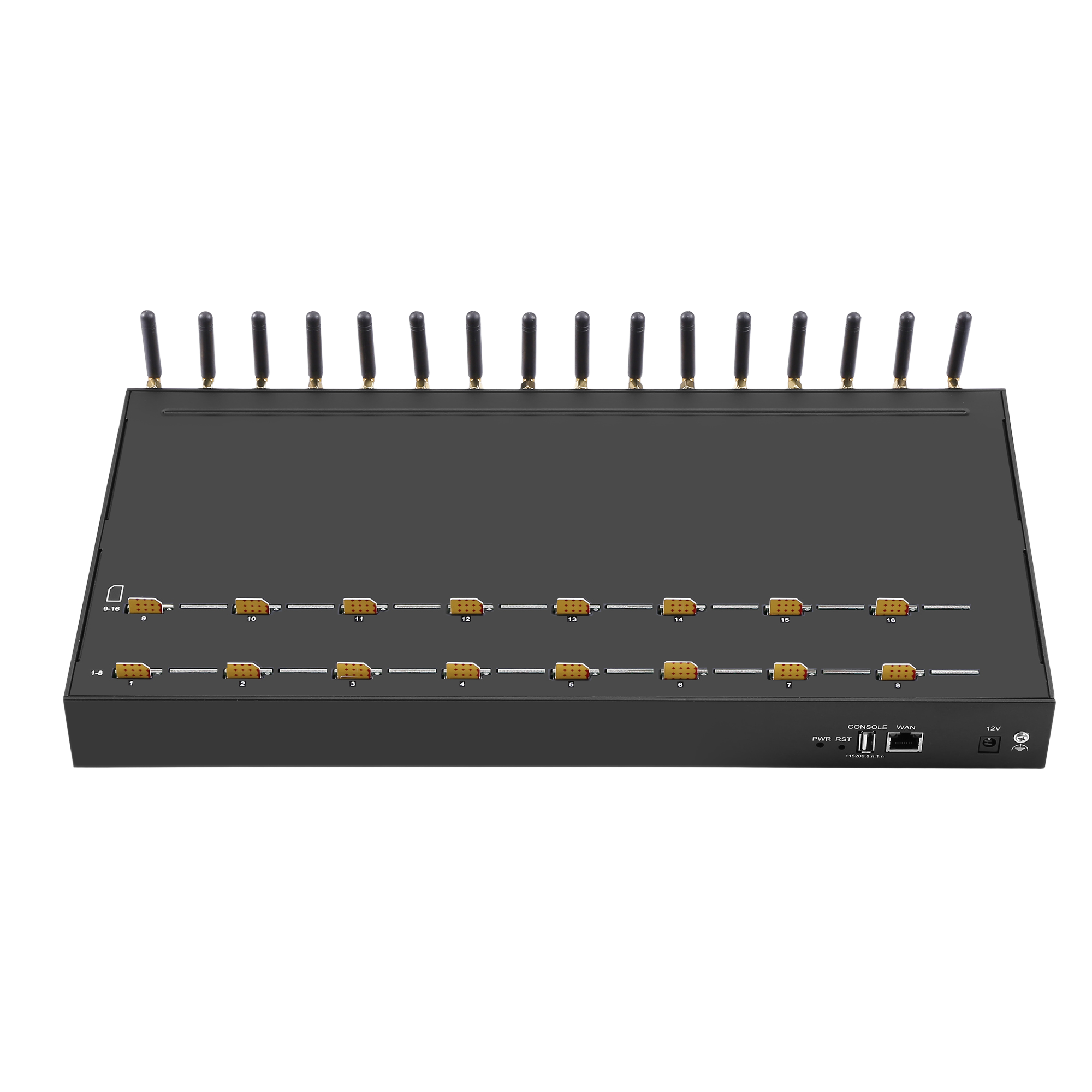
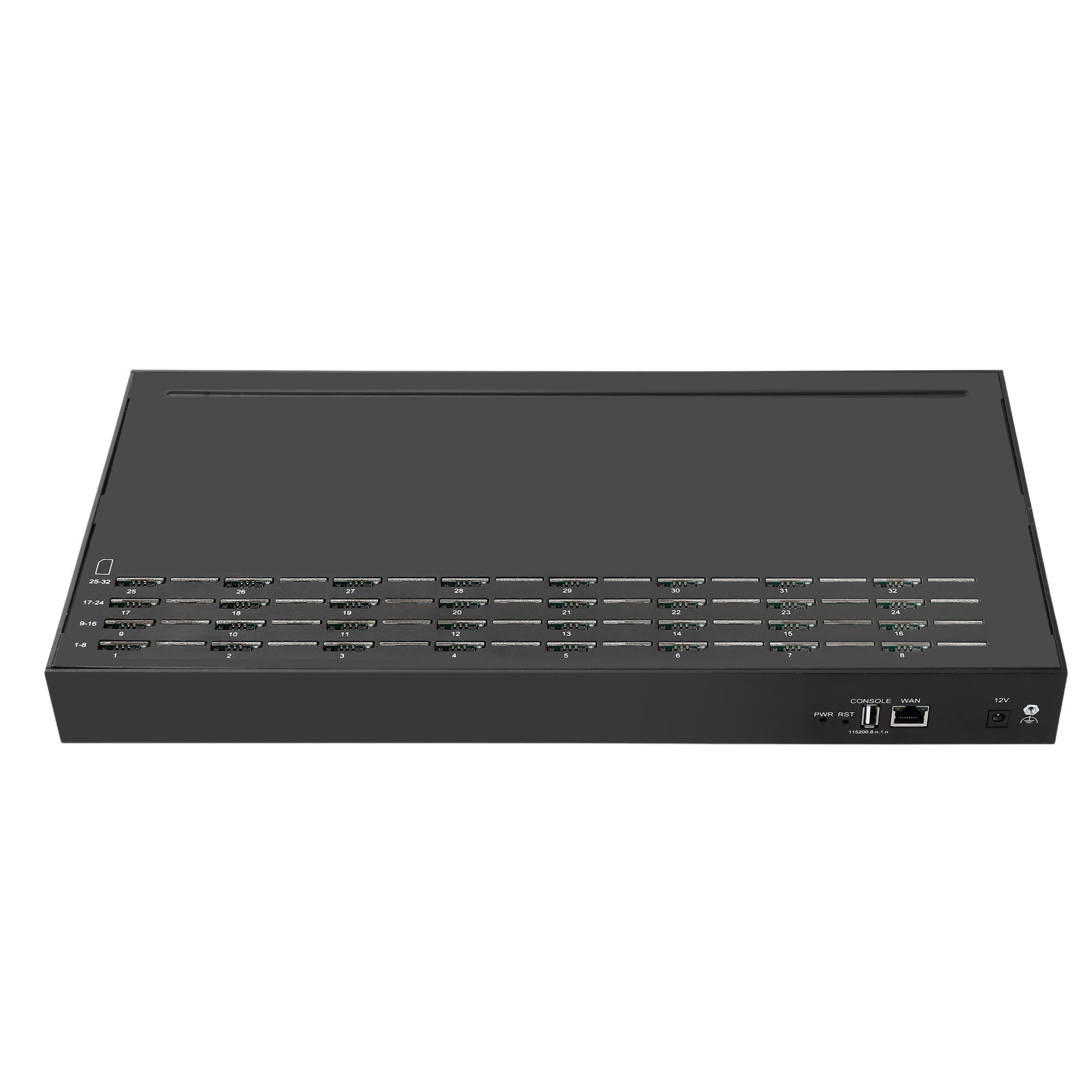
Three controls resolve it in practice. The first is physical separation: reserve a subset of SIM slots for inbound-only traffic so that outbound campaigns cannot occupy them, using a model such as the SK-SMS Gateway 32-32 where 32 ports and 32 SIM slots let you partition channels by direction. The second is queue discipline: cap outbound concurrency per SIM so a campaign drains at a rate that leaves headroom for responses. The third is port-to-SIM ratio, described in the next section.
The failure to avoid is shared-channel optimism, where one pool of SIM slots carries both directions and the outbound scheduler has no awareness of the inbound queue. That configuration works in testing, at low volume, and fails precisely when a campaign and a reply wave coincide.
How many SIM cards should each port handle?
Size the SIM ratio from inbound commitments first.
More SIM slots per port raises the throughput ceiling of a small deployment; fewer slots per port simplifies inventory. The published ladder prices that trade directly.
The ratio is a capacity decision rather than a hardware limitation, and buying it deliberately is cheaper than discovering it later. More SIM slots per port means more numbers available across a fixed number of channels. Fewer slots per port means a simpler SIM inventory. The table below states the published configurations and list prices for the SK-SMS Gateway range so you can compare ratios directly.
| Model | Ports | SIM slots | Network | List price (USD) |
|---|---|---|---|---|
| SK-SMS Gateway 4-4 | 4 | 4 | 2G/4G | $238.00 |
| SK-SMS Gateway 8-8 | 8 | 8 | 2G/4G | $355.00 |
| SK-SMS Gateway 8-32 | 8 | 32 | 2G/4G | $450.00 |
| SK-SMS Gateway 16-16 | 16 | 16 | 2G/4G | $645.00 |
| SK-SMS Gateway 16-128 | 16 | 128 | 2G/4G | $970.00 |
| SK-SMS Gateway 32-32 | 32 | 32 | 2G/4G | $1,160.00 |
| SK-SMS Gateway 32-512 | 32 | 512 | 2G/4G | $1,690.00 |
| SK-SMS Gateway 64-512 | 64 | 512 | 2G/4G | $2,480.00 |
| SK-SMS Gateway-32E-SIM | 32 | 32, eSIM | 4G | $2,550.00 |
| SK-SMS Gateway-64E-SIM | 64 | 64, eSIM | 4G | $4,080.00 |
Read the table as a set of ratios rather than a price list. The 8-32 model buys four SIM slots per port for outbound rotation; the 32-32 model buys a clean one-to-one mapping that is easier to reason about when inbound and outbound traffic must be separated. The eSIM variants remove the physical SIM inventory step entirely, which changes the operational cost of a multi-country deployment more than it changes the hardware cost.
When you size the ratio, work backwards from the inbound commitment. Decide how many simultaneous replies you must accept without queuing, reserve at least that many slots, and only then allocate the remainder to outbound rotation.
What does a failed two-way exchange actually cost?
A lost reply costs a support contact, not just a resend.
The transactional cost is easy to see: the segment is sent again, and you pay the delivery cost twice. The operational cost is the part that changes budgets. In verification and appointment flows, a missing reply converts into a support contact, a retry through another channel, or an abandoned step in a customer journey. In ticketing and access control, a missing reply means a person standing at a gate.
That asymmetry is why duplex confirmation deserves explicit design attention. A gateway that reports per-message status, including carrier latency and retry counts, gives your team the evidence to distinguish a carrier-level problem from an application-level one. Without that record, every incident becomes a debate about whose logs are correct.
The published SK-SMS Gateway line supports SMS sending and receiving over an IP network with SMPP and an HTTP API, and its management interface exposes message status and retry information. Treat that logging as the acceptance artefact for the deployment: if you cannot state, for any given reply, when it arrived, whether it was acknowledged, and how many attempts it took, the deployment is not yet observable enough to operate.
Where does the gateway stop and your CRM or platform start?
The gateway moves messages; your platform owns consent.
That boundary invites scope creep in both directions. Business logic placed inside a device outlives its usefulness, and SIM storage or retry timers placed inside your platform waste the reason you bought hardware.
A workable division runs as follows. The gateway maintains SIM state, carrier registration, message buffering, delivery status and retry policy. The platform maintains the mapping between numbers and accounts, the consent record behind each number, the conversation or case identifier, and the escalation rules. The integration point is a normalized message object carrying the originating address in E.164 form, a timestamp, the message body, and the gateway’s own message identifier.
Consent belongs firmly on the platform side. Rules for commercial messaging differ by market, and industry bodies publish guidance on consent, sender identification and opt-out handling that your compliance owner should own rather than the hardware vendor — the Messaging, Malware and Mobile Anti-Abuse Working Group and the CTIA both publish material in this area for the North American market. The gateway’s job is to carry and record; it should not be the system of record for permission.
One more interoperability note belongs here. Where your platform needs to reference a message or a handset outside the SMS submission path, the SMS URI scheme defined in RFC 5724 is the standard way to express that reference, and using it avoids inventing a private identifier format that later has to be migrated.
What should a two-way acceptance test cover?
Accept against failure paths, not a happy path.
A single successful exchange proves almost nothing about a two-way system, because every interesting behaviour happens when something is unavailable.
Run this sequence before go-live, and keep the results as the baseline for later incidents.
- Bidirectional smoke test. Send outbound, receive the reply, and confirm both appear in the gateway log with matching identifiers.
- Endpoint outage. Stop the receiving service for longer than one retry interval, restart it, and confirm every message that was sent during the outage arrives exactly once.
- Duplicate delivery. Replay a captured callback against the receiver and confirm the idempotency layer rejects the duplicate without side effects.
- Directional contention. Start an outbound burst and send replies into the same pool, then measure inbound latency against the published service target.
- SIM removal and reinsertion. Pull a SIM during operation, confirm the channel is marked unavailable rather than silently dropped, and confirm recovery on reinsertion.
- Carrier registration. Confirm each SIM registers and that the network generation in use matches what you planned for that market.
- Capacity at the port-to-SIM ratio you bought. Drive the deployment to its stated throughput and record the point at which latency rises.
- Log reconciliation. Export the message log and reconcile it against your application database; every message must appear on both sides with the same state.
Tests two and three are the ones that catch architecture mistakes rather than configuration mistakes. If duplicates appear after the outage test, the retry policy and the idempotency window are mismatched. If they do not, you have a two-way deployment you can operate with confidence.
Conclusion
Inbound and outbound SMS on the same hardware is a reliability problem disguised as a capacity problem. The design decisions that matter are the store-and-forward behaviour of the gateway, the retry window against the deduplication window of your receiver, and the physical or logical separation of the two directions. Port-to-SIM ratio follows from the inbound commitment you make, not from the outbound volume you hope to reach; the SK-SMS Gateway ladder prices that ratio directly, from the 4-port SK-SMS Gateway 4-4 at $238.00 through the 64-port SK-SMS Gateway 64-512 at $2,480.00.
Two-way messaging projects also live or die on observability. A gateway that records per-message status, carrier latency and retry counts turns a delivery dispute into a log query, and that record is the artefact you will lean on when a carrier, a customer or your own team asks what happened.
Before you specify hardware, confirm the retry window and log granularity of the model you plan to buy. Send your port count, SIM slot requirement and response-time target to service@telarvo.com, or review the published configurations on the SK-SMS Gateway range.
FAQ
Does an SMS gateway need a separate SIM for inbound traffic?
Not necessarily, but separating the directions is the most reliable way to protect response latency. Reserving a subset of SIM slots for inbound-only traffic stops an outbound burst from occupying the channel a reply needs. If your commitment to reply latency is strict, budget slots for inbound first and allocate the remainder to outbound rotation.
What replaces consumer messaging gateways such as vtext.com?
Consumer-facing email-to-SMS addresses have been progressively withdrawn by carriers, and the correct replacement depends on your use case rather than on the old address format. Business messaging normally moves to a registered sender identity with a provider or to hardware you operate yourself. Confirm current requirements with the carriers and the regulator in each market you send to.
How long should a gateway keep retrying a failed inbound callback?
The retry window should exceed the longest planned outage of your receiving service, including deployment restarts. A window of several minutes covers routine maintenance; a window measured in seconds does not. Whatever you choose, keep your deduplication key retention longer than the retry window so suppressed duplicates stay suppressed.
Can one gateway handle both SMS and voice on the same SIM pool?
Some deployments run messaging and voice on related hardware, but the two workloads compete for the same cellular channel. If you combine them, treat the SIM pool as contended capacity and test the worst case where a call and a message burst coincide. Where either service has a hard latency target, separate hardware is the simpler answer.